Dietary supplementation of Durvillaea potatorum fucoidan enhances the immune responses and improves survival of juvenile black tiger shrimp Penaeus monodon against white spot syndrome virus and acute hepatopancreatic necrosis disease
View/
Date
2026-03-09Page views
70ASFA keyword

AGROVOC keyword
Taxonomic term

Metadata
Show full item recordShare
Abstract
The use of natural immunostimulants as alternatives to antibiotics has gained attention in aquaculture to mitigate disease impacts. In this study, we evaluated fucoidan extracted from giant bull kelp (Durvillaea potatorum) as a dietary additive in black tiger shrimp (Penaeus monodon). Four experimental diets containing increasing levels of fucoidan (0, 1.0, 2.5, and 5.0 g kg−1 diet) were tested for their effects on growth, non-specific immune parameters, and survival against white spot syndrome virus (WSSV) and acute hepatopancreatic necrosis disease (AHPND)-causing Vibrio parahaemolyticus. After 30 days of feeding, fucoidan supplementation did not adversely affect shrimp growth or culture survival, even at the highest inclusion level (5 g kg−1). Non-specific immunological indices, including total hemocyte count (THC), differential hemocyte count (DHC), phenoloxidase (PO) activity, plasma total protein (PTP), and plasma agglutination titer (PAT), were enhanced by fucoidan supplementation, with improvements observed even at 1 g kg−1 relative to the control group. Activation of non-specific immunity translated into increased resistance against WSSV and AHPND, with the highest survival recorded in shrimp fed 5 g kg−1 fucoidan, followed by 2.5 g kg−1. In comparison, similar survival rates against WSSV and AHPND were observed in the unsupplemented control and 1 g kg−1 fucoidan. Overall, this study demonstrates that dietary inclusion of D. potatorum fucoidan at 5 g kg−1 effectively enhances immune responses and disease resistance in P. monodon without negatively impacting growth performance, highlighting its potential as a functional feed additive in shrimp aquaculture.
Contributes to SDGs
Keywords
Acute hepatopancreatic necrosis disease (AHPND) Early mortality syndrome (EMS) Fucoidan White spot syndrome virus (WSSV) Shrimp VibrioSubjects
Shrimps--Diseases
Suggested Citation
Faisan, J. P., Jr., Traifalgar, R. F., de la Peña, L. D., Corre, V. L., Pagapulan, M. J. B. B., & Gayosa, V. E. (2026). Dietary supplementation of Durvillaea potatorum fucoidan enhances the immune responses and improves survival of juvenile black tiger shrimp Penaeus monodon against white spot syndrome virus and acute hepatopancreatic necrosis disease. Aquaculture International , 34(3), 101. https://doi.org/10.1007/s10499-026-02507-0
Type
ArticleISSN
0967-6120; 1573-143XCollections
- Journal Articles [1267]
Related items
Showing items related by title, author, creator and subject.
-
Mortality of pond-cultured Litopenaeus vannamei associated with acute hepatopancreatic necrosis disease (AHPND) and white spot syndrome virus (WSSV) infection in the Philippines
; ; Amar, Edgar C. ; ; ; Faisan, Joseph P., Jr. ; ; ; ; ; (Japanese Society of Fish Pathology, 2017)
Mortalities of up to 60% were observed in pond-cultured Litopenaeus vannamei in Bohol, Philippines. Histopathological examination revealed typical acute hepatopancreatic necrosis disease (AHPND) pathology. PCR test generated 1,269 bp and 230 bp amplicons confirmative for the toxin-producing AHPND strain of Vibrio parahaemolyticus among shrimp sampled from eight ponds. The same samples were subjected to PCR analyses for the presence of other viruses, namely WSSV, IHHNV, IMNV, and TSV. The samples were negative for the viruses except WSSV, which was detected after one-step PCR in six out of eight ponds. These results suggested that shrimp were infected dually with AHPND V. parahaemolyticus and WSSV.
; ; ; Faisan, Joseph P., Jr. ; ; ; ; ; (Japanese Society of Fish Pathology, 2017)
Mortalities of up to 60% were observed in pond-cultured Litopenaeus vannamei in Bohol, Philippines. Histopathological examination revealed typical acute hepatopancreatic necrosis disease (AHPND) pathology. PCR test generated 1,269 bp and 230 bp amplicons confirmative for the toxin-producing AHPND strain of Vibrio parahaemolyticus among shrimp sampled from eight ponds. The same samples were subjected to PCR analyses for the presence of other viruses, namely WSSV, IHHNV, IMNV, and TSV. The samples were negative for the viruses except WSSV, which was detected after one-step PCR in six out of eight ponds. These results suggested that shrimp were infected dually with AHPND V. parahaemolyticus and WSSV. -
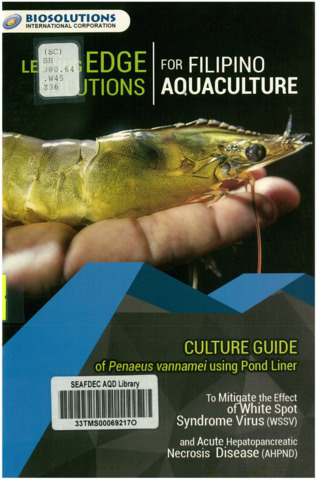
Culture guide of Penaeus vannamei using pond liner to mitigate the effects of white spot syndrome virus (WSSV) and acute hepatopancreatic necrosis disease (AHPND)
(Biosolutions International Corporation, 2016)This manual aims to share the methodologies leading to the success of shrimp farming operations. It is a work in progress to be regularly updated as new techniques are developed to deal with future challenges and diseases that will affect the shrimp industry. -
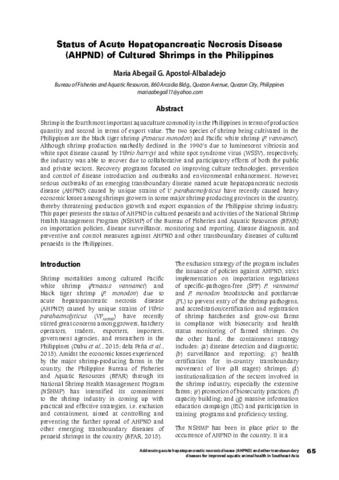
Status of acute hepatopancreatic necrosis disease (AHPND) of cultured shrimps in the Philippines
(Aquaculture Department, Southeast Asian Fisheries Development Center, 2016)Shrimp is the fourth most important aquaculture commodity in the Philippines in terms of production quantity and second in terms of export value. The two species of shrimp being cultivated in the Philippines are the black tiger shrimp (Penaeus monodon) and Pacific white shrimp (P. vannamei). Although shrimp production markedly declined in the 1990 s due to luminescent vibriosis and white spot disease caused by Vibrio harveyi and white spot syndrome virus (WSSV), respectively, the industry was able to recover due to collaborative and participatory efforts of both the public and private sectors. Recovery programs focused on improving culture technologies, prevention and control of disease introduction and outbreaks and environmental enhancement. However, serious outbreaks of an emerging transboundary disease named acute hepatopancreatic necrosis disease (AHPND) caused by unique strains of V. parahaemolyticus have recently caused heavy economic losses among shrimps growers in some major shrimp producing provinces in the country, thereby threatening production growth and export expansion of the Philippine shrimp industry. This paper presents the status of AHPND in cultured penaeids and activities of the National Shrimp Health Management Program (NSHMP) of the Bureau of Fisheries and Aquatic Resources (BFAR) on importation policies, disease surveillance, monitoring and reporting, disease diagnosis, and preventive and control measures against AHPND and other transboundary diseases of cultured penaeids in the Philippines.