Improved hatchery rearing techniques for the Asian catfish, Clarias macrocephalus (Gunther)

Share
Abstract
The Asian catfish, Clarias macrocephalus, is a popular freshwater foodfish in the Philippines. However, grow-out farming of this species is hampered by the lack of juveniles for stocking. A series of experiments on zooplankton feed density, weaning and stocking density were conducted in order to improve production of C. macrocephalus fry in the hatchery.
Suggested Citation
Fermin, A. C., Bolivar, M. E. C., Balad-on, S. B. M., & Vargas, J. B. (1995). Improved hatchery rearing techniques for the Asian catfish, Clarias macrocephalus (Gunther). In P. Lavens, E. Jaspers, & I. Roelants (Eds.), Larvi ’95 - Fish & Shellfish Larviculture Symposium, 3-7 September 1995, Gent, Belgium (pp. 394-397). Gent, Belgium: European Aquaculture Society.
Type
Conference paperISBN
9071625141Series
Special Publication; No. 24Collections
- Conference Proceedings [300]
Related items
Showing items related by title, author, creator and subject.
-
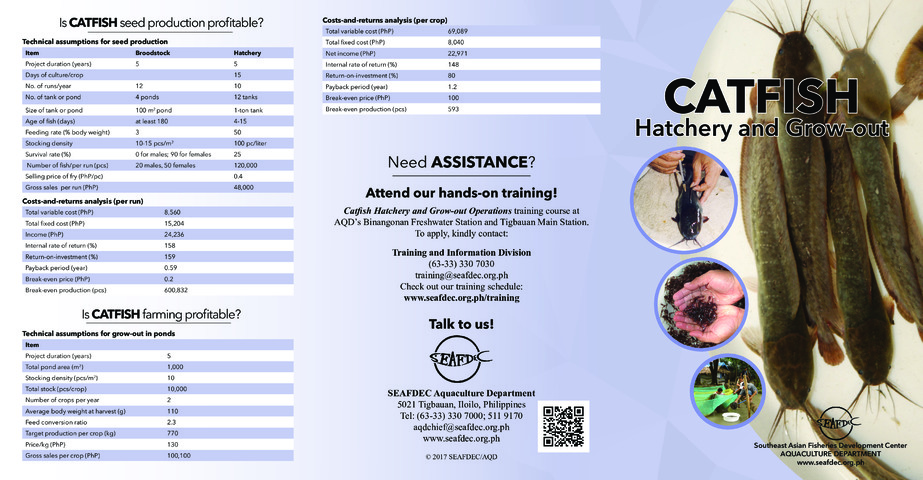
Catfish hatchery and grow-out
(Aquaculture Department, Southeast Asian Fisheries Development Center, 2017) -
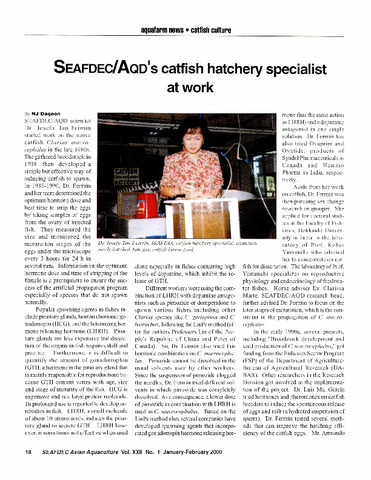
SEAFDEC/AQD's catfish hatchery specialist at work
(Aquaculture Department, Southeast Asian Fisheries Development Center, 2000) -
Aeromonas hydrophila in the epizootic ulcerative syndrome (EUS) of snakehead, Ophicephalus striatus, and catfish, Clarias batrachus: quantitative estimation in natural infection and experimental induction of dermo-muscular necrotic lesion
; ; Tendencia, Eleonor (1992)
Snakehead (Ophicephalus striatus) and catfish (Clarias batraclus) with the Epizootic Ulcerative Syndrome (EUS) were sampled for bacteria. Total bacterial counts of skin and muscle/dermal lesions revealed mean colony forming units (CFU) per gram tissue of 1.22 x 10³, 1.40 x 10⁵, 5.31 x 195 and 1.14 x 10⁷ in apparently normal, slightly lesioned, moderately lesioned and severely lesioned snakehead samples, respectively. In catfish, mean CFU per gram tissue were 4.30 x 10⁴ and 2.00 x 10⁵ in apparently normal and slightly lesioned specimens, respectively. Kidney samples likewise revealed the presence of bacteria. Bacteria isolated on trypticase soy agar and Rimler-Shotts medium were predominantly Aeromonas hydrophila occurring in 90% of snakeheads and in 33% of catfish specimens. Infection experiments of A. hydrophila injected intramuscularly into healthy snakehead and catfish induced dermo-muscular necrotic lesions. A dose of at least 106 cells of A. hydrophila was required to induce EUS-like lesions in snakehead and catfish at 21-25 degree C in 24-96 h.
(1992)
Snakehead (Ophicephalus striatus) and catfish (Clarias batraclus) with the Epizootic Ulcerative Syndrome (EUS) were sampled for bacteria. Total bacterial counts of skin and muscle/dermal lesions revealed mean colony forming units (CFU) per gram tissue of 1.22 x 10³, 1.40 x 10⁵, 5.31 x 195 and 1.14 x 10⁷ in apparently normal, slightly lesioned, moderately lesioned and severely lesioned snakehead samples, respectively. In catfish, mean CFU per gram tissue were 4.30 x 10⁴ and 2.00 x 10⁵ in apparently normal and slightly lesioned specimens, respectively. Kidney samples likewise revealed the presence of bacteria. Bacteria isolated on trypticase soy agar and Rimler-Shotts medium were predominantly Aeromonas hydrophila occurring in 90% of snakeheads and in 33% of catfish specimens. Infection experiments of A. hydrophila injected intramuscularly into healthy snakehead and catfish induced dermo-muscular necrotic lesions. A dose of at least 106 cells of A. hydrophila was required to induce EUS-like lesions in snakehead and catfish at 21-25 degree C in 24-96 h.