Culture of tilapia in saline water

Share
Suggested Citation
Yap, W. G. (2001). Culture of tilapia in saline water. In Fishlink 2001, 29-31 May 2001 (11 pp). Iloilo City, Philippines: University of the Philippines Aquaculture Society, Inc.
Type
Conference paperCollections
- Conference Proceedings [300]
Related items
Showing items related by title, author, creator and subject.
-
Growth response of Nile tilapia fry to salinity stress in the presence of an ‘internal reference’ fish
(Blackwell Publishing, 2005)Growth of three strains of Oreochromis niloticus L. fry exposed to salinity stress in the presence of an internal reference fish were compared. The Central Luzon State University (CLSU) strain was obtained from the Freshwater Aquaculture Center, CLSU, Philippines. The ISRAEL strain was acquired from the Philippine government's Bureau of Fisheries and Aquatic Resources National Freshwater Fisheries Technology Center (BFAR-NFFTC), Munoz, Nueva Ecija. The National Inland Fisheries Institute (NIFI) strain was obtained from the NIFI, Bangkok, Thailand. Eight to nine full-sib families (replicates) per strain were split into two groups. One group was grown in freshwater for 2 weeks, acclimated to 32 ppt and reared for 2 weeks and finally grown in freshwater for another 2 weeks. Another group was contemporaneously grown in freshwater polyethylene tanks for 6 weeks. Each replicate family included a size-matched internal reference population of red tilapia strain. Two-way analysis of variance (anova) revealed no significant strain differences (P=0.081; r2=0.106). However, analysis of covariance with the internal reference strain used as a covariate showed significant (P=0.049; r2=0.638) strain effects on specific growth (based on standard length measurements). The ISRAEL strain showed consistently better growth rate in both saline and freshwater environments than the NIFI and CLSU strains. We estimated the statistical power of the two-way anova (ϕ=√(k′−1)(factor MS−s2)/(k′s>2); Zar 1984) to be ∼0.30. There was a 70% probability of a Type II error and no true difference in the growth of the three strains was detected. The use of internal reference strain as a covariate improved the r2 from 0.106 to 0.638 and increased the efficiency of the test in detecting a true difference. Other strain comparison studies in our laboratory at the Southeast Asian Fisheries Development Center Aquaculture Department showed that the ISRAEL strain shows better growth than the NIFI and CLSU strains in a crowding stress tolerance experiment, when fed only with rice bran and under restrictive feeding regimes. -
Growth of five Asian red tilapia strains in saline environments
Romana-Eguia, Ma. Rowena R. ; (Elsevier, 1999)
Growth of five Asian red tilapia strains (BFS, NIFI, FAC, PF and HL) were evaluated in brackish and seawater. Eight-week-old juveniles from the five test strains were size-matched with similarly aged Oreochromis mossambicus which served as internal reference. Fish were stocked at a ratio of 15 test:15 reference in 100-l tanks supported by a recirculating system. Commercial feed was given twice daily at 10-20% of the fish biomass. Growth, measured from length and weight increment at 10 weeks, was recorded. Statistical analyses on mean specific growth rates showed significant differences among the strains reared in seawater. The Philippine strain PF grew best in seawater while the Thai strain NIFI performed well in brackishwater. In the Philippines, red tilapias are farmed in intensive freshwater culture systems by few aquaculturists. Results of this study indicate that some Asian strains can be developed for use in more sustainable brackish and seawater culture systems.
; (Elsevier, 1999)
Growth of five Asian red tilapia strains (BFS, NIFI, FAC, PF and HL) were evaluated in brackish and seawater. Eight-week-old juveniles from the five test strains were size-matched with similarly aged Oreochromis mossambicus which served as internal reference. Fish were stocked at a ratio of 15 test:15 reference in 100-l tanks supported by a recirculating system. Commercial feed was given twice daily at 10-20% of the fish biomass. Growth, measured from length and weight increment at 10 weeks, was recorded. Statistical analyses on mean specific growth rates showed significant differences among the strains reared in seawater. The Philippine strain PF grew best in seawater while the Thai strain NIFI performed well in brackishwater. In the Philippines, red tilapias are farmed in intensive freshwater culture systems by few aquaculturists. Results of this study indicate that some Asian strains can be developed for use in more sustainable brackish and seawater culture systems. -
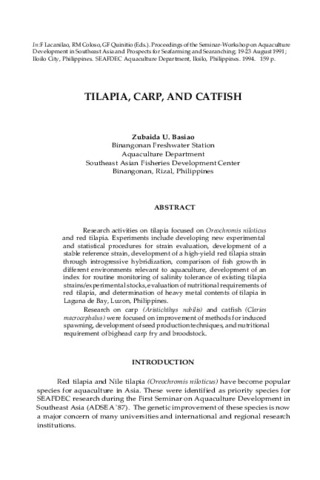
Tilapia, carp and catfish
(Aquaculture Department, Southeast Asian Fisheries Development Center, 1994)Research activities on tilapia focused on Oreochromis niloticus and red tilapia. Experiments include developing new experimental and statistical procedures for strain evaluation, development of a stable reference strain, development of a high-yield red tilapia strain through introgressive hybridization, comparison of fish growth in different environments relevant to aquaculture, development of an index for routine monitoring of salinity tolerance of existing tilapia strains/experimental stocks, evaluation of nutritional requirements of red tilapia, and determination of heavy metal contents of tilapia in Laguna de Bay, Luzon, Philippines. Research on carp (Aristichthys nobilis) and catfish (Clarias macrocephalus) were focused on improvement of methods for induced spawning, development of seed production techniques, and nutritional requirement of bighead carp fry and broodstock. Research on carp (Aristichthys nobilis) and catfish (Clarias macrocephalus) were focused on improvement of methods for induced spawning, development of seed production techniques, and nutritional requirement of bighead carp fry and broodstock.