Philippine Council for Agriculture, Aquatic and Natural Resources Research and Development (PCAARRD): Recent submissions
Now showing items 61-69 of 69
-
[The Philippines recommends for milkfish:] Pen culture
(DOST-PCAARRD, 2016) -
[The Philippines recommends for milkfish:] Cage culture
(DOST-PCAARRD, 2016) -
[The Philippines recommends for milkfish:] Pond culture
(DOST-PCAARRD, 2016) -
[The Philippines recommends for milkfish:] Fingerling production
(DOST-PCAARRD, 2016) -
[The Philippines recommends for milkfish:] Fry production
(DOST-PCAARRD, 2016) -
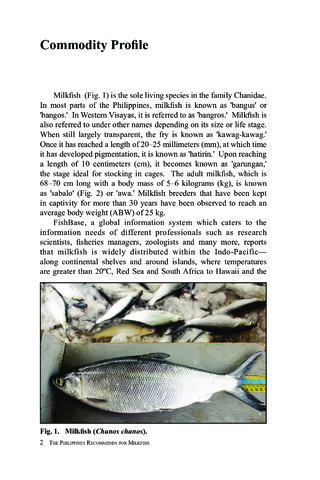
[The Philippines recommends for milkfish:] Commodity profile
(DOST-PCAARRD, 2016) -
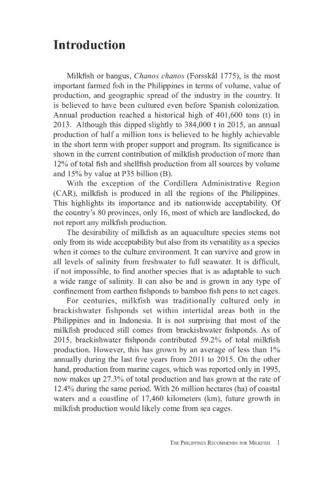
[The Philippines recommends for milkfish:] Introduction
(DOST-PCAARRD, 2016) -
Series: Summary of Proceedings No. 1/2013
The Agusan Marsh and the Agusan River Basin: The need for science-based development and management
Primavera, Jurgenne (PCAARRD-DOST, 2013)
-
Tilapia hatchery and nursery systems: Operation and management
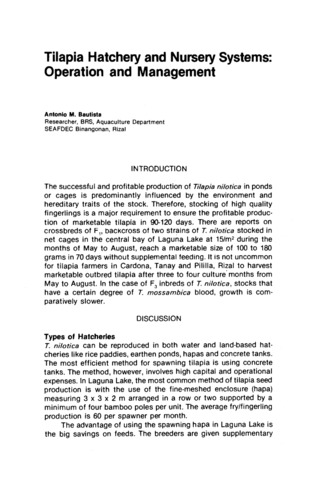
(Philippine Council for Agriculture, Forestry and Natural Resources Research and Development; Bureau of Fisheries and Aquatic Resources; Aquaculture Department, Southeast Asian Fisheries Development Center, 1987)The successful and profitable production of Tilapia nilotica in ponds or cages is predominantly influenced by the environment and hereditary traits of the stock. Therefore, stocking of high quality fingerlings is a major requirement to ensure the profitable production of marketable tilapia in 90-120 days. There are reports on crossbreds of F1 backcross of two strains of T. nilotica stocked in net cages in the central bay of Laguna Lake at 15/m2 during the months of May to August, reach a marketable size of 100 to 180 grams in 70 days without supplemental feeding. It is not uncommon for tilapia farmers in Cardona, Tanay and Pililla, Rizal to harvest marketable outbred tilapia after three to four culture months from May to August. In the case of F3 inbreds of T. nilotica, stocks that have a certain degree of T. mossambica blood, growth is comparatively slower.