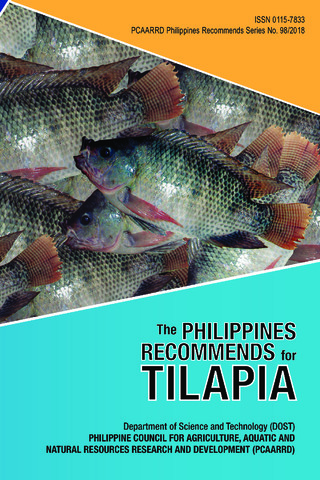
The Philippines recommends for tilapia
View/
Date
2018Page views
12,354ASFA keyword
fry 
breeding stock
hatcheries
seed collection
seed production
rearing techniques
nursery ponds
fingerlings
pond culture
site selection
pond construction
stocking density
feeding
feeds
water management
disease prophylaxis
disease control
growing ponds
polyculture (aquaculture)
harvesting
cage culture
stocking (organisms)
aquaculture techniques
fish kill
processing fishery products
packing fishery products
frozen products
refrigerated foods
hygiene
dried products
fish handling
packaging materials
product labelling
marketing
pricing
costs
returns
breeding stock
hatcheries
seed collection
seed production
rearing techniques
nursery ponds
fingerlings
pond culture
site selection
pond construction
stocking density
feeding
feeds
water management
disease prophylaxis
disease control
growing ponds
polyculture (aquaculture)
harvesting
cage culture
stocking (organisms)
aquaculture techniques
fish kill
processing fishery products
packing fishery products
frozen products
refrigerated foods
hygiene
dried products
fish handling
packaging materials
product labelling
marketing
pricing
costs
returns
AGROVOC keyword
Metadata
Show full item recordShare
Description
Tilapia is one of the most commercially important commodities in fisheries and aquaculture.
Although tilapia is relatively easy to propagate and culture, the Philippine tilapia industry needs the necessary boost in the quality and quantity of production outputs. Years of local tilapia R&D works have generated several innovative field-tested breeding and farming methods, which when adopted on-farm, may help the tilapia industry attain its goals.
PCAARRD, with the help of a technical team of experts has come up with an updated compilation of the latest working technologies in tilapia breeding and farming. It is hoped that fish farm technicians, students, fish farm managers/operators, and aquaculturists will benefit fully from this publication, apply the recommended techniques, and as such, contribute further to the success of the tilapia industry in the Philippines.
Suggested Citation
The Tilapia Technical Committee 2017. (2018). The Philippines recommends for tilapia. Los Baños, Laguna, Philippines: DOST-PCAARRD.
Type
BookISSN
0115-7833Series
Philippines Recommends Series; No. 98/2018Format
xvi, 123 pages : color illustrations.
Collections
Related items
Showing items related by title, author, creator and subject.
-
Series: Aquaculture extension manual; No. 48
Seed production of sandfish (Holothuria scabra) in Vietnam
(Aquaculture Department, Southeast Asian Fisheries Development Center, 2010)An extension manual describing broodstock management, larval rearing, and management of nursery systems. -
Development of protocol for the production of hatchery-reared mud crab Scylla serrata juveniles for soft-shell crab farming
Quinitio, Emilia T. ; ; (Aquaculture Department, Southeast Asian Fisheries Development Center, 2017)
Development of economically viable techniques for growing hatchery-reared juvenile crabs to suitable sizes will address the problem on the source of seed stocks for soft-shell crab farming. This paper reports the production of hatchery-reared mud crab Scylla serrata from juveniles in the nursery to 73-106 g body weight (BW) crabs in the grow-out pond for the individual system soft-shell crab farming. Likewise, the performance of hatchery-reared S. serrata, and wild S. tranquebarica and S. olivacea juveniles was determined in the soft-shell crab production set-up. The BW increased from 1.8-1.9 g to 78-113.7 g when stocked at 0.5 ind m-2 and from 1.6-2.3 g to 73-106.7 g at 1.0 ind m-2 after 75 days. Growth rates at both stocking densities were comparable. However, survival was significantly higher (P<0.05) in lower (63.6~c1.01%) than in higher (35.6~c3.34%) stocking density. Male S. serrata (46.0 ~c 1.75%) had significantly higher BW increase than females (39.4 ~c 2.05%). Crabs stocked at sizes of 51-60 g showed significantly greater percent increase in BW (43.26~c 0.98%) compared with those at 61-70 g (40.98~c1.33%), 71-80 g (38.55~c 1.04%), 81-90 g (36.34 ~c 1.27%) and 91-100 g (38.52 ~c 1.67%). Among the three species, hatchery-reared S. serrata (42.14 ~c 1.34%) had significantly higher mean percent BW increase compared with S. olivacea (38.23 ~c 0.49%) and S. tranquebarica (36.16 ~c 0.78%). S. serrata had significantly shorter mean culture period (24.11 ~c 0.95 days) than S. tranquebarica (28.48 ~c 0.54 days) and S. olivacea (28.75 ~c 0.34 days).
; ; (Aquaculture Department, Southeast Asian Fisheries Development Center, 2017)
Development of economically viable techniques for growing hatchery-reared juvenile crabs to suitable sizes will address the problem on the source of seed stocks for soft-shell crab farming. This paper reports the production of hatchery-reared mud crab Scylla serrata from juveniles in the nursery to 73-106 g body weight (BW) crabs in the grow-out pond for the individual system soft-shell crab farming. Likewise, the performance of hatchery-reared S. serrata, and wild S. tranquebarica and S. olivacea juveniles was determined in the soft-shell crab production set-up. The BW increased from 1.8-1.9 g to 78-113.7 g when stocked at 0.5 ind m-2 and from 1.6-2.3 g to 73-106.7 g at 1.0 ind m-2 after 75 days. Growth rates at both stocking densities were comparable. However, survival was significantly higher (P<0.05) in lower (63.6~c1.01%) than in higher (35.6~c3.34%) stocking density. Male S. serrata (46.0 ~c 1.75%) had significantly higher BW increase than females (39.4 ~c 2.05%). Crabs stocked at sizes of 51-60 g showed significantly greater percent increase in BW (43.26~c 0.98%) compared with those at 61-70 g (40.98~c1.33%), 71-80 g (38.55~c 1.04%), 81-90 g (36.34 ~c 1.27%) and 91-100 g (38.52 ~c 1.67%). Among the three species, hatchery-reared S. serrata (42.14 ~c 1.34%) had significantly higher mean percent BW increase compared with S. olivacea (38.23 ~c 0.49%) and S. tranquebarica (36.16 ~c 0.78%). S. serrata had significantly shorter mean culture period (24.11 ~c 0.95 days) than S. tranquebarica (28.48 ~c 0.54 days) and S. olivacea (28.75 ~c 0.34 days). -
Hatchery management techniques for tiger-tail seahorse (Hippocampus comes)
(Aquaculture Department, Southeast Asian Fisheries Development Center, 2015)Seahorse culture has been practiced throughout the world to meet the demand for global trade and reduce the pressure on wild stocks through overexploitation. Development of culture techniques for seed production of seahorses is one of the most effective measures to avoid such anthropological repercussions on the wild stocks, and is currently being conducted at SEAFDEC/ AQD with the aim to produce seed for stock release to protect these internationally threatened and overexploited species in Southeast Asia. This paper describes the breakthroughs in seahorse breeding and nursery rearing. So far, we have developed water and feeding management schemes that resulted in improved reproductive performance of broodstock and higher survival and growth rates in newborn and juvenile seahorses. We highlight the concern of providing desirable food organisms and maintenance of suitable water quality in order to maintain maximum efficiency in the management of the seahorse hatchery. Newborn seahorses fed with formalin-treated food organisms and reared in UV-treated seawater had significantly higher survival and daily growth rate based on stretched height and body weight than those fed with untreated food organisms and reared in both chlorinated and sand-filtered seawater. Broodstocks fed with mysid shrimps showed higher brood size and shorter parturition interval. Thus, improved reproductive performance as well as survival and growth of newborn seahorses were largely influenced by refinement of hatchery management techniques.