Hydrological features of Lakes Bito, Mahagnao, and Danao in Leyte

Share
Abstract
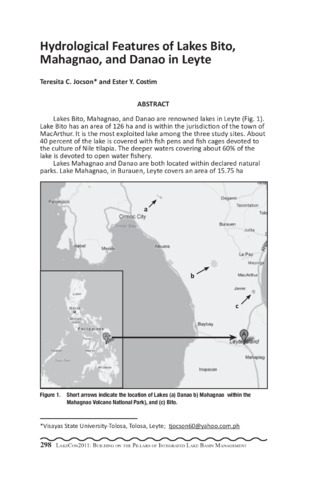
Lakes Bito, Mahagnao, and Danao are renowned lakes in Leyte (Fig. 1). Lake Bito has an area of 126 ha and is within the jurisdiction of the town of MacArthur. It is the most exploited lake among the three study sites. About 40 percent of the lake is covered with fish pens and fish cages devoted to the culture of Nile tilapia. The deeper waters covering about 60% of the lake is devoted to open water fishery.
Lakes Mahagnao and Danao are both located within declared natural parks. Lake Mahagnao, in Burauen, Leyte covers an area of 15.75 ha (Francisco, et al., 2001). The whole lake area is devoted to open water fishery, aside from being a source of the micro-hydroelectric power that provides electricity to Barangays Lugsungan, Cansiboy, and Mahagnao. Lake Danao in Ormoc City covers an area of 148 ha. The lake supplies water to the cities of Ormoc and Tacloban. The lake is also developed for tourism, with activities like boating, swimming, and hook and line fishing. There is very limited information about these lakes, with prior studies conducted by Montemayor (1985) and Francisco, et al. (2001). The data obtained was part of a preliminary study on the biodiversity of aquatic flora and fauna of these three lakes. The study was conducted in a period of one year to come up with baseline information about the three lakes. Sampling was conducted once a month in each of the three lakes. Depth, percent transparency, pH level, temperature, and dissolved oxygen (DO) were monitored through a longitudinal survey. Depth was measured using a depth gauge, transparency was monitored using a secchi disc; and pH level was determined using a pen-type pH meter (Milwaukee). Temperature and dissolved oxygen were determined using a DO meter (Cyberscan DO 110). Univariate Analysis of Variance and Tukey HSD were the statistical tools used to analyze the data obtained.
Results showed that overall mean depth of water ranged between 1.48 m and 1.90 m; 2.61 m and 4.92; and 2.84 m and 4.11 m in Lakes Bito, Mahagnao, and Danao, respectively (Table 1). Overall mean percent transparency were between 52.59% and 68.06 %; 40.35% and 92.37%; and 63.19% and 97.41 % in Lakes Bito, Mahagnao, and Danao, respectively. Overall mean temperature ranged from 24.99°C to 29.74°C; 20.74°C to 27.32°C; and 19.90°C to 25.60°C in Lakes Bito, Mahagnao, and Danao, respectively. Overall mean DO were between 4.04 mg/l and 10.77 mg/l; 5.37 mg/l and 13.28 mg/l; and 4.93 mg/l and 12.84 mg/l in Lakes Bito, Mahagnao, and Danao, respectively. Overall mean pH were between 6.3 and 8.3; 6.2 and 8.4; and 6.0 and 8.8 in Lakes Bito, Mahagnao, and Danao, respectively (Table 1).
There were significant differences (P<0.01) in depth, transparency, temperature, and DO among the three lakes during the study period. No significant differences in pH were observed among the three lakes, although monthly fluctuations within each lake was observed.
Suggested Citation
Jocson, T. C., & Costim, E. Y. (2013). Hydrological features of Lakes Bito, Mahagnao, and Danao in Leyte. In M. L. C. Aralar, A. S. Borja, A. L. Palma, M. M. Mendoza, P. C. Ocampo, E. V. Manalili, & L. C. Darvin (Eds.), LakeCon2011: Building on the pillars of Integrated Lake Basin Management (Second National Congress on Philippine Lakes) (pp. 298-300). Los Baños, Laguna, Philippines: PCAARRD-DOST.
Type
Conference paperISSN
1656-8099Series
Summary of Proceedings No. 1/2013;Collections
- LakeCon2011 [30]
Related items
Showing items related by title, author, creator and subject.
-
Series: Summary of Proceedings No. 1/2013;
Water quality trends of the Rinconada lake system and the implications in lake management
(PCAARRD-DOST, 2013)Monitoring of important water quality parameters were conducted in the Rinconada Lake System in Camarines Sur composed of Lake Bato (3,800 ha), Lake Buhi (1,800 ha), and Lake Baao-Bula (400 ha). Monthly samplings were conducted in 14 stations in Lakes Bato and Buhi and in ten stations in Lake Baao-Bula. For Lake Bato, dissolved oxygen at the surface is within the optimum range of 6.3 mg/L-10.47 mg/L for the wet seasons and 5.7 mg/L - 9 mg/L for the dry seasons but drops drastically at the bottom during the dry season. Critically low mean average of 0.71 mg/L prevailed in the diurnal oxygen trend. High levels of ammonia were recorded in particularly in Station 1 (0.81 mg/l), Station 2 (0.8125 mg/l), and Station 10 (0.8825 mg/l). The mean values of the water quality parameters of Lake Buhi from the surface to a depth of 4 m are within the optimum level. However, critically low dissolved oxygen and high levels of ammonia were recorded at the bottom, indicating the build up of anoxic layer. The Lake is stratified in most months of the year with a gradient difference of 1.74°C during the wet season and 2.15°C in the dry season. Dissolved oxygen, temperature and pH of Lake Baao-Bula is generally within the optimum levels with slight fluctuation in alkalinity. Nitrite (0.7 mg/l) and ammonia (1.5 mg/l) were critically high during the wet season. Results of the water quality monitoring provided management recommendations in establishing aquaculture zones, redesigning of cages and the use of the lakes for aquaculture and fisheries. -
Sustaining the resource use and management of Sampaloc Lake, San Pablo City, Philippines: A potable source of water
(Southeast Asian Regional Center for Graduate Study and Research in Agriculture (SEARCA), 2005)Water is the most basic and indispensable commodity. In the past, nobody realized the value of water until the wells and rivers started to dry. Of the numerous natural lakes of the Philippines (about 59), all are potential sources of surface water. The existing natural lakes are one of the best solutions to meet the water shortage of the different users and stakeholders. But human activities interfere with the natural life of these lakes, depleting its life-giving support characteristics, its productivity and usefulness. San Pablo City, situated in the apex of the heart-shaped Province of Laguna, is known as the City of Seven Lakes . Sampaloc Lake is the biggest, having a surface area of 104 ha. It is one of the ecotourism spots of the city and used to have an abundant supply of clear springs in the lakeshore area. This policy research study sought to address the question: What policies should be pursued to sustain the natural resources of Sampaloc Lake? There were several policy issues identified related to the sustainability, conservation and protection of the lake and its natural resources: (1) the capacity of the people in the lakeshore area to sustain the benefits and ecological balance; (2) enforcement of the regulations and laws to sustain the initiatives of the city government to rehabilitate, protect and conserve the natural resources of the lake; and (3) policy support for a relocation plan of the settlers within the lakeshore area. Major issues and concerns related to the lake were evaluated. First was the community-based approach in resource management and development. Second was the efficient delivery of services by the government, non-government organizations (NGOs), and other entities. Third was the synergy and complementation in the integration of policy interventions and initiatives of the city government and private sectors. Effectiveness, equity and distribution, and financial and institutional sustainability were the criteria used for the analysis in the policy research. Effectiveness was evaluated in terms of impact to poverty alleviation and lakeshore rehabilitation and protection, while equity and distribution were evaluated in terms of the quality of life of lakeshore-beneficiaries and settlers. Financial sustainability was measured in terms of the adequacy of funds to meet the financing obligations while institutional sustainability was evaluated in terms of whether the existing policy environment is favorable to supporting the proposed alternatives in response to Republic Act 7160, Local Government Code, Republic Act (RA) 8041, National Water Crisis Act of 1995, and RA 8550 and Fishery Code of 1998. -
Series: Summary of Proceedings No. 1/2013;
Treating Laguna de Bay water to Philippine National Standards for drinking water with high-performance membranes
(PCAARRD-DOST, 2013)The demand for reliable water supplies has been growing for years and is increasingly urgent in the Philippines. Using membrane technology, difficult-to-treat water sources are now viable water supply options. Hollow-fiber microfiltration (MF) membrane systems are especially effective in treating surface water supplies such as lakes, rivers, and reservoirs and are now used to supplement or to replace conventional water treatment technologies, e.g., rapid-mix, coagulation, sedimentation, and multimedia filtration. These low-pressure polymeric hollow-fiber membrane systems are used globally to treat surface and groundwaters for drinking water. High-quality drinking water (turbidity<0.1 NTU) can be assured by MF membranes, which effectively remove Cryptosporidium and Giardia and exceed United States EPA Surface Water Treatment Rule (SWTR) logremoval requirements. Hollow-fiber MF membrane systems made of the fluorocarbon polyvinylidenefluoride (PVDF) provide comprehensive oxidant compatibility that allows the oxidation and subsequent removal of iron and manganese. Taste and odor compounds are oxidized or removed by coagulants or powdered activated carbon. Automated integrity test procedures assure long-term membrane reliability. Low-pressure microfiltration technology is combined with reverse osmosis that removes dissolved solids caused by saltwater intrusion into the lake. This combined membrane system provides drinking water that surpasses the stringent water purity specifications of the Philippine National Standards for Drinking Water. Membrane systems can consistently produce drinking water with turbidity below 0.1 NTU, independent of feed water quality. This paper discusses design considerations for a custom-designed integrated membrane system combining hollow-fiber membrane technology with reverse osmosis to produce 100 million liters per day of potable and palatable drinking water (Fig.1).