
Conference Proceedings
Browse by
Collections in this community
-
LakeCon2011 [30]
2nd National Congress on Philippine Lakes -
Tilapia Farming [9]
Proceedings of the First National Symposium and Workshop on Tilapia Farming, PCARRD, Los Baños, Laguna, November 24-26, 1986
Recent Submissions
-
Extension and training programs in support of tilapia farming in the Philippines
(Philippine Council for Agriculture, Forestry and Natural Resources Research and Development, 1987)The Bureau of Fisheries and Aquatic Resources (BFAR), now a staff bureau of the Department of Agriculture (DA), is an agency mandated to look after the national development and management of the fishing industry. It constantly demonstrated its sensitivity towards the attainment of improving the lot of poor fish farmers and fishermen in the countryside. Fisheries, as a major sector of agriculture is expected to push the country s Economic Recovery Program and must be developed to realize its potential contribution. This sector contributed 4.7% at current prices to the Gross National Product (GNP) and 5.0% on constant prices in 1985. The fishing industry directly employs an estimated one million fishfarmers and fishermen. Indirectly, the industry provides employment to household members who are engaged in allied fisheries industries like fish processing, net making, boat building, ice plant and cold storage operation, fish handling, marketing and fish distribution. -
Handling and processing of tilapia
(Philippine Council for Agriculture, Forestry and Natural Resources Research and Development, 1987)Tilapia is a very promising aquaculture species with the development of the aquaculture industry. The commercial value of tilapia varies greatly with size in certain countries like Israel and Africa. In Southeast Asia, size is not an important factor; the market price varies regionally. Although tilapia could compare favorably with other aquaculture products, its flesh being very high in quality, some consumers have a strong objection to its dark skin. Nonetheless, tilapia is currently one of the most important fish crops in most countries of the world. With the improvement of aquaculture technology, tilapia is now grown in fish cages, fishponds and other inland waters. There is no doubt that this has helped increase the production of the aquaculture sector to the total fish production by over 20% in 1983. The 1984 production of tilapia in fish cages was 7,070 kg; for inland fisheries, the production was 22,295 kg; and in fishponds, 10,508 kg. This gave a total value of P485,653 (BFAR Statistics 1981). With appropriate processing technology, tilapia can be manufactured into various products both for human consumption and as feed ingredients which will help increase its commercial value. Tilapia which are too small for human consumption should not be wasted. These can be converted into feed ingredients for livestock feeds or used as baits in commercial fishing. In developing countries like the Philippines where there is an immediate need for protein source, tilapia could be readily available due to subsistence and commercial-scale culture of this fish. -
Marketability of tilapia in Metro Manila
(Philippine Council for Agriculture, Forestry and Natural Resources Research and Development, 1987)The Nile tilapia (Tilapia nilotica) is now accepted in Metro Manila market. The past ten years have shown an increasing trend in the marketability of tilapia. From a price of P5.00 per kilo in 1976, tilapia is now selling at P15.00 per kilo, more or less. The volume of production of this particular fish has increased during the last ten years. The increase in price and volume is very indicative of the acceptability of tilapia in the market. There is no doubt that this fish, when properly cultured, is now considered a quality fish, like milkfish. -
Tilapia marketing in Metro Manila
(Philippine Council for Agriculture, Forestry and Natural Resources Research and Development, 1987)The culture of tilapia in the Philippines has spread across the country. Tilapia production is increasing as reflected in the volume of tilapia unloaded in major fish landings in the country. In Metro Manila, where a large percentage of the country s population is concentrated, tilapia consumption has gained wide acceptance among consumers. The introduction of a new and better tilapia species which is meaty and bigger in size than the first species introduced in the country has ushered in the acceptance of tilapia even among sophisticated consumers in urban areas. While literature on the culture of tilapia abounds, only a few papers on the marketing of this fish have been written, thus leaving much questions on this matter still unanswered. This paper hopes to add to whatever information is available on the marketing of tilapia. Primary focus is given on the marketing of tilapia in Metro Manila. Special emphasis of this paper will be on the distribution, production, price trends and problems in marketing of tilapia in Metro Manila. The data are based on a study conducted among fish traders, wholesalers and retailers and other available information related to the subject. Experiences and observations of the author in marketing tilapia in Metro Manila for the past five years have also been included to add practical relevance to this paper. -
Culture studies on Tilapia sp. under saline conditions at the Brackishwater Aquaculture Center
(Philippine Council for Agriculture, Forestry and Natural Resources Research and Development, 1987)This paper reviews the various researches on tilapia at the BAC with the purpose of disseminating the information so far generated and identifying the gaps in tilapia research under saline conditions. Primary studies on tilapia at BAC were concentrated on increasing production of tilapia in brackishwater ponds and how this targetted production could be obtained more effectively and efficiently. Monoculture and polyculture procedures for tilapias including fertilization and feeding were studied. Forage fish: carnivore fish ratios were established for certain species which could be effective in thinning down the population of young tilapia while allowing the original stocks to grow bigger and at the same time producing fingerlings for restocking. This paper presents the results of various studies on tilapia. -
Commercial production of tilapia in freshwater ponds and cages in the Philippines
(Philippine Council for Agriculture, Forestry and Natural Resources Research and Development, 1987)This paper reviews the state-of-the-art of Nile tilapia production on a commercial scale in Philippine freshwater ponds and cages. Culture practices and problems are also discussed. Commercial production of tilapia as applied here refers to growing of table fish to generate income. -
Improved tilapia strains through broodstock development in the Philippines
(Philippine Council for Agriculture, Forestry and Natural Resources Research and Development, 1987)Increased tilapia production can be attained in several ways. It can be achieved through development of better diets, proper stocking densities, increasing cultural inputs, efficient management practices, etc. but yields cannot be optimized if genetically inferior species are used. The continued use of deteriorated stocks of tilapia (i.e. Tilapia nilotica) is a deterring factor in the expansion of the tilapia industry (PCARRD, 1985). -
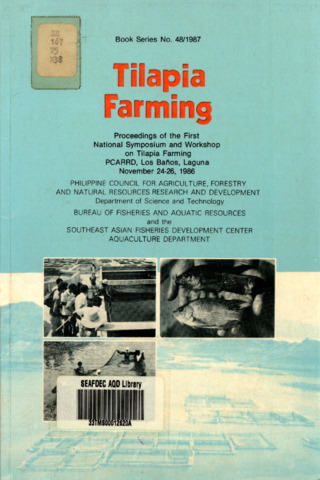
Tilapia Farming: Proceedings of the First National Symposium and Workshop on Tilapia Farming, PCARRD, Los Baños, Laguna, November 24-26, 1986
(Philippine Council for Agriculture, Forestry and Natural Resources Research and Development, 1987) -
Series: Summary of Proceedings No. 1/2013;
Save Lake Buhi now
(PCAARRD-DOST, 2013)Lake Buhi (Fig. 1) is found in Buhi, Camarines Sur. It is situated at the north-eastern part of Iriga City. The lake has an area of 18 km2 and has an average depth of 8 m. The lake lies in the valley formed by two ancient volcanoes, Mt. Asog and Mt. Malinao. It was formed in 1641 when an earthquake caused a side of Mt. Asog to collapse. The resulting landslide created a natural dam that blocked the flow of nearby streams. Another theory suggests that it was formed by the eruption of Mt. Asog, which is now dormant. The lake is the home of the world s smallest fish, sinarapan (Mistichthys luzonensis). Aside from sinarapan, it also home for other native freshwater fishes such as 'irin-irin' (Redigobius dispar), 'dalag' (Channa striata), 'puyo' (Anabas studines), 'kotnag' (Hemiramphus sp.), 'burirawan' (Strophidon sathete), and native catfish (Clarias sp.). Today, the lake is one of the major aquaculture areas in the Bicol Region where commercial production of Nile tilapia (Oreochromis niloticus) and Mozambique tilapia (Oreochromis mossambicus) is done. The lake supplies the fish demand in the province. But the cyclical occurrence of fish kills threaten the aquaculture industry in the lake. On October 31, 2010, a massive fish kill was again experienced that resulted to almost 75% loss of the lake s fish stocks. The incident calls for inter-agency planning and consultations to address the cause of fish kill and save Lake Buhi from further deterioration. One of the major solutions that arised was the implementation of the ten percent area utilization for aquaculture activity as prescribed in R.A 8550, also known as the Philippine Fisheries Code of 1998. Thus, on March 24, 2011, navigational lanes, buffer zones, fish sanctuaries and reserves, and fishcage belts in Buhi Lake were delineatedupon the request of Mayor Rey P. Lacoste of Buhi. -
Series: Summary of Proceedings No. 1/2013;
Epipelic diatoms of Lake Caliraya, Laguna, Philippines
(PCAARRD-DOST, 2013)A taxonomic survey of diatom flora was conducted through sediments (from 25 cm to 200 cm depth) along the shoreline of Lake Caliraya, a man-made lake in Laguna Province, Philippines. There were a total of 63 diatom taxa belonging to three classes and 28 genera. About 93% were pennate diatoms and the other 7% are centric diatoms. Cocconeis placentula, Sellphora pupula, and Gomphonema accuminatum var. turris were the more abundant and frequently occurring pennate diatom species in the study. More frequently occurring centric diatoms include Aulacoseira granulata and Cyclotella menehegniana. Rarely occurring diatoms in this lake were also noted, including Synedra incisa, Fragilaria crotonensis, Bacillaria paxillifer, Craticula perotettii, and Amphora ovalis. -
Series: Summary of Proceedings No. 1/2013;
Carbon credits for lake basin management
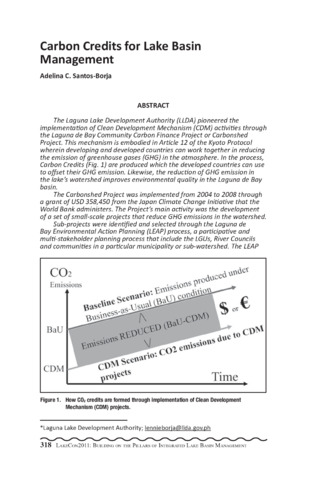
(PCAARRD-DOST, 2013)The Laguna Lake Development Authority (LLDA) pioneered the implementation of Clean Development Mechanism (CDM) activities through the Laguna de Bay Community Carbon Finance Project or Carbonshed Project. This mechanism is embodied in Article 12 of the Kyoto Protocol wherein developing and developed countries can work together in reducing the emission of greenhouse gases (GHG) in the atmosphere. In the process, Carbon Credits (Fig. 1) are produced which the developed countries can use to offset their GHG emission. Likewise, the reduction of GHG emission in the lake s watershed improves environmental quality in the Laguna de Bay basin. The Carbonshed Project was implemented from 2004 to 2008 through a grant of USD 358,450 from the Japan Climate Change Initiative that the World Bank administers. The Project s main activity was the development of a set of small-scale projects that reduce GHG emissions in the watershed. Sub-projects were identified and selected through the Laguna de Bay Environmental Action Planning (LEAP) process, a participative and multi-stakeholder planning process that include the LGUs, River Councils and communities in a particular municipality or sub-watershed. The LEAP process was developed under another World Bank and Dutch Governmentfunded project, the Laguna de Bay Institutional Strengthening and Community Participation Project or LISCOP that was implemented almost as the same time as the Carbonshed Project. The small-scale CDM sub-projects (Fig. 2) are being implemented by local government units (LGUs) with technical support from the LLDA and funding support under the LISCOP project. The first bundle under the Methane Avoidance Category consists of seven LGU sub-projects on Materials Recovery Facility with Composting. A significant milestone, both for the LLDA and for the participating LGUs was reached on March 16, 2008 with the registration of the Laguna de Bay Community Waste Management Project: Avoidance of Methane Production from Biomass Decay through Composting-1 to the United Nations Framework Convention on Climate Change- Clean Development Mechanism Executive Board (UNFCCC-CDMEB). The estimated Carbon Emission Reduction was 6,058 tons CO2-e. The buyers of Carbon Emission Reduction (CER), which translates into Carbon Credits is the Community Development Carbon Fund (CDCF). An Emission Reduction Purchase Agreement (ERPA) was signed on June 30, 2006 between the LLDA, representing the CDM-project participants and the World Bank, representing the CDCF. A sub-ERPA was then signed between the LLDA and the project participants as a commitment to meet the obligations under the ERPA. The Carbonshed Project has also established a mechanism to ensure that the money from the carbon credits will be used for operational costs of the existing composting facilities or for new environmental and social investments in the localities implementing these projects. -
Series: Summary of Proceedings No. 1/2013;
Treating Laguna de Bay water to Philippine National Standards for drinking water with high-performance membranes
(PCAARRD-DOST, 2013)The demand for reliable water supplies has been growing for years and is increasingly urgent in the Philippines. Using membrane technology, difficult-to-treat water sources are now viable water supply options. Hollow-fiber microfiltration (MF) membrane systems are especially effective in treating surface water supplies such as lakes, rivers, and reservoirs and are now used to supplement or to replace conventional water treatment technologies, e.g., rapid-mix, coagulation, sedimentation, and multimedia filtration. These low-pressure polymeric hollow-fiber membrane systems are used globally to treat surface and groundwaters for drinking water. High-quality drinking water (turbidity<0.1 NTU) can be assured by MF membranes, which effectively remove Cryptosporidium and Giardia and exceed United States EPA Surface Water Treatment Rule (SWTR) logremoval requirements. Hollow-fiber MF membrane systems made of the fluorocarbon polyvinylidenefluoride (PVDF) provide comprehensive oxidant compatibility that allows the oxidation and subsequent removal of iron and manganese. Taste and odor compounds are oxidized or removed by coagulants or powdered activated carbon. Automated integrity test procedures assure long-term membrane reliability. Low-pressure microfiltration technology is combined with reverse osmosis that removes dissolved solids caused by saltwater intrusion into the lake. This combined membrane system provides drinking water that surpasses the stringent water purity specifications of the Philippine National Standards for Drinking Water. Membrane systems can consistently produce drinking water with turbidity below 0.1 NTU, independent of feed water quality. This paper discusses design considerations for a custom-designed integrated membrane system combining hollow-fiber membrane technology with reverse osmosis to produce 100 million liters per day of potable and palatable drinking water (Fig.1). -
Series: Summary of Proceedings No. 1/2013;
A fisheries in crisis: Threatened biodiversity and fish production of Lake Mainit, northeastern Mindanao
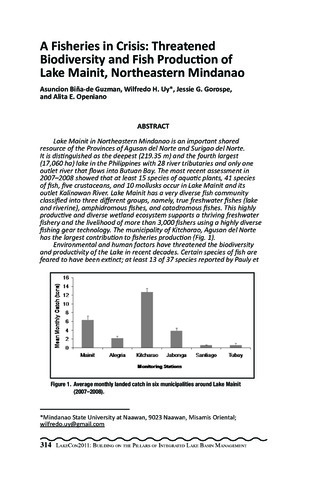
(PCAARRD-DOST, 2013)Lake Mainit in Northeastern Mindanao is an important shared resource of the Provinces of Agusan del Norte and Surigao del Norte. It is distinguished as the deepest (219.35 m) and the fourth largest (17,060 ha) lake in the Philippines with 28 river tributaries and only one outlet river that flows into Butuan Bay. The most recent assessment in 2007-2008 showed that at least 15 species of aquatic plants, 41 species of fish, five crustaceans, and 10 mollusks occur in Lake Mainit and its outlet Kalinawan River. Lake Mainit has a very diverse fish community classified into three different groups, namely, true freshwater fishes (lake and riverine), amphidromous fishes, and catadromous fishes. This highly productive and diverse wetland ecosystem supports a thriving freshwater fishery and the livelihood of more than 3,000 fishers using a highly diverse fishing gear technology. The municipality of Kitcharao, Agusan del Norte has the largest contribution to fisheries production (Fig. 1). Environmental and human factors have threatened the biodiversity and productivity of the Lake in recent decades. Certain species of fish are feared to have been extinct; at least 13 of 37 species reported by Pauly et al. (1990) were no longer encountered in the present study. More than 65% of the fish are migratory between the lake and Butuan Bay through the Kalinawan River. The population of the once abundant giant mottled eel (Anguilla marmorata) has drastically declined, resulting from massive fishing on adult eels during their seasonal spawning along Kalinawan River. The native white goby (Glossogobius giuris), locally known as pijanga, remains the most important fishery resource in Lake Mainit (Fig. 2), but the current fish catch is about 63% of the 1997-98 production as reported by Galicia and Lopez (2000). Many species are caught in progressively smaller sizes, resulting in lower economic value and hence, marginal fisher incomes. Pollution, unsustainable fishing practices, high fishing pressure, and lack of enforcement of fisheries policies have drastically reduced the annual fish catch from 15,108 t in 1980-81 to only about 831.50 t in 2007-08, which is only about 5.5% of the production level 26 years ago. Lake Mainit experiences the typical syndrome of a threatened fisheries resources: biodiversity loss, high fishing pressure, use of unsustainable fishing gears and methods, declining fish catch and catch-per-unit-effort, decreasing size of fish caught, and marginal or meager fisher incomes barely enough to provide for the basic daily needs like food, health, and children s education. The Lake Mainit Development Alliance (LMDA), an inter-LGU alliance among the eight municipalities around the lake, provides a ray of hope for this threatened resource. A fisheries management program is being integrated into the Lake Mainit Development Agenda to help restore Lake Mainit fisheries resources to sustainable levels. -
Series: Summary of Proceedings No. 1/2013;
Dead zones in Philippine protected areas law: Institutional tolerance of lawbreaking and the complicity of the stakeholders
(PCAARRD-DOST, 2013)As many problems associated with the conservation and protection of lakes are perceived to be caused by the simple failure to enforce laws, this paper is an analysis of the myriad reasons behind the lack of law enforcement. These include high enforcement and transaction costs, overly broad scope of policies, conflicting laws or varying interpretations of laws, and lack of information or understanding of existing laws, among other reasons. It suggests that at least for some laws, these are not the main reasons for lack of implementation. Instead, both political leaders and stakeholders are complicit in such failure to enforce and therefore make what Tim Wu of the University of Columbia calls dead zones. The complicity can be due to economic and social benefits that lack of enforcement allows, the sources of which are perceived not to be morally reprehensible. Furthermore, using the policy-making and decision-making experience in the Taal Volcano Protected Landscape (Fig. 1), such complicity has boundaries and enforcement is agreed upon and even pushed when the economic benefits arising from the political failure are threatened. In the space where there is complicity in the failure to enforce, or where the resulting policy is overly broad and allows for selective enforcement, such complicity also leads to politicized decision-making, itself variably tolerated by stakeholders or opposed based on the risk versus economic benefits balance. Finally, the study suggests that despite the dead zones, there is an inherent aversion to withdrawing these unenforced laws from the books. Utpal Bhattacharya and Hazem Daouk of Cornell University, in their study of insider trading, suggests that unenforced law may be more harmful than no law at all. As such, the study was in the context of law-breaking for economic benefit, it is contrasted with law-breaking in a protected area for economic gain. Bhattacharya and Daouk suggests that a less transparent, unequal marketplace tends to disadvantage outsiders, and disadvantaged outsiders demand a higher return on their investments. The paper explores whether those disadvantaged by politicized decision-making on the issuance of licenses for fishcages in Taal Lake will tend to circumvent other protected area policies in order to get a higher return on investment, thereby creating a larger dead zone in a different area of regulation. Hence, the enforcement cost would be higher in terms of monitoring compliance with aquaculture regulations that are harder to monitor such as stocking density standards and feeding regulations. -
Series: Summary of Proceedings No. 1/2013;
Time- and space-related water quality fluctuations and phytoplankton community dynamics in Lake Sampaloc of San Pablo City and Lake Crocodile of Los Baños, Laguna, Philippines
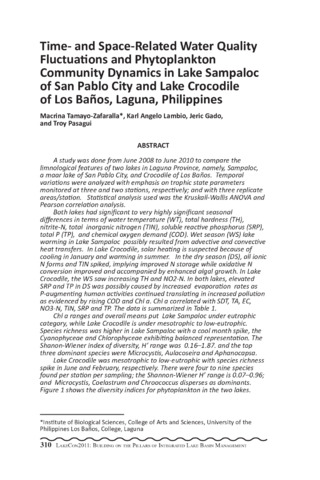
(PCAARRD-DOST, 2013)A study was done from June 2008 to June 2010 to compare the limnological features of two lakes in Laguna Province, namely, Sampaloc, a maar lake of San Pablo City, and Crocodile of Los Baños. Temporal variations were analyzed with emphasis on trophic state parameters monitored at three and two stations, respectively; and with three replicate areas/station. Statistical analysis used was the Kruskall-Wallis ANOVA and Pearson correlation analysis. Both lakes had significant to very highly significant seasonal differences in terms of water temperature (WT), total hardness (TH), nitrite-N, total inorganic nitrogen (TIN), soluble reactive phosphorus (SRP), total P (TP), and chemical oxygen demand (COD). Wet season (WS) lake warming in Lake Sampaloc possibly resulted from advective and convective heat transfers. In Lake Crocodile, solar heating is suspected because of cooling in January and warming in summer. In the dry season (DS), all ionic N forms and TIN spiked, implying improved N storage while oxidative N conversion improved and accompanied by enhanced algal growth. In Lake Crocodile, the WS saw increasing TH and NO2-N. In both lakes, elevated SRP and TP in DS was possibly caused by increased evaporation rates as P-augmenting human activities continued translating in increased pollution as evidenced by rising COD and Chl a. Chl a correlated with SDT, TA, EC, NO3-N, TIN, SRP and TP. The data is summarized in Table 1. Chl a ranges and overall means put Lake Sampaloc under eutrophic category, while Lake Crocodile is under mesotrophic to low-eutrophic. Species richness was higher in Lake Sampaloc with a cool month spike, the Cyanophyceae and Chlorophyceae exhibiting balanced representation. The Shanon-Wiener index of diversity, H range was 0.16-1.87. and the top three dominant species were Microcystis, Aulacoseira and Aphanocapsa. Lake Crocodile was mesotrophic to low-eutrophic with species richness spike in June and February, respectively. There were four to nine species found per station per sampling; the Shannon-Wiener H range is 0.07-0.96; and Microcystis, Coelastrum and Chroococcus disperses as dominants. Figure 1 shows the diversity indices for phytoplankton in the two lakes. -
Series: Summary of Proceedings No. 1/2013;
Land use and water quality assessment of some lakes in San Pablo City, Laguna, Philippines
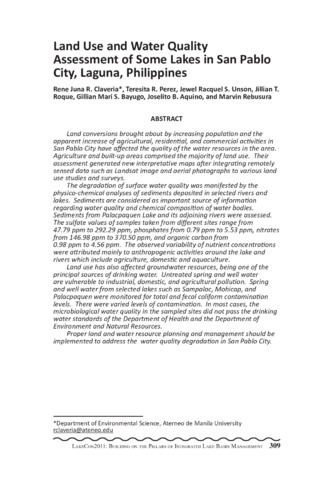
(PCAARRD-DOST, 2013)Land conversions brought about by increasing population and the apparent increase of agricultural, residential, and commercial activities in San Pablo City have affected the quality of the water resources in the area. Agriculture and built-up areas comprised the majority of land use. Their assessment generated new interpretative maps after integrating remotely sensed data such as Landsat image and aerial photographs to various land use studies and surveys. The degradation of surface water quality was manifested by the physico-chemical analyses of sediments deposited in selected rivers and lakes. Sediments are considered as important source of information regarding water quality and chemical composition of water bodies. Sediments from Palacpaquen Lake and its adjoining rivers were assessed. The sulfate values of samples taken from different sites range from 47.79 ppm to 292.29 ppm, phosphates from 0.79 ppm to 5.53 ppm, nitrates from 146.98 ppm to 370.50 ppm, and organic carbon from 0.98 ppm to 4.56 ppm. The observed variability of nutrient concentrations were attributed mainly to anthropogenic activities around the lake and rivers which include agriculture, domestic and aquaculture. Land use has also affected groundwater resources, being one of the principal sources of drinking water. Untreated spring and well water are vulnerable to industrial, domestic, and agricultural pollution. Spring and well water from selected lakes such as Sampaloc, Mohicap, and Palacpaquen were monitored for total and fecal coliform contamination levels. There were varied levels of contamination. In most cases, the microbiological water quality in the sampled sites did not pass the drinking water standards of the Department of Health and the Department of Environment and Natural Resources. Proper land and water resource planning and management should be implemented to address the water quality degradation in San Pablo City. -
Series: Summary of Proceedings No. 1/2013;
Petrographic analysis of rocks and sediments around the seven lakes of San Pablo City, Laguna: Implications to sulfate distribution and provenance
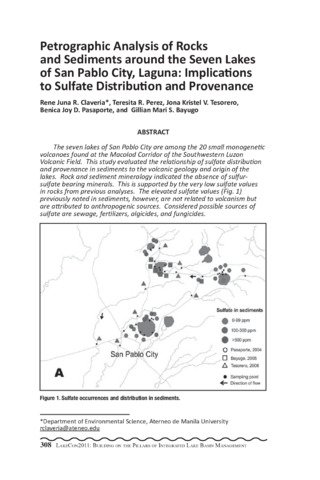
(PCAARRD-DOST, 2013)The seven lakes of San Pablo City are among the 20 small monogenetic volcanoes found at the Macolod Corridor of the Southwestern Luzon Volcanic Field. This study evaluated the relationship of sulfate distribution and provenance in sediments to the volcanic geology and origin of the lakes. Rock and sediment mineralogy indicated the absence of sulfursulfate bearing minerals. This is supported by the very low sulfate values in rocks from previous analyses. The elevated sulfate values (Fig. 1) previously noted in sediments, however, are not related to volcanism but are attributed to anthropogenic sources. Considered possible sources of sulfate are sewage, fertilizers, algicides, and fungicides. -
Series: Summary of Proceedings No. 1/2013;
Seven lakes research program updates
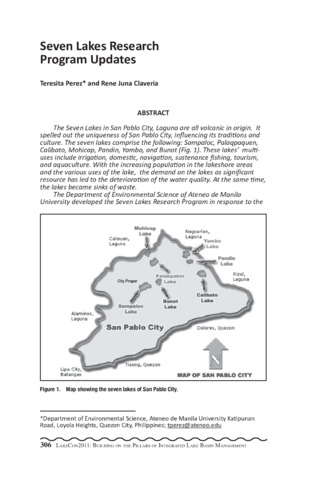
(PCAARRD-DOST, 2013)The Seven Lakes in San Pablo City, Laguna are all volcanic in origin. It spelled out the uniqueness of San Pablo City, influencing its traditions and culture. The seven lakes comprise the following: Sampaloc, Palaqpaquen, Calibato, Mohicap, Pandin, Yambo, and Bunot (Fig. 1). These lakes multiuses include irrigation, domestic, navigation, sustenance fishing, tourism, and aquaculture. With the increasing population in the lakeshore areas and the various uses of the lake, the demand on the lakes as significant resource has led to the deterioration of the water quality. At the same time, the lakes became sinks of waste. The Department of Environmental Science of Ateneo de Manila University developed the Seven Lakes Research Program in response to the urgent need to maintain the sustainability of the lakes uses. It has been coordinating with the local government units and the fisherfolk community and the FARMC for the past five years. The following are the expected outputs of the Department of Environmental Science for the Seven Lakes: 1. Determining Macrophyte Primary Production and Nutrient Availability in Lake Palacpaquen, San Pablo City, Laguna 2. An assessment of the Coliform Contamination in Sampaloc, Calibato and Mohicap Lake Waters and Selected Springs 3. A Comparative Study of the Effectiveness of Commercial and Farmmade feeds on the Growth of Tilapia 4. Nutrient Dispersion Patterns in Drainage and Lake Sediments: A Study of Sourcing for Selected Lakes in San Pablo City, Laguna 5. The Physico-Chemical Characterization of Sediments in Palacpaquen Lake and Adjoining River Systems, San Pablo City, Laguna 6. Assessing the Effects of Anthropogenic Activities to the Hydrology of San Pablo City, Laguna 7. A Geo-physical and Geo-chemical Assessment of Soils Surrounding Selected Lakes in San Pablo City, Laguna 8. Isolation and Characterization of Denitrifying and Phenoldegrading Microorganisms from Sampaloc Morphometry and Sedimentation of Palacpaquen Lake, San Pablo City, Laguna 9. An Assessment of the Phytoplankton and Macrobenthic Organisms as Biological Indicators in Calibato, Mohicap and Sampaloc Lakes 10. An Assessment of the Benthic Community Structure: Implications on the Water Quality of Lake Palacpaquen, San Pablo City, Philippines 11. A Study of the History of Fishery Utilization of Tilapia in Lake Palacpaquen, San Pablo City, Philippines There is also an existing collaboration with the Department of Electrical and Computer Engineering (ECE) of Ateneo de Manila University where using solar powered water pH, temperature and dissolved oxygen meters immersed in the Lake Palacpaquen are monitored and transmitted to the main server. The Department of Environmental Science is in the process of identifying gaps on the researches done in the Seven Lakes and assessing the future directions. -
Series: Summary of Proceedings No. 1/2013;
Phylogeography of the freshwater sardine (Sardinella tawilis) in Taal Lake, Batangas and its implications for a sustainable management strategy
(PCAARRD-DOST, 2013)Sardinella tawilis (Clupeiformes: Clupeidae) is the world s only freshwater sardine and is endemic to Taal Lake, Batangas, Philippines. Locally referred to as tawilis, it is the most dominant and commercially important fishery of the lake, but in recent years severe depletion has been apparent in catch records. A proposed management strategy favors the demarcation of a new fish sanctuary; however, it is unclear which area in the lake is appropriate for conservation. This study applied molecular genetics tools to describe the phylogeographic pattern of tawilis across Taal Lake to determine whether a single or multiple stocks exist; and which location supports the highest level of haplotype diversity to assist in the placement of the fish sanctuary. One hundred and forty-one specimens were collected from eight fishing locations around Taal Lake. Fish were indentified, the DNA extracted using a Chelex-resin method, amplified for the ribosomal 16S and mtDNA Cyt B gene regions, and sequenced. Sequences were cleaned using the genetics software Sequencher v4.8 (GeneCode Corp.), aligned and phylogenetic trees visualized in MEGA v5 (Tamura et al., 2007), and assessed for haplotype composition by location using DnaSP v5.1 (Librado and Rozas, 2009). Results for the haplotype frequency analysis showed two dominant haplotypes to be common at most or all fishing locations, with northern basin locations of the lake supporting a higher mean and absolute number of haplotypes than locations in the southern basin. Yet no fishing ground contained more than 45% of the total observed haplotype diversity and thus no ideal location for a new fish reserve could be identified. Rather, all specimens formed a single clade with no significant divergence between individuals from the eight fishing grounds for both genetic markers (Fig. 1). This suggests that all tawilis within Taal Lake are part of a single, panmictic stock. Given the mixing population, we suggest that a closed season be considered as an alternative strategy in managing the world s only freshwater sardine fishery. -
Series: Summary of Proceedings No. 1/2013;
ILBM: The Laguna de Bay experience
(PCAARRD-DOST, 2013)The Laguna Lake Development Authority (LLDA), in its four decades of existence, is the only lake management institution in the Philippines. It was created in 1966 through Republic Act 4850. Since then, several laws and decrees were passed that further strengthened the powers and functions of LLDA. This paved the way for the formulation of policies and in the implementation of plans and programs in accordance with its general mandate to promote and accelerate the development and balanced growth of the Laguna de Bay Region with due regard for environmental management. In 2003, the Laguna de Bay, through the efforts of the LLDA, was among the 26 case study lakes from different parts of the world in the international project: Towards a Lake Basin Management Initiative (LBMI): Sharing Lessons and Experiences from GEF and non-GEF Lake Basin Management Projects. This was implemented by a number of international institutions led by the International Lake Environment Committee Foundation with funding from the Global Environment Facility. The experiences and lessons of the LLDA in lake basin management, together with other key institutions and lakes from five continents, were shared to the international lake stakeholders in order to guide ongoing and future programs on lake management. Further into the evolution of the LBMI project is the development of the Integrated Lake Basin Management Approach (ILBM) by International Lake Environment Committee (ILEC) and Shiga University of Japan, of which the LLDA is again one of the key institutions chosen in the assessment and applicability of the ILBM approach. All the six pillars of ILBM, namely, Institutions, Policies, Participation, Finance, Technology, and Information (Fig. 1) are under the management of Laguna de Bay. Yet, the big challenge of integration and coordination were magnified when Typhoon Ondoy happened in 2009 (Fig. 2). The devastation in the watershed, the loss of lives and properties, the flooding caused by denuded forests, uncontrolled development, and blocked waterways have shown that while the six pillars are present, they are not of the same strength. This has prompted the LLDA to revise its Master Plan in 2011 under the ILBM approach to reinforce and strengthen the weak pillars, to address the current pressures in the lake and in the watershed, and to respond to opportunities for better lake basin management.



 RSS 1.0