Save Lake Buhi now
View/
Date
2013Page views
7,278ASFA keyword

AGROVOC keyword
Taxonomic term

Metadata
Show full item recordShare
Abstract
Lake Buhi (Fig. 1) is found in Buhi, Camarines Sur. It is situated at the north-eastern part of Iriga City. The lake has an area of 18 km2 and has an average depth of 8 m. The lake lies in the valley formed by two ancient volcanoes, Mt. Asog and Mt. Malinao. It was formed in 1641 when an earthquake caused a side of Mt. Asog to collapse. The resulting landslide created a natural dam that blocked the flow of nearby streams. Another theory suggests that it was formed by the eruption of Mt. Asog, which is now dormant.
The lake is the home of the world s smallest fish, sinarapan (Mistichthys luzonensis). Aside from sinarapan, it also home for other native freshwater fishes such as 'irin-irin' (Redigobius dispar), 'dalag' (Channa striata), 'puyo' (Anabas studines), 'kotnag' (Hemiramphus sp.), 'burirawan' (Strophidon sathete), and native catfish (Clarias sp.).
Today, the lake is one of the major aquaculture areas in the Bicol Region where commercial production of Nile tilapia (Oreochromis niloticus) and Mozambique tilapia (Oreochromis mossambicus) is done. The lake supplies the fish demand in the province. But the cyclical occurrence of fish kills threaten the aquaculture industry in the lake. On October 31, 2010, a massive fish kill was again experienced that resulted to almost 75% loss of the lake s fish stocks.
The incident calls for inter-agency planning and consultations to address the cause of fish kill and save Lake Buhi from further deterioration. One of the major solutions that arised was the implementation of the ten percent area utilization for aquaculture activity as prescribed in R.A 8550, also known as the Philippine Fisheries Code of 1998. Thus, on March 24, 2011, navigational lanes, buffer zones, fish sanctuaries and reserves, and fishcage belts in Buhi Lake were delineatedupon the request of Mayor Rey P. Lacoste of Buhi.
Suggested Citation
Grutas, M. B., & Noblefranca, L. P. (2013). Save Lake Buhi now. In M. L. C. Aralar, A. S. Borja, A. L. Palma, M. M. Mendoza, P. C. Ocampo, E. V. Manalili, & L. C. Darvin (Eds.), LakeCon2011: Building on the pillars of Integrated Lake Basin Management (Second National Congress on Philippine Lakes) (pp. 321-322). Los Baños, Laguna, Philippines: PCAARRD-DOST.
Type
Conference paperISSN
1656-8099Series
Summary of Proceedings No. 1/2013;Collections
- LakeCon2011 [30]
Related items
Showing items related by title, author, creator and subject.
-
An environmental assessment of the aquaculture potential of Lake Gawaan, Lake Lenneng and Lake Banao/Danum at the Mt. Province
(Aquaculture Department, Southeast Asian Fisheries Development Center; Philippine Council for Aquatic and Marine Research and Development (PCAMRD), Department of Science and Technology; Bureau of Fisheries and Aquatic Resources, 2001)This study reviews the existing conditions of the three Mt. Province lakes: Lake Gawaan, Lake Lenneng and Lake Banao/Danum. Three mechanisms were employed. First is the overview of the resource capabilities. This includes the geographical, physical and biological characteristics, as well as the identification of nearby communities and the possible market distribution channels. The physical characteristics are the watershed type, color of water, kind of shoreline, source of water, water fluctuation levels and transparency/turbidity. Biological and chemical characteristics comprise the primary productivity, dissolved oxygen, nitrate, pH, ammonia, and stock availability (catch composition, gear type, seasonal distribution and production rate). The second mechanism is the understanding of the limitations of the area and development prospects which could cater to the needs of the growing population. This tackles suitable aquaculture practices that may be adopted at the areas concerned in order to increase fish production at the Mt. Province. The last mechanism is to determine if the combined efforts of the non-government organizations, government agencies and other concerned groups could be improved to prevent a piece-rate resource development program. Results showed that favorable conditions for fish culture are present in the three lakes. Culture of fish in net cages and pens appears suitable for the lakes. -
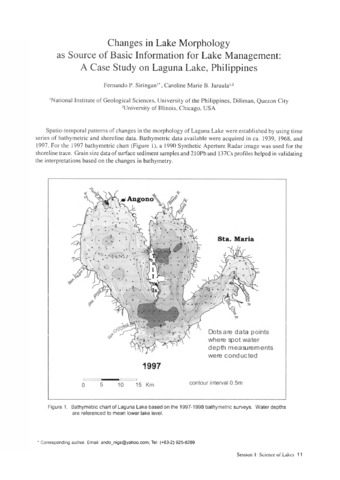
Changes in lake morphology as source of basic information for lake management: A case study on Laguna Lake, Philippines
(Southeast Asian Regional Center for Graduate Study and Research in Agriculture (SEARCA), 2005) -
Assessment of local government's implementation of open access policy in Taal Lake, Philippines: Effects on lake conservation and management
(Aquaculture Department, Southeast Asian Fisheries Development Center; Philippine Council for Aquatic and Marine Research and Development (PCAMRD), Department of Science and Technology; Bureau of Fisheries and Aquatic Resources, 2001)The effects of local government's implementation of the current national policy on open access in municipal fisheries are assessed in terms of their impact on the fishery resources of Taal Lake. Local officials and fisherfolk were interviewed and their responses were analyzed for trends in perceptions on how local open access policies affect fishing practices and productivity in the lake. A policy matrix containing certain areas of concern of local governments related to sound decisionmaking on lake fishery was designed. The study shows that local government implementation of open access policy in Taal Lake tends to have negative effects on the lake's fisheries. Open access allows for the unregulated entry of fishing practices like fish cage culture which tend to increase the pollution load in the lake. Pollution due to fish farming in cages seems to even exceed loads from domestic wastes and agricultural runoff. While fish cages flourished in the lake, the income of small fisher folk has declined because of dwindling catch from capture fisheries. It is recommended that national government agencies (e.g., Department of Agriculture, Bureau of Fisheries and Aquatic Resources, Department of Environment and Natural Resources) should forge an agreement with local government units for a continuing assessment of the fishery resources in Taal. This needs to be coupled with technical assistance to undertake sustained efforts to improve the conservation, productivity and management of the lake's aquatic resources. There is also a need to increase the budgetary allocations for new research and extension activities to address problems and issues of the fishery sector in the lake and for upgrading the capability of local and sectoral policy and decision makers on the lake's fisheries.