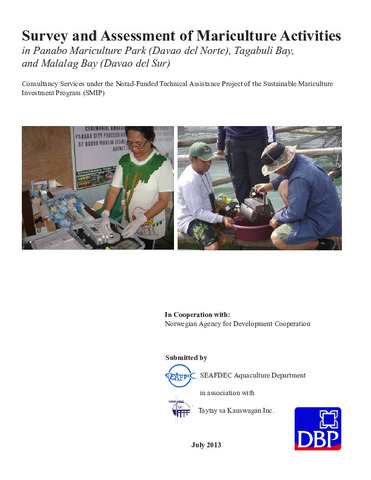
Survey and assessment of mariculture activities in Panabo Mariculture Park (Davao del Norte), Tagabuli Bay and Malalag Bay (Davao del Sur)
View/
Preview (Limited to 10 pages)
smip_survey_assessment_final.pdf (5.142Mb)
 Restricted Access
Restricted Access
Downloads: 5
Date
2013-07Page views
3,826ASFA keyword
surveys 
evaluation
mariculture
aquaculture
socioeconomic aspects
geographical distribution
demography
marine resources
governance
environmental assessment
profiling
mapping
physicochemical properties
parameters
water quality
sediment
milkfish culture
financing
marketing
cages
financial institutions
coastal zone
property rights
economics
evaluation
mariculture
aquaculture
socioeconomic aspects
geographical distribution
demography
marine resources
governance
environmental assessment
profiling
mapping
physicochemical properties
parameters
water quality
sediment
milkfish culture
financing
marketing
cages
financial institutions
coastal zone
property rights
economics
Metadata
Show full item recordShare
Description
The Development Bank of the Philippines (DBP) embarked on a financing program called the Sustainable Mariculture Investment Program (SMIP) aimed to make credit and support facilities available for the establishment, development, operation and maintenance of mariculture parks including support services and industries. Since DBP lacks the expertise and experience in technically assessing the viability of projects proposed by borrowers that include local government units, private locators, fish farmer cooperatives or associations, and operators of support businesses, DBP requested and was granted a fund from the Norwegian Agency for Development Assistance (Norad) to seek technical assistance in developing tools and templates that will be used in evaluating and assessing prospective mariculture sites and projects.
DBP contracted the Southeast Asian Fisheries Development Center Aquaculture Department (SEAFDEC/AQD) in collaboration with Taytay sa Kauswagan Inc. (TSKI) to: (i) undertake technical, socioeconomic, and financial assessments of selected MPs; (ii) develop technical assessment tools and templates in evaluating prospective sites; and (iii) develop financing instruments and modules/schemes to fund proposed projects and a financing program or strategies for fund sourcing purposes. A rating system will be developed integrating all parameters and indicators measured from the various evaluation tools. The rating system will be used in developing standards for assessing the suitability of existing MPs for further development, the establishment of new MPs and in identifying support facilities, services, opportunities etc. These standards are conceived to develop strategies that need to be taken to support current locators and investors, and encourage investment in MP zones.
DBP has already developed the SMIP financing facility before Norad’s approval of the Bank’s request for technical assistance. The technical assistance will pave the necessary preparation and program approach of the Bank to carry out financing support to the mariculture industry.
The SEAFDEC-TSKI team proposed to undertake surveys in four MPs in Davao: Panabo MP in Davao del Norte; Pantukan MP in Compostela Valley; Samal Island MP in Davao City; and Mati MP in Davao Oriental. However, with information gathered from the survey done in Panabo MP and on mariculture activities in Tagabuli Bay, Sta. Cruz, Davao del Norte and some sites in Malalag Bay, Digos City, Davao del Norte; the team suggested that information gathered from LGUs initiated and managed sites may provide additional information and insights that may not be captured if the surveys are done only on BFAR established and managed MPs. The request to change the survey sites to Tagabuli Bay and adjoining areas in Digos City was endorsed by DBP.
This report presents the results of the socioeconomic, techno-environmental and financial assessments done in Panabo MP, Panabo City, Davao del Norte from 27 June to 1 July 2011; and Tagabuli Bay, Sta. Cruz and Malalag Bay, Digos City, Davao del Sur from 7 to 13 August 2011.
Suggested Citation
SEAFDEC/AQD. (2013). Survey and assessment of mariculture activities in Panabo Mariculture Park (Davao del Norte), Tagabuli Bay and Malalag Bay (Davao del Sur). Aquaculture Department, Southeast Asian Fisheries Development Center.
Type
BookFormat
66 pages : color illustrations.
Collections
Related items
Showing items related by title, author, creator and subject.
-
Assessment of relocation sites for mariculture operations in Tagabuli Bay, Sta. Cruz, Davao del Sur
(Aquaculture Department, Southeast Asian Fisheries Development Center, 2013-07) -
Distribution and abundance of hard clam shells Meretrix meretrix along the coastal areas of Panguil bay, Lanao del Norte, Philippines
(Aquaculture Department, Southeast Asian Fisheries Development Center, 2015)Meretrix meretrix is believed to be abundant in Panguil Bay and in the absence of relevant fishery statistics, it is useful to quantify their biomass with a view to determining their fishery potential. This study aims to monitor the gonadal development, identify the associated macrofauna and determine the distribution and abundance of hard clam shells M. meretrix along the coastline of four municipalities of Lanao del Norte at Panguil Bay. Four sampling sites were selected and established to achieve and relate some generalities using the transect-quadrat method. Clams were counted, measured and identified. Physicochemical parameters were also noted every sampling. M. meretrix was found to be most abundant in Raw-an Pt. Baroy (28-542 pcs./m2) followed by Mayao, Lala (0.3-26 pcs/m2). M. meretrix at Aloha Tubod occurred in low densities (0.1-4 pcs/m2). No hard clam shell was found in Taguitic, Kapatagan. Mean length differed significantly at the three locations. The coastal area of Mayao, Lala, had the highest diversity (H' = 4.236737) in terms of shell species identified and recorded during the twelve months sampling period. Most of the shells dissected were sexually immature with male shellfishes being more predominant than females. Differences in distribution, density and length size of hard clam shells were compared in this study at four locations. Anthropogenic causes e.g. exploitation as well as environmental parameters such as salinity levels and sediment quality are suggested to be the main cause of the variation. These results will be used as baseline information to properly manage hard clam shell resources in Panguil Bay. -
Fire + water + bombs: Disaster management among academic libraries in Marawi City, Lanao del Sur, Philippines
Superio, Daryl ; ; Oliveros, Mary Grace H. ; Delgado, Allana S. ; Palcullo, Vince Ervin ; Geromiano, Joy F. (Elsevier, 2019-09)
The academic libraries in Marawi City, Lanao del Sur, Philippines are vulnerable to disasters. In the last ten years, the majority of the 13 respondent libraries have sustained at least one disaster that may have been caused by civil unrest, war or terrorism, flood, earthquake, or fire. The majority were unprepared to face such disasters, may it be small-scale or catastrophic, and only one library has a disaster management plan. The lack of significant holdings of rare books, shortage of financial resources, no perceived risk, and the unavailability of staff to write a disaster management plan, are the reasons why most libraries do not have a plan. Moreover, the majority lacked staff that has undergone training in disaster preparedness and management. On the other hand, all of the libraries have disaster management practices that although not enough, will still enable them to lessen the effects of the disaster and save their library and parts of their collection when necessary. The respondents identified management support as an essential factor in their success in disaster management. The results of the study provide valuable information on the current state of the libraries in the Philippines with regards to disaster preparedness and management. Therefore, it is an essential addition to the literature on disaster management in the Philippines, which is very scarce as of the moment.
; ; Oliveros, Mary Grace H. ; Delgado, Allana S. ; Palcullo, Vince Ervin ; Geromiano, Joy F. (Elsevier, 2019-09)
The academic libraries in Marawi City, Lanao del Sur, Philippines are vulnerable to disasters. In the last ten years, the majority of the 13 respondent libraries have sustained at least one disaster that may have been caused by civil unrest, war or terrorism, flood, earthquake, or fire. The majority were unprepared to face such disasters, may it be small-scale or catastrophic, and only one library has a disaster management plan. The lack of significant holdings of rare books, shortage of financial resources, no perceived risk, and the unavailability of staff to write a disaster management plan, are the reasons why most libraries do not have a plan. Moreover, the majority lacked staff that has undergone training in disaster preparedness and management. On the other hand, all of the libraries have disaster management practices that although not enough, will still enable them to lessen the effects of the disaster and save their library and parts of their collection when necessary. The respondents identified management support as an essential factor in their success in disaster management. The results of the study provide valuable information on the current state of the libraries in the Philippines with regards to disaster preparedness and management. Therefore, it is an essential addition to the literature on disaster management in the Philippines, which is very scarce as of the moment.