Recent advances in diagnosis and prevention of fish and shrimp diseases in Southeast Asia: Terminal report of the regional fish disease project on development of fish disease inspection methodologies for artificially-bred seeds funded by the Government of Japan Trust Fund from 2000 to 2004

Share
Description
Fish diseases are one of the major constraints and threats to aquaculture production in Southeast Asia. Numerous infectious diseases have been reported from fish and shrimp cultured in this region. Currently, several emerging diseases are also recognized in the region. These diseases cause large-scale mass mortalities of cultured species, inducing devastating losses to the regional aquaculture production.
Various chemicals including antibiotics, pesticides, disinfectants and others are often used to control fish diseases in the region. There is, however, a need to ensure that aquaculture products are safe for humans, and the presence of chemical residues in aquaculture products have made a serious, negative impact on international trade in exporting countries.
The Aquaculture Department of the Southeast Asian Fisheries Development Center (SEAFDEC) based in Tigbauan, Iloilo, Philippines, has conducted the Regional Fish Disease Project to address fish disease problems and food safety issues in the region with funding from the Government of Japan (GOJ) Trust Fund. Under the title of “Development of Fish Disease Inspection Methodologies for Artificially-Bred Seeds,” the first phase of the project was implemented for five years from 2000 to 2004. During this period, many activities including research, hands-on training, international meetings and extension were conducted.
This volume entitled “Recent Advances in Diagnosis and Prevention of Fish and Shrimp Diseases in Southeast Asia” is a terminal report of the Regional Fish Disease Project on “Development of Fish Disease Inspection Methodologies for Artificially-Bred Seeds” funded by the GOJ Trust Fund. This is a compilation of the outcome of various activities conducted from 2000 to 2004. In addition to this report, a number of scientific papers, manuals, proceedings of international meetings and others have been published to disseminate the outputs of the project (see Chapter 4).
Suggested Citation
Nagasawa, K. (Ed.). (2005). Recent advances in diagnosis and prevention of fish and shrimp diseases in Southeast Asia: Terminal report of the regional fish disease project on development of fish disease inspection methodologies for artificially-bred seeds funded by the Government of Japan Trust Fund from 2000 to 2004. Tigbauan, Iloilo, Philippines: Aquaculture Department, Southeast Asian Fisheries Development Center.
Type
BookISBN
9718511732Format
ix, 484 pages ; 30 cm.
Related items
Showing items related by title, author, creator and subject.
-
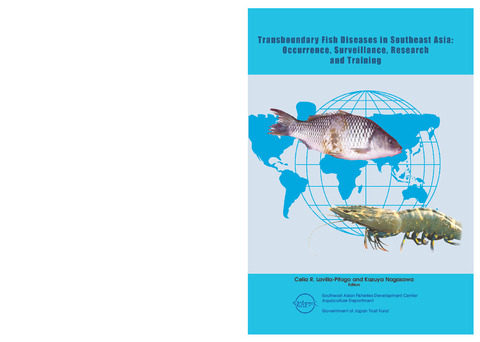
Transboundary fish diseases in Southeast Asia: Occurrence, surveillance, research and training
(Aquaculture Department, Southeast Asian Fisheries Development Center, 2004)The meeting aims to share and collect the most current information on the occurrence of transboundary fish diseases and surveillance, quarantine, diagnosis, monitoring, research and training for aquatic animal diseases in the SEAFDEC member countries. In the meeting, three viruses, namely KHV, WSSV and TSV, were highlighted because of their high virulence and devastating impact to the region. -
Transboundary aquatic animal diseases: History and impacts in ASEAN aquaculture
(Aquaculture Department, Southeast Asian Fisheries Development Center, 2019)Aquaculture is one of the important sectors in the economy of most Asia-Pacific countries. However, majority of aquaculture farms are small-scale and most often lack the necessary facilities to comply with or are not well informed of the product standards imposed by concerned authorities, especially for international trade. Most countries in the region have a high reliance on aquatic animals as the major source of protein for their populations. In the past 20 years, farming of shrimp and fish for export has become a major employer and revenue earner for many countries in the region. Aquaculture is a major employer, contributes significantly to national economies, assists in poverty reduction, and is an important element in food security and other national development priorities. Aquaculture has developed rapidly in the region and is now a significant component in the national economies of many countries. However, recent disease events in fish and shrimp farming have indicated that preparedness and response measures are lacking, contributing to spread of disease across large areas of the countries involved. The growth of aquaculture in recent decades has been dependent on the international movement of aquatic animals and, in particular, the introduction of non-native species. The movement of live aquatic animals and their products has the potential to spread pathogens from one country or region to another, which may result to disease outbreaks. In shrimps as example, most major disease outbreaks were associated with the movement of live animals (broodstock, nauplii and postlarvae) when the patterns of disease spread were analyzed. Many aquatic animal diseases, once established, are often difficult to treat or to eliminate. Over the past 30 years, the Asia-Pacific region has been swept by a number of devastating diseases of aquatic animals which have caused massive economic and social losses. These include spread and outbreaks of infection with Aphanomyces invadans (EUS) in freshwater fish, viral nervous necrosis (VNN) in marine fish, viral hemorrhagic septicaemia (VHS) in marine and freshwater fish, and several viral diseases in shrimps such as white spot disease (WSD), white tail disease (WTD), yellow head disease (YHD) and infectious myonecrosis (IMN) among others. This demonstrates the vulnerability of the aquaculture industry as well as the wild populations to disease emergence in the region. The impacts of these diseases have been aggravated by the lack of effective preparedness and response whenever diseases emerge. Although some national, regional and international actions towards disease emergencies have paved way to disease spread prevention in recent years (e.g. Acute hepatopancreatic necrosis diseases; AHPND), there are still several emerging diseases that need to be considered by aquaculture-producing countries, especially in the ASEAN, through a harmonized and effective emergency preparedness and disease response. -
FAO TCP/INT/3501: Emergency preparedness and response systems capacity and performance self-assessment survey
(Aquaculture Department, Southeast Asian Fisheries Development Center, 2019)The purpose of this survey is to obtain information on national capacity and the agencies mandated to implement emergency preparedness and response systems with respect to aquatic animal diseases. The results of this survey will help guide regional and national strategic planning with respect to improving aquatic EPR systems, thereby improving aquatic animal health more broadly and assuring adequate and rational support services to achieve sustainable aquaculture development. This FAO questionnaire on aquatic EPR system capacity and performance is a country level self-assessment survey with four sections: (1) general administration, (2) operational components, (3) support systems and (4) additional information.