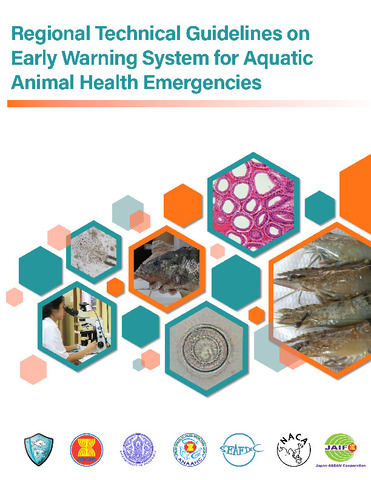
Regional technical guidelines on early warning system for aquatic animal health emergencies


Share
Abstract
This Regional Technical Guidelines for Early Warning System on Aquatic Animal Health Emergencies was developed to enumerate the actions to be undertaken by the AMS in case of the occurrence of known, unknown, existing, emerging or re-emerging disease(s). The guidelines identified the key players in aquatic emergency preparedness and response system including their roles and responsibilities. Actions to be undertaken during any disease emergencies were also described.
Description
This set of guidelines is developed to help national regulators and stakeholders in responding to and managing suspected outbreaks of emergency aquatic animal diseases; thus improve national emergency preparedness in order to maximize the efficiency of response to serious outbreaks of aquatic animal diseases.
This document aims to provide guidance to Competent Authorities (CAs) in the decision-making and in issuing regulations that can minimize the impacts of serious aquatic disease occurrence and/or outbreaks through containment or eradication or mitigation whether at the regional, national, or farm level. It is envisaged that a harmonized guideline for aquatic EPRS among AMS is developed.
The purpose of this set of guidelines is to enumerate the actions to be undertaken by the AMS in case of the occurrence of known, unknown, existing, emerging or re-emerging disease(s).
The set of guidelines is based on the analysis of the FAO Emergency Preparedness and Response Systems audit for aquatic animal diseases completed by the AMS.
Suggested Citation
SEAFDEC/AQD. (2020). Regional technical guidelines on early warning system for aquatic animal health emergencies. Aquaculture Department, Southeast Asian Fisheries Development Center.
Type
BookFormat
ii, 20 pages
Collections
Related items
Showing items related by title, author, creator and subject.
-
The role of quarantine in preventing the spread of serious pathogens of aquatic animals in Southeast Asia
(Aquaculture Department, Southeast Asian Fisheries Development Center, 2004)Quarantine, in the strict sense, is the confinement of aquatic animals of unknown or questionable health status in secure facilities such that neither they nor any pathogens they may be carrying can escape into the external environment. During the period of quarantine, the animals are observed, tested, and treatment may be applied, and a decision will be made as to whether or not they should be released to the external environment. While the concept of quarantine for aquatic animals has existed for many years, within the current framework of "national biosecurity", quarantine is seen as one of a number of risk mitigation options that governments can apply to reduce the likelihood of serious pathogens being introduced with the importation of live aquatic animals and their products. Although the concept of quarantine is relatively simple, its effective implementation may be complex, due to the need for specialized infrastructure, capability and expertise. Several Southeast Asian countries have considered or attempted to implement border quarantine for live aquatic animals; however, these efforts have met with little success. This has been due to a number of reasons, including failure to carefully define the scope and purpose of quarantine within a national aquatic animal health program, the diversity of forms in which trade occurs, the sheer volume of commodity traded, the lack of simple and accurate diagnostics tests for some pathogens, and the limited capital and human resources that governments are able to commit to this effort. To improve this situation, risk analysis can be used to determine whether or not the importation of a given commodity (living aquatic animal or its product) poses an unacceptable disease risk to national biosecurity. In those cases where an unacceptably high level of risk exists, possible risk mitigation measures can then be examined to determine what actions, if any, can be applied to reduce the risk to within the country's appropriate level of protection (ALOP). In this way, quarantine, as one of a suite of possible risk reduction measures, can be applied effectively on a case-by-case basis to reduce the risk of introduction, establishment and spread of serious aquatic animal pathogens into new areas. -
Transboundary fish diseases in Southeast Asia: Occurrence, surveillance, research and training
(Aquaculture Department, Southeast Asian Fisheries Development Center, 2004)The meeting aims to share and collect the most current information on the occurrence of transboundary fish diseases and surveillance, quarantine, diagnosis, monitoring, research and training for aquatic animal diseases in the SEAFDEC member countries. In the meeting, three viruses, namely KHV, WSSV and TSV, were highlighted because of their high virulence and devastating impact to the region. -
FAO TCP/INT/3501: Emergency preparedness and response systems capacity and performance self-assessment survey
(Aquaculture Department, Southeast Asian Fisheries Development Center, 2019)The purpose of this survey is to obtain information on national capacity and the agencies mandated to implement emergency preparedness and response systems with respect to aquatic animal diseases. The results of this survey will help guide regional and national strategic planning with respect to improving aquatic EPR systems, thereby improving aquatic animal health more broadly and assuring adequate and rational support services to achieve sustainable aquaculture development. This FAO questionnaire on aquatic EPR system capacity and performance is a country level self-assessment survey with four sections: (1) general administration, (2) operational components, (3) support systems and (4) additional information.