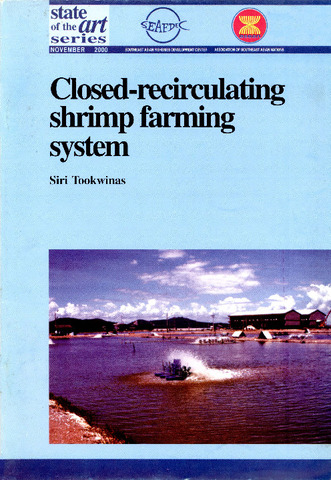
Closed-recirculating shrimp farming system


Share
Abstract
This collaborative SEAFDEC/ASEAN project aimed to develop sustainable shrimp culture technology packages to address the problems in shrimp culture (e.g. discharges from shrimp farms threatening mangrove and marine ecosystems, clearing of mangrove forests to make way for shrimp ponds, etc.). In this context, a closed recirculating shrimp farming system is discussed touching on: pond preparation, water preparation, stocking, feeding, management, DO level, problems, record keeping, and harvesting.
Suggested Citation
Tookwinas, S. (2000). Closed-recirculating shrimp farming system. Tigbauan, Iloilo, Philippines: Aquaculture Department, Southeast Asian Fisheries Development Center.
Type
BookISBN
9718511482Series
State of the art seriesFormat
27 pages : illustrations ; 26 cm.
Koleksi
Related items
Showing items related by title, author, creator and subject.
-
Series: Asia-Pacific Marine Finfish Aquaculture Network; Publication No. 2005–01
A guide to small-scale marine finfish hatchery technology
(Network of Aquaculture Centres in Asia-Pacific, 2005)Recent improvements in hatchery production technology for high-value marine finfish species such as groupers have led to an increased interest in setting up hatcheries to produce fingerlings for aquaculture. Small-scale hatcheries make this technology available to poor people in developing countries. Capital costs for small-scale hatcheries are relatively low, and the profitability of these ventures ensures rapid payback of capital investment. This guide provides an outline of the requirements to establish a small-scale marine finfish hatchery, particularly the economic aspects. It is intended to provide sufficient information for potential investors to decide whether investment in such ventures is appropriate for them. The guide provides some basic technical information in order to give an indication of the level of technical expertise necessary to operate a small-scale marine finfish hatchery. However, it is not intended as a detailed technical guide to the operation of small-scale hatcheries. Additional resources, such as training courses in marine finfish hatchery production, are available and these are listed in this document. Development of small-scale hatcheries may be more appropriate where there are existing marine hatchery operations, e.g. for shrimp or milkfish. By definition, small-scale hatcheries do not have broodstock facilities, so a supply of fertilised eggs (usually from a larger hatchery) is essential. Access to fertilised eggs and experienced hatchery staff will limit the application of small-scale hatchery technology. Despite this, there is considerable potential for this technology to be widely adopted. This guide has been written by a team of experts in marine finfish aquaculture who have been involved in a multinational collaborative research project since 1999. -
Aquaculture industry profile and trends
(University of the Philippines Aquaculture Society, Inc., 2001) -
Aquaculture in Malaysia
(Aquaculture Department, Southeast Asian Fisheries Development Center, 1995)Aquaculture in Malaysia is experiencing rapid growth. Total production in 1992 amounted to 79,699 tons valued at RM 207.4 million. These figures are 23% and 25% higher than the previous year's. Semi-culture of the cockle Anadara granosa was still predominant, contributing about 70% of the total output. Culture and production of the oyster Crassostrea iredalei is still insignificant. Sea bass Lates calcarifer constituted over 80% of the production from marine cages. Cage culture of grouper Epinephelus sp., snapper Lutjanus sp. and pompano Trachinotus blochii were also done in much smaller scale. The mangrove snapper Lutjanus argentimaculatus was recently spawned in captivity and larvae and juveniles were produced. In 1992, the tiger shrimp Penaeus monodon constituted about 87% of brackishwater pond production. Pond culture of the white shrimp P. merguiensis and the mudcrab Scylla sp. is at the experimental stage. Red tilapia hybrid was the major freshwater species cultured in cages, with 1,486 tons harvested in 1992. Freshwater pond production was valued at RM 100.85 million, 22% of which was due to the eel Anguilla japonica. Production of freshwater ornamental fishes is also becoming significant. Other exotic species recently bred and cultured are the African catfish Clarias gariepinus and the pacu Piaractus brachypomus. The indigenous freshwater catfish Mystus nemurus and carp Probarbus julleini have recently been bred in captivity and cultured experimentally. Lately, there have been attempts to culture non-conventional species such as the bullfrog Rana catesbeiana, the soft-shell turtle Trionyx sinensis, and aquatic ornamental plants.