Response of phytoplankton to temporal changes in nutrients in Taal Lake, Batangas, Philippines
View/
Date
2005Page views
1,016ASFA keyword

AGROVOC keyword
Taxonomic term

Geographic names

Metadata
Show full item recordShare
Abstract
It is important to note that different adaptations are successful at different times and in different environments, so that different algal species become dominant at different times and locations. Hence, the species composition of the phytoplankton community is arbitrary, but allows the alert observer to discover the characteristics of the lake or pond investigated, including nutrient status, climate acidity, and the composition of the grazer community.
Phytoplankton taxa collected and identified within the sampling regime were subjected to ordination within the set of environmental axes and revealed that indeed, and the vectors in the absorbed data of Ceratium can be assumed largely for NH4-N, and soluble and total P. A positive correlation between Ceratium and NH4 is stronger than that of total P and soluble P. Vectors in the absorbed data for centric diatoms, Selenastrum, Phormidium, Coelastrum, Chroococcus, and Oscillatoria, can be assumed for largely by NO3.
The location of the sampling stations, months and depths within the Canonical Correspondence Analysis (CCA) ordination field with the same environmental factors defining the axes were also analyzed. The least important environmental variable considered in this study was the soluble phosphate with the shortest vector among the other factors. The study also found out that the nutrient status of the lake appears to influence it during the dry season. It must be noted though that 2.5 m depth collections were considered in this data and may not be very reliable because of the nature of the flow of nutrient in a deep lake being dispersed in the deeper portion and remains drift to the bottom (Smith, 1996). Previous discussions on statistical analyses support these results from Multivariate Statistical Package (MVSP). Observations on the temporal changes in nutrients and the phytoplankton biomass and cell count are found parallel to the studies of Lewis (1978) in Lake Lanao, Martines (1977) and Zafaralla (1990) in Laguna de Bay.
Suggested Citation
Enriquez, E. B., & Perez, T. R. (2005). Response of phytoplankton to temporal changes in nutrients in Taal Lake, Batangas, Philippines. In M. L. Cuvin-Aralar, R. S. Punongbayan, A. Santos-Borja, L. V. Castillo, E. V. Manalili, & M. M. Mendoza (Eds.), Proceedings of the First National Congress on Philippine Lakes (pp. 54-71). Southeast Asian Regional Center for Graduate Study and Research in Agriculture (SEARCA).
Type
Conference paperISSN
1656-8099Collections
- LakeCon2003 [49]
Related items
Showing items related by title, author, creator and subject.
-
An environmental assessment of the aquaculture potential of Lake Gawaan, Lake Lenneng and Lake Banao/Danum at the Mt. Province
(Aquaculture Department, Southeast Asian Fisheries Development Center; Philippine Council for Aquatic and Marine Research and Development (PCAMRD), Department of Science and Technology; Bureau of Fisheries and Aquatic Resources, 2001)This study reviews the existing conditions of the three Mt. Province lakes: Lake Gawaan, Lake Lenneng and Lake Banao/Danum. Three mechanisms were employed. First is the overview of the resource capabilities. This includes the geographical, physical and biological characteristics, as well as the identification of nearby communities and the possible market distribution channels. The physical characteristics are the watershed type, color of water, kind of shoreline, source of water, water fluctuation levels and transparency/turbidity. Biological and chemical characteristics comprise the primary productivity, dissolved oxygen, nitrate, pH, ammonia, and stock availability (catch composition, gear type, seasonal distribution and production rate). The second mechanism is the understanding of the limitations of the area and development prospects which could cater to the needs of the growing population. This tackles suitable aquaculture practices that may be adopted at the areas concerned in order to increase fish production at the Mt. Province. The last mechanism is to determine if the combined efforts of the non-government organizations, government agencies and other concerned groups could be improved to prevent a piece-rate resource development program. Results showed that favorable conditions for fish culture are present in the three lakes. Culture of fish in net cages and pens appears suitable for the lakes. -
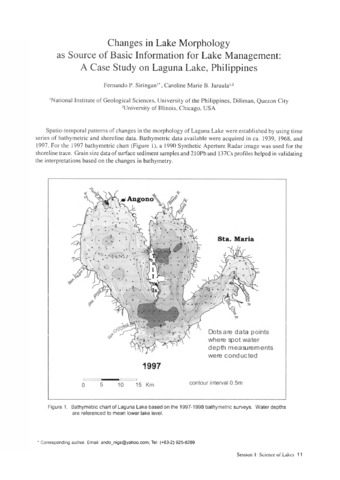
Changes in lake morphology as source of basic information for lake management: A case study on Laguna Lake, Philippines
(Southeast Asian Regional Center for Graduate Study and Research in Agriculture (SEARCA), 2005) -
Assessment of local government's implementation of open access policy in Taal Lake, Philippines: Effects on lake conservation and management
(Aquaculture Department, Southeast Asian Fisheries Development Center; Philippine Council for Aquatic and Marine Research and Development (PCAMRD), Department of Science and Technology; Bureau of Fisheries and Aquatic Resources, 2001)The effects of local government's implementation of the current national policy on open access in municipal fisheries are assessed in terms of their impact on the fishery resources of Taal Lake. Local officials and fisherfolk were interviewed and their responses were analyzed for trends in perceptions on how local open access policies affect fishing practices and productivity in the lake. A policy matrix containing certain areas of concern of local governments related to sound decisionmaking on lake fishery was designed. The study shows that local government implementation of open access policy in Taal Lake tends to have negative effects on the lake's fisheries. Open access allows for the unregulated entry of fishing practices like fish cage culture which tend to increase the pollution load in the lake. Pollution due to fish farming in cages seems to even exceed loads from domestic wastes and agricultural runoff. While fish cages flourished in the lake, the income of small fisher folk has declined because of dwindling catch from capture fisheries. It is recommended that national government agencies (e.g., Department of Agriculture, Bureau of Fisheries and Aquatic Resources, Department of Environment and Natural Resources) should forge an agreement with local government units for a continuing assessment of the fishery resources in Taal. This needs to be coupled with technical assistance to undertake sustained efforts to improve the conservation, productivity and management of the lake's aquatic resources. There is also a need to increase the budgetary allocations for new research and extension activities to address problems and issues of the fishery sector in the lake and for upgrading the capability of local and sectoral policy and decision makers on the lake's fisheries.