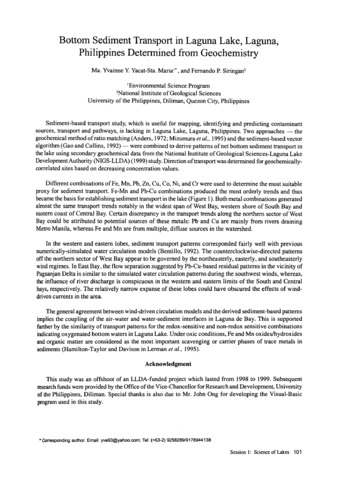
Bottom sediment transport in Laguna Lake, Laguna, Philippines determined from geochemistry

Share
Suggested Citation
Yacat-Sta. Maria, Ma. Y. Y., & Siringan, F. P. (2005). Bottom sediment transport in Laguna Lake, Laguna, Philippines determined from geochemistry. In M. L. Cuvin-Aralar, R. S. Punongbayan, A. Santos-Borja, L. V. Castillo, E. V. Manalili, & M. M. Mendoza (Eds.), Proceedings of the First National Congress on Philippine Lakes (pp. 101-103). Southeast Asian Regional Center for Graduate Study and Research in Agriculture (SEARCA).
Type
Conference paperISSN
1656-8099Collections
- LakeCon2003 [49]
Related items
Showing items related by title, author, creator and subject.
-
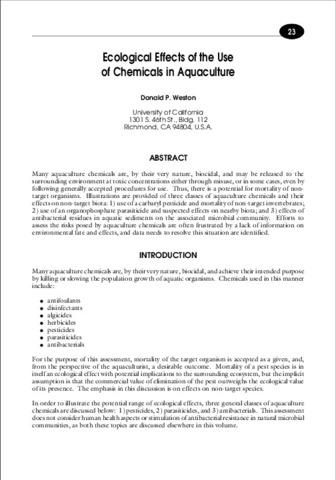
Ecological effects of the use of chemicals in aquaculture
(Aquaculture Department, Southeast Asian Fisheries Development Center, 2000)Many aquaculture chemicals are, by their very nature, biocidal, and may be released to the surrounding environment at toxic concentrations either through misuse, or in some cases, even by following generally accepted procedures for use. Thus, there is a potential for mortality of nontarget organisms. Illustrations are provided of three classes of aquaculture chemicals and their effects on non-target biota: 1) use of a carbaryl pesticide and mortality of non-target invertebrates; 2) use of an organophosphate parasiticide and suspected effects on nearby biota; and 3) effects of antibacterial residues in aquatic sediments on the associated microbial community. Efforts to assess the risks posed by aquaculture chemicals are often frustrated by a lack of information on environmental fate and effects, and data needs to resolve this situation are identified. -
Mercury levels in the sediment, water, and selected finfishes of Laguna Lake, the Philippines
(Elsevier, 1990)Monthly samples of sediment, water and commercially important species of fish, primarily Oreochromis niloticus and Chanos chanos , plus a few other species, were collected from the West Bay area of Laguna Lake, The Philippines from January to December 1987. Mercury levels were determined in all samples by cold vapor atomic absorption spectrophotometry. Results showed that sediment samples contained mercury levels ranging from 26.7 to 117 ppb. Mercury levels in water samples were low, ranging from below detectable to 0.5670 ppb. The mercury levels in the water were negatively correlated with conductivity and dissolved oxygen and positively correlated with turbidity. The mercury burden of the fish species samples was below the maximum permissible level set by the WHO and USFDA of 0.05 ppm. No direct correlation was observed between mercury levels in sediment and water, water and fish and sediment and fish. -
Oxygen, sulphide and nutrient uptake of the mangrove mud clam Anodontia edentula (Family: Lucinidae)
Lebata, Ma. Junemie Hazel L. (Elsevier, 2001)
Oxygen, sulphide and nutrient (ammonia, nitrite and phosphate) uptake of Anodontia edentula was measured. Oxygen and sulphide were measured from sealed containers provided with 1 l fresh mangrove mud (sulphide source) and seawater (oxygen source) with two treatments (with and without clam) at 16 replicates each. Oxygen, sulphide and other parameters were measured at days 1 (initial), 3 and 5 (final). Nutrients were measured from containers filled with 1.5 l wastewater from a milkfish broodstock tank with two treatments (with and without clam) at eight replicates each. Ammonia, NO2 and PO4 were measured at days 0 (initial) 3, 6, 9 and 12 (final). Results showed significantly decreasing oxygen and sulphide concentrations in treatment with clams (ANOVA, p < 0.001). A significantly higher ammonia concentration (ANOVA, p < 0.05) was observed in treatment with clams while no significant difference was observed in nitrite and phosphate between the two treatments. A decreasing ammonia and an increasing nitrite trend was also observed in both treatments starting at day 3.
(Elsevier, 2001)
Oxygen, sulphide and nutrient (ammonia, nitrite and phosphate) uptake of Anodontia edentula was measured. Oxygen and sulphide were measured from sealed containers provided with 1 l fresh mangrove mud (sulphide source) and seawater (oxygen source) with two treatments (with and without clam) at 16 replicates each. Oxygen, sulphide and other parameters were measured at days 1 (initial), 3 and 5 (final). Nutrients were measured from containers filled with 1.5 l wastewater from a milkfish broodstock tank with two treatments (with and without clam) at eight replicates each. Ammonia, NO2 and PO4 were measured at days 0 (initial) 3, 6, 9 and 12 (final). Results showed significantly decreasing oxygen and sulphide concentrations in treatment with clams (ANOVA, p < 0.001). A significantly higher ammonia concentration (ANOVA, p < 0.05) was observed in treatment with clams while no significant difference was observed in nitrite and phosphate between the two treatments. A decreasing ammonia and an increasing nitrite trend was also observed in both treatments starting at day 3.