Catastrophic flood hazards from crater lakes: Parker and Pinatubo volcanoes, Philippines


Share
Abstract
In a span of seven years, three catastrophic flood events ensued from the breakout of two crater lakes: two from Maughan Lake, the crater lake of Parker volcano, and one from Pinatubo volcano. The mechanisms of the three lake-breakouts differ significantly from each other.
In September 1995, about 30 million m3 of water was suddenly released from Maughan Lake, resulting in large life and property losses. The breakout, which lowered the lake level by 10 m, was caused by the sudden removal of the material that had been damming the lake at its outlet along the Gao Creek. How the dam material was removed remains the subject of a criminal investigation.
A result of the 1995 breakout was the destabilization of the slopes along the Gao Creek, which resulted in several large landslides that dammed the lake outlet anew. By January 1997, Maughan Lake had risen by more than 8 m, equivalent to an additional 24 million m3 of water.
Maughan Lake broke out again in March 2002, hours after a M6.8 earthquake occurred offshore southwest of Cotabato City. The lake level was lowered by more than 9 m, and the total volume of water released was about 27 million m3. The debris flows and floods resulting from the breakout emplaced deposits that could be traced to at least 80 km along the Gao-Alah River. The breakout is believed to have been caused by the progressive weakening of the landslide dam due to the earthquakes, and/or to seiches that may have been produced along the blocked Gao Creek.
The lake-breakout scenario at Pinatubo was anticipated as early as 1998, with the lake rising at ~10 m per year. Judging from the loose emplacement and low density of the uppermost layers of the deposits at the Maraunot Notch (the lowest part of the crater rim), Philippine Institute of Volcanology and Seismology (PHIVOLCS) and United States Geological Service (USGS) scientists predicted a potentially large lake-breakout lahar event that might inundate the town of Botolan, Zambales. In September 2001, while the lake was still 5 m below spilling level, the government decided to excavate a trench that would drain the lake at a scheduled time and prevent the accumulation of an additional 15 million m3 of water. However, miscommunication between scientists and engineers resulted in a trench that favored slow drainage of the crater lake. It was only in July 2002, during heavy typhoon rains, that the lake actually broke out, releasing about 65 million m3 of water and lowering the lake by 23 m. The floodwaters bulked up with sediments downstream to form lahars with a total volume of 165 million m3, reaching the Bucao Bridge but sparing the Botolan town proper. Without the 2001 trenching, the lahar volume could have been more than 200 million m3, perhaps enough to adversely affect Botolan.
The 2002 Pinatubo crater-lake breakout was probably generated by channel-bed erosion at the Maraunot Notch, as predicted by commonly used dam-breach models. With the lake now draining through the Maraunot Notch over erosion-resistant dacitic bedrock, a catastrophic breakout by such mechanism is no longer expected. Lake-breakout, however, may be triggered by unpredictable events such as an eruption from the crater.
Description
Abstract only.
Suggested Citation
Tuñgol, N. M., Abigania, Ma. I. T., & Bornas, Ma. A. V. (2005). Catastrophic flood hazards from crater lakes: Parker and Pinatubo volcanoes, Philippines. In M. L. Cuvin-Aralar, R. S. Punongbayan, A. Santos-Borja, L. V. Castillo, E. V. Manalili, & M. M. Mendoza (Eds.), Proceedings of the First National Congress on Philippine Lakes (p. 123). Southeast Asian Regional Center for Graduate Study and Research in Agriculture (SEARCA).
Type
Conference paperISSN
1656-8099Collections
- LakeCon2003 [49]
Related items
Showing items related by title, author, creator and subject.
-
An environmental assessment of the aquaculture potential of Lake Gawaan, Lake Lenneng and Lake Banao/Danum at the Mt. Province
(Aquaculture Department, Southeast Asian Fisheries Development Center; Philippine Council for Aquatic and Marine Research and Development (PCAMRD), Department of Science and Technology; Bureau of Fisheries and Aquatic Resources, 2001)This study reviews the existing conditions of the three Mt. Province lakes: Lake Gawaan, Lake Lenneng and Lake Banao/Danum. Three mechanisms were employed. First is the overview of the resource capabilities. This includes the geographical, physical and biological characteristics, as well as the identification of nearby communities and the possible market distribution channels. The physical characteristics are the watershed type, color of water, kind of shoreline, source of water, water fluctuation levels and transparency/turbidity. Biological and chemical characteristics comprise the primary productivity, dissolved oxygen, nitrate, pH, ammonia, and stock availability (catch composition, gear type, seasonal distribution and production rate). The second mechanism is the understanding of the limitations of the area and development prospects which could cater to the needs of the growing population. This tackles suitable aquaculture practices that may be adopted at the areas concerned in order to increase fish production at the Mt. Province. The last mechanism is to determine if the combined efforts of the non-government organizations, government agencies and other concerned groups could be improved to prevent a piece-rate resource development program. Results showed that favorable conditions for fish culture are present in the three lakes. Culture of fish in net cages and pens appears suitable for the lakes. -
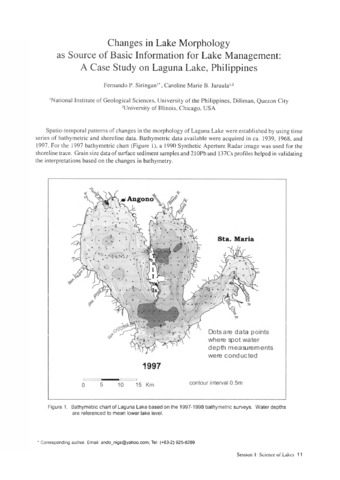
Changes in lake morphology as source of basic information for lake management: A case study on Laguna Lake, Philippines
(Southeast Asian Regional Center for Graduate Study and Research in Agriculture (SEARCA), 2005) -
Assessment of local government's implementation of open access policy in Taal Lake, Philippines: Effects on lake conservation and management
(Aquaculture Department, Southeast Asian Fisheries Development Center; Philippine Council for Aquatic and Marine Research and Development (PCAMRD), Department of Science and Technology; Bureau of Fisheries and Aquatic Resources, 2001)The effects of local government's implementation of the current national policy on open access in municipal fisheries are assessed in terms of their impact on the fishery resources of Taal Lake. Local officials and fisherfolk were interviewed and their responses were analyzed for trends in perceptions on how local open access policies affect fishing practices and productivity in the lake. A policy matrix containing certain areas of concern of local governments related to sound decisionmaking on lake fishery was designed. The study shows that local government implementation of open access policy in Taal Lake tends to have negative effects on the lake's fisheries. Open access allows for the unregulated entry of fishing practices like fish cage culture which tend to increase the pollution load in the lake. Pollution due to fish farming in cages seems to even exceed loads from domestic wastes and agricultural runoff. While fish cages flourished in the lake, the income of small fisher folk has declined because of dwindling catch from capture fisheries. It is recommended that national government agencies (e.g., Department of Agriculture, Bureau of Fisheries and Aquatic Resources, Department of Environment and Natural Resources) should forge an agreement with local government units for a continuing assessment of the fishery resources in Taal. This needs to be coupled with technical assistance to undertake sustained efforts to improve the conservation, productivity and management of the lake's aquatic resources. There is also a need to increase the budgetary allocations for new research and extension activities to address problems and issues of the fishery sector in the lake and for upgrading the capability of local and sectoral policy and decision makers on the lake's fisheries.