Culture studies on Tilapia sp. under saline conditions at the Brackishwater Aquaculture Center

Share
Abstract
This paper reviews the various researches on tilapia at the BAC with the purpose of disseminating the information so far generated and identifying the gaps in tilapia research under saline conditions.
Primary studies on tilapia at BAC were concentrated on increasing production of tilapia in brackishwater ponds and how this targetted production could be obtained more effectively and efficiently. Monoculture and polyculture procedures for tilapias including fertilization and feeding were studied. Forage fish: carnivore fish ratios were established for certain species which could be effective in thinning down the population of young tilapia while allowing the original stocks to grow bigger and at the same time producing fingerlings for restocking. This paper presents the results of various studies on tilapia.
Suggested Citation
Fortes, R. D. (1987). Culture studies on Tilapia sp. Under saline conditions at the Brackishwater Aquaculture Center. In R. D. Guerrero III, D. L. de Guzman, & C. M. Lantican (Eds.), Tilapia Farming: Proceedings of the First National Symposium and Workshop on Tilapia Farming, PCARRD, Los Baños, Laguna, November 24-26, 1986 (pp. 21-33). Philippine Council for Agriculture, Forestry and Natural Resources Research and Development.
Type
Conference paperCollections
- Tilapia Farming [9]
Related items
Showing items related by title, author, creator and subject.
-
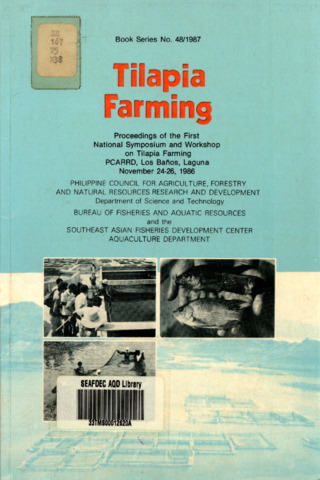
Tilapia Farming: Proceedings of the First National Symposium and Workshop on Tilapia Farming, PCARRD, Los Baños, Laguna, November 24-26, 1986
(Philippine Council for Agriculture, Forestry and Natural Resources Research and Development, 1987) -
Effect of shrimp biomass and feeding on the anti-Vibrio harveyi activity of Tilapia sp. in a simulated shrimp–tilapia polyculture system
Tendencia, Eleonor ; ; (Elsevier, 2006)
The efficiency of Tilapia hornorum to control luminous bacteria in a simulated shrimp farm environment has been reported. However, the effects of different factors such as feed input and the shrimp biomass were not taken into consideration. This study investigated the effect of feeding and increased shrimp biomass on the efficiency of tilapia to inhibit the growth of luminous bacteria. Results showed that feeding enhances the antibacterial activity or improves the efficiency of tilapia to inhibit the growth of luminous bacteria. However, the efficiency of tilapia at a biomass of 500 g/m3 is reduced if the shrimp biomass is greater than 80 g/m3. This explains the discrepancies in the results obtained in the use of tilapia to control luminous bacterial disease in shrimp ponds. The effect of starvation on the bacterial load of tilapia, grouper and milkfish feces and the amount of feces in the intestine was also investigated. Results showed that total bacterial and presumptive Vibrio count of fish feces decreased after 1 week of starvation except for the presumptive Vibrio count of grouper. The amount of feces in the intestine also decreased as starvation progressed. Moreover, bacteria isolated from the three species have antibacterial activity against the luminous bacteria Vibrio harveyi.
; ; (Elsevier, 2006)
The efficiency of Tilapia hornorum to control luminous bacteria in a simulated shrimp farm environment has been reported. However, the effects of different factors such as feed input and the shrimp biomass were not taken into consideration. This study investigated the effect of feeding and increased shrimp biomass on the efficiency of tilapia to inhibit the growth of luminous bacteria. Results showed that feeding enhances the antibacterial activity or improves the efficiency of tilapia to inhibit the growth of luminous bacteria. However, the efficiency of tilapia at a biomass of 500 g/m3 is reduced if the shrimp biomass is greater than 80 g/m3. This explains the discrepancies in the results obtained in the use of tilapia to control luminous bacterial disease in shrimp ponds. The effect of starvation on the bacterial load of tilapia, grouper and milkfish feces and the amount of feces in the intestine was also investigated. Results showed that total bacterial and presumptive Vibrio count of fish feces decreased after 1 week of starvation except for the presumptive Vibrio count of grouper. The amount of feces in the intestine also decreased as starvation progressed. Moreover, bacteria isolated from the three species have antibacterial activity against the luminous bacteria Vibrio harveyi. -
Antibacterial activity of tilapia Tilapia hornorum against Vibrio harveyi
Tendencia, Eleonor; ; ; ; ; (Elsevier, 2004)
Disease due to luminous Vibrio has been a major problem of the shrimp industry. Different technologies have been introduced to control the disease. One of the techniques reported to work against luminous bacteria in the Philippines is the green water culture system (or finfish–shrimp integrated culture system). A green water culture system is an innovative technique wherein shrimp are cultured in water collected from a pond where tilapia or other fish species are grown. In some cases, the fish are cultured in an isolated net pen inside the shrimp culture pond. This study clarifies the effect of one component of the green water culture system, the presence of all male tilapia (Tilapia hornorum) on luminous bacteria Vibrio harveyi. Results showed that stocking tilapia at a biomass not lower than 300 g/m3 efficiently inhibited the growth of luminous bacteria in shrimp (biomass=80 g/m3) rearing water without the growth of microalgae.