Browsing SEAFDEC/AQD-Seaweed Industry Association of the Philippines by Issue Date
Now showing items 1-20 of 21
-
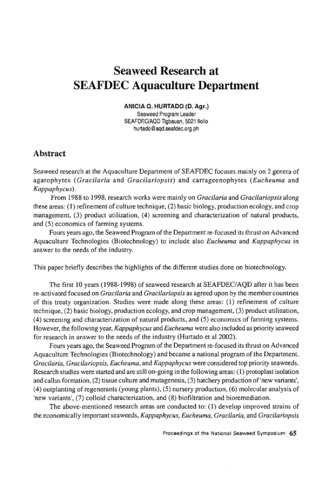
Seaweed research at SEAFDEC Aquaculture Department
(Seaweed Industry Association of the Philippines, 2003)Seaweed research at the Aquaculture Department of SEAFDEC focuses mainly on 2 genera of agarophytes (Gracilaria and Gracilariopsis) and carrageenophytes (Eucheuma and Kappaphycus). From 1988 to 1998, research works were mainly on Gracilaria and Gracilariopsis along these areas: (1) refinement of culture technique, (2) basic biology, production ecology, and corp management, (3) product utilization, (4) screening and characterization of natural products, and (5) economics of farming system. Four years ago, the Seaweed Program of the Department re-focused its thrust on Advanced Aquaculture Technologies (Biotechnology) to include also Eucheuma and Kappaphycus in answer to the needs of the industry. This paper briefly describes the highlights of the different studies done on biotechnology. -
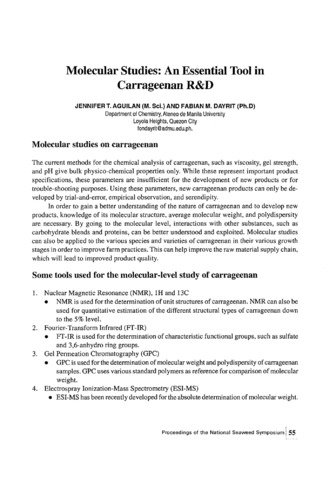
Molecular studies: An essential tool in carrageenan R&D
(Seaweed Industry Association of the Philippines, 2003) -
Department of Agriculture (DA) Program on seaweed
(Seaweed Industry Association of the Philippines, 2003) -
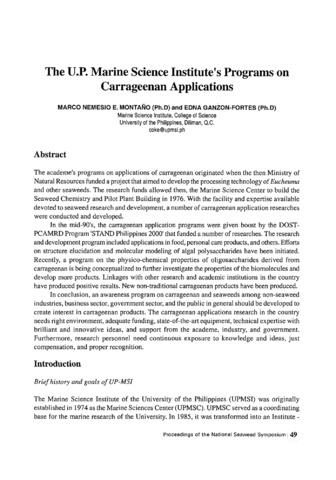
The U.P. Marine Science Institute's Programs on carrageenan applications
(Seaweed Industry Association of the Philippines, 2003)The academe's programs on applications of carrageenan originated when the then Ministry of Natural Resources funded a project that aimed to develop the processing technology of Eucheuma and other seaweeds. The research funds allowed then, the Marine Science Center to build the Seaweed Chemistry and Pilot Plant Building in 1976. With the facility and expertise available devoted to seaweed research and development, a number of carrageenan application researches were conducted and developed. In the mid-90's, the carrageenan application programs were given boost by the DOST- PCAMRD Program 'STAND Philippines 2000' that funded a number of researches. The research and development program included applications in food, personal care products, and others. Efforts on structure elucidation and molecular modeling of algal polysaccharides have been initiated. Recently, a program on the physico-chemical properties of oligosaccharides derived from carrageenan is being conceptualized to further investigate the properties of the biomolecules and develop more products. Linkages with other research and academic institutions in the country have produced positive results. New non-traditional carrageenan products have been produced. In conclusion, an awareness program on carrageenan and seaweeds among non-seaweed industries, business sector, government sector, and the public in general should be developed to create interest in carrageenan products. The carrageenan applications research in the country needs right environment, adequate funding, state-of-the-art equipment, technical expertise with brilliant and innovative ideas, and support from the academe, industry, and government. Furthermore, research personnel need continuous exposure to knowledge and ideas, just compensation, and proper recognition. -
Status of the DOST Seaweeds R & D Program
(Seaweed Industry Association of the Philippines, 2003) -
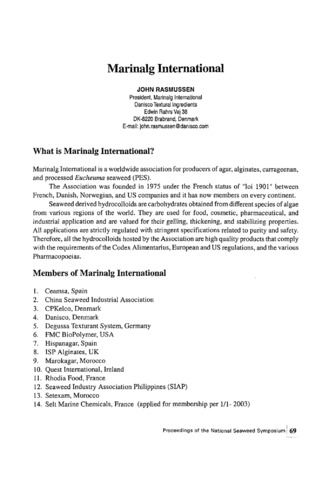
Marinalg International
(Seaweed Industry Association of the Philippines, 2003) -
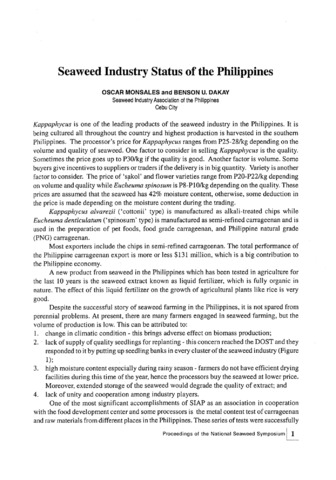
Seaweed industry status of the Philippines
(Seaweed Industry Association of the Philippines, 2003) -
Proceedings of the National Seaweed Symposium, September 3-4, 2002, Cebu City
(Seaweed Industry Association of the Philippines, 2003)The Proceedings of the National Seaweed Symposium is published by the Seaweed industry association of the Philippines (SIAP). The 109-page book is edited by SEAFDEC/AQD researchers Dr. AQ Hurtado and Ms. Ma. RJ Luhan. It ... -
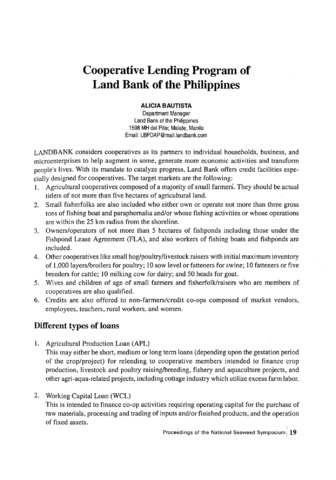
Cooperative Lending Program of Land Bank of the Philippines
(Seaweed Industry Association of the Philippines, 2003) -
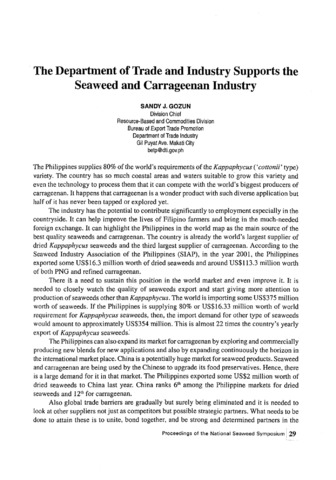
The Department of Trade and Industry supports the seaweed and carrageenan industry
(Seaweed Industry Association of the Philippines, 2003) -
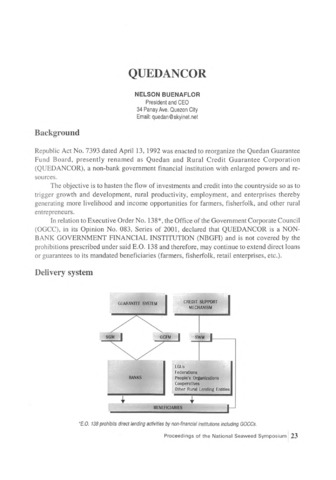
QUEDANCOR
(Seaweed Industry Association of the Philippines, 2003) -
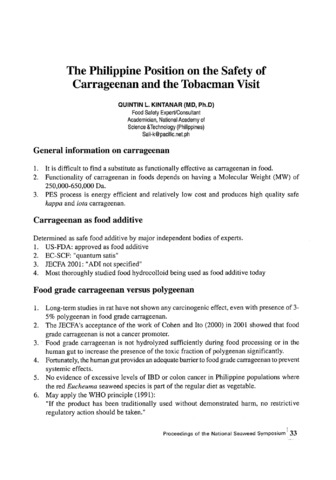
The Philippine position on the safety of carrageenan and the tobacman visit
(Seaweed Industry Association of the Philippines, 2003) -
Seaweed developments in Western Mindanao - Cluster II
(Seaweed Industry Association of the Philippines, 2003) -
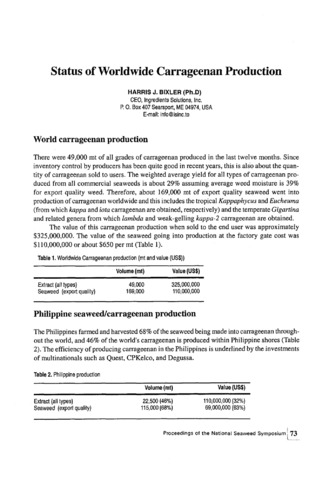
Status of worldwide carrageenan production
(Seaweed Industry Association of the Philippines, 2003) -
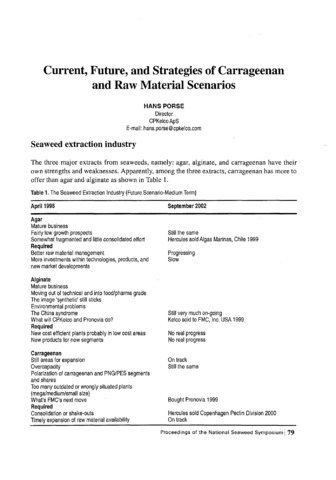
Current, future, and strategies of carrageenan and raw material scenarios
(Seaweed Industry Association of the Philippines, 2003) -
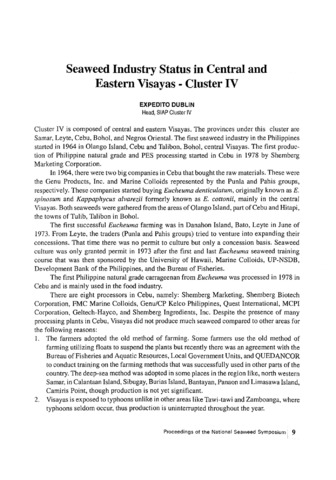
Seaweed industry status in Central and Eastern Visayas - Cluster IV
(Seaweed Industry Association of the Philippines, 2003) -
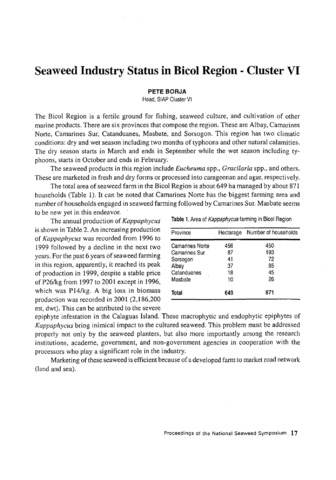
Seaweed industry status in Bicol Region - Cluster VI
(Seaweed Industry Association of the Philippines, 2003) -
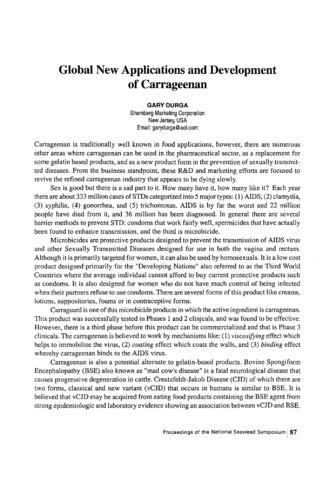
Global new applications and development of carrageenan
(Seaweed Industry Association of the Philippines, 2003) -
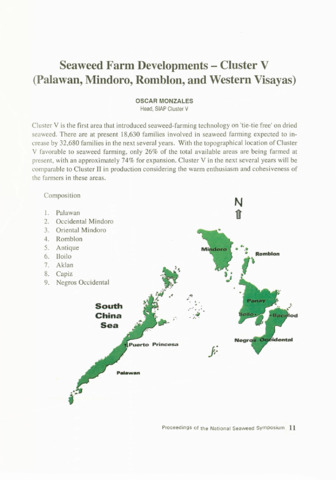
Seaweed farm developments - Cluster V (Palawan, Mindoro, Romblon, and Western Visayas)
(Seaweed Industry Association of the Philippines, 2003) -
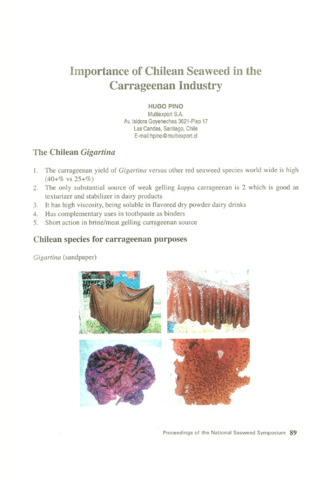
Importance of Chilean seaweed in the carrageenan industry
(Seaweed Industry Association of the Philippines, 2003)