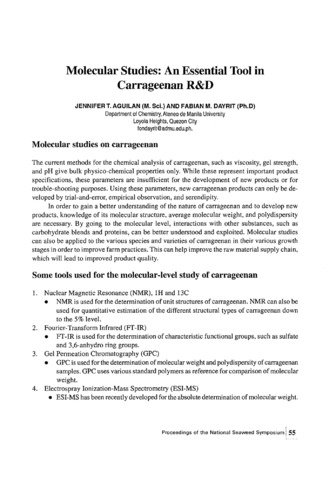
Molecular studies: An essential tool in carrageenan R&D

Share
Subjects
Molecular biology--Technique Nuclear magnetic resonance Gel permeation chromatography Electrospray ionization mass spectrometry
Suggested Citation
Aguilan, J. T., & Dayrit, F. M. (2003). Molecular studies: An essential tool in carrageenan R&D. In A. Q. Hurtado & M. R. J. Luhan (Eds.), Proceedings of the National Seaweed Symposium, September 3-4, 2002, Cebu City (pp. 55-63). Cebu City, Philippines: Seaweed Industry Association of the Philippines.
Type
Conference paperCollections
Related items
Showing items related by title, author, creator and subject.
-
Immunological and molecular biology techniques in disease diagnosis
(Aquaculture Department, Southeast Asian Fisheries Development Center, 2001)The improvement of existing immunoassay techniques, development of monoclonal antibody technology and the development of new immunoassay approaches are all working together to provide new tools for the detection of disease-causing organisms in fish and crustaceans. Following the introduction of nucleic acid hybridization technique and PCR, it was recognized that the methods offered a sensitive approach to the detection and identification of specific microorganisms as in the case of a bacterial or viral infection in a variety of sample types. Potentially, a characteristic DNA sequence from a single virus particle or cell of a particular organism can be amplified to detectable levels within a short period of time. Conventional diagnostic methods that involve the culture of microorganisms can take days or weeks to complete or very tedious to perform. PCR offers a rapid, very sensitive, very specific and simple alternative. Further developments in immunodiagnostics and emerging technologies such as DNA-based tests will revolutionize the detection and identification of infectious disease agents. -
Molecular typing and antimicrobial susceptibility of Vibrio parahaemolyticus strains
(Fish Health Section, Asian Fisheries Society, 2008)The aim of the present study was to use three PCR-based techniques for the analysis of genetic variability among Vibrio parahaemolyticus strains isolated from the Philippines. Seventeen strains of V. parahaemolyticus isolated from shrimps and from the environments where these shrimps are being cultivated were analyzed by RAPD, ERIC and REP-PCR. Antimicrobial susceptibility of these strains to selected compounds was investigated using broth microdilution method. Results of this work and analysis of similarity among strains using Dice coefficient and unweighted average pair group method have demonstrated genetic variability within the V. parahaemolyticus strains. The RAPD, ERIC and REP-PCR were found to be suitable typing methods for V. parahaemolyticus. They have good discriminative ability and can be used as rapid means of comparing these strains for epidemiological investigation. However, the REP-PCR analysis yielded a relatively small number of products suggesting that the REP sequences may not be widely distributed in the V. parahaemolyticus genome. Results of antimicrobial susceptibility revealed that resistance among the strains was rare. In conclusion, RAPD, ERIC and REP-PCR techniques are useful methods for molecular typing of V. parahaemolyticus strains. To our knowledge this is the first study of this kind carried out on V. parahaemolyticus strains isolated from the Philippines. -
Molecular epidemiology of koi herpesvirus
(Japanese Society of Fish Pathology, 2009)Three regions of koi herpesvirus (KHV) genomic DNA were compared for 34 samples from Japan, six from Indonesia, two from Taiwan, one from the Philippines, 13 from the Netherlands, one from the UK, one from the USA and one from Israel. The analyzed genomic regions included known PCR-detection targets (SphI-5, 9/5 and the thymidine kinase gene). The KHVs from Asian countries were very homogeneous, although two variants were noted based on a single nucleotide polymorphism. In contrast, seven variants were found in KHVs from outside of Asia, and although closely related to one another, they were clearly distinct from those from Asian. The results suggest that a clear genetic distinction exists between Asian and European (including each single isolate from the USA and Israel) types of KHV, and that unique types of KHV were independently introduced or emerged in the respective geographic locations.