Promoting tropical eel culture in the Philippines: Comparative performance of Anguilla bicolor pacifica and A. marmorata in captivity
View/

Date
2023-02Author
Page views
1,999ASFA keyword

Taxonomic term

Geographic names

Metadata
Show full item recordShare
Abstract
Eel aquaculture is an important activity in Southeast Asian countries such as Indonesia, Philippines, and Viet Nam. With the decline in the wild fishery stock of cold-water eel species (European eel Anguilla anguilla, Japanese eel A. japonica, and American eel A. rostrata (Tatsukawa, 2003; Gómez-Limia et al., 2022), there has been an increasing interest in the culture of tropical eel species as an export commodity. In the Philippines, species of anguillid eels cultured are mainly the Pacific shortfin eel A. bicolor pacifica and the giant mottled eel A. marmorata. Anguilla bicolor pacifica is now being considered as an alternative to A. japonica (Muthmainnah et al., 2016), being the most preferred eel species for consumption in East Asian countries. However, A. marmorata, which comprised the bulk of the wild glass eel catch in the Cagayan River, Philippines, has rarely been cultured as an export commodity. Comparison of performance and feed utilization may provide relevant information on the culture requirements of these two eel species under cage conditions.
Suggested Citation
Aya, F. (2023). Promoting tropical eel culture in the Philippines: Comparative performance of Anguilla bicolor pacifica and A. marmorata in captivity. Fish for the People , 20(3), 35-38. http://hdl.handle.net/20.500.12066/7176
Type
magazineArticleCollections
- Fish for the People [41]
Related items
Showing items related by title, author, creator and subject.
-
Series: Aquaculture extension manual; No. 65
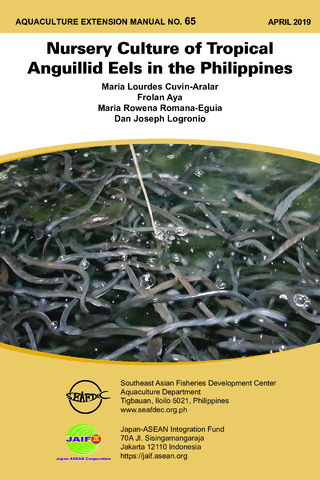
Nursery culture of tropical anguillid eels in the Philippines
; Aya, FrolanThis technical publication focused on nursery production of anguillid eels from glass eels to elver using data gathered from eel farm surveys and rearing trials conducted by SEAFDEC/AQD as part of the JAIF (Japan-ASEAN ... ; Romana-Eguia, Maria Rowena R. ; (Aquaculture Department, Southeast Asian Fisheries Development Center, 2019)
-
The sargeant fish and the eel
(Aquaculture Department, Southeast Asian Fisheries Development Center, 2000)The culture of sargeant fish, or cobia (Rachycentron canadum) and eel (Anguilla spp) in the Philippines is discussed. Market potentials for the cultured products are examined. -
Aquaculture in Malaysia
(Aquaculture Department, Southeast Asian Fisheries Development Center, 1995)Aquaculture in Malaysia is experiencing rapid growth. Total production in 1992 amounted to 79,699 tons valued at RM 207.4 million. These figures are 23% and 25% higher than the previous year's. Semi-culture of the cockle Anadara granosa was still predominant, contributing about 70% of the total output. Culture and production of the oyster Crassostrea iredalei is still insignificant. Sea bass Lates calcarifer constituted over 80% of the production from marine cages. Cage culture of grouper Epinephelus sp., snapper Lutjanus sp. and pompano Trachinotus blochii were also done in much smaller scale. The mangrove snapper Lutjanus argentimaculatus was recently spawned in captivity and larvae and juveniles were produced. In 1992, the tiger shrimp Penaeus monodon constituted about 87% of brackishwater pond production. Pond culture of the white shrimp P. merguiensis and the mudcrab Scylla sp. is at the experimental stage. Red tilapia hybrid was the major freshwater species cultured in cages, with 1,486 tons harvested in 1992. Freshwater pond production was valued at RM 100.85 million, 22% of which was due to the eel Anguilla japonica. Production of freshwater ornamental fishes is also becoming significant. Other exotic species recently bred and cultured are the African catfish Clarias gariepinus and the pacu Piaractus brachypomus. The indigenous freshwater catfish Mystus nemurus and carp Probarbus julleini have recently been bred in captivity and cultured experimentally. Lately, there have been attempts to culture non-conventional species such as the bullfrog Rana catesbeiana, the soft-shell turtle Trionyx sinensis, and aquatic ornamental plants.