Aquaculture development plan in Ivory Coast

Date
1978-11Page views
697ASFA keyword

AGROVOC keyword
Taxonomic term

Geographic names

Metadata
Show full item recordShare
Abstract
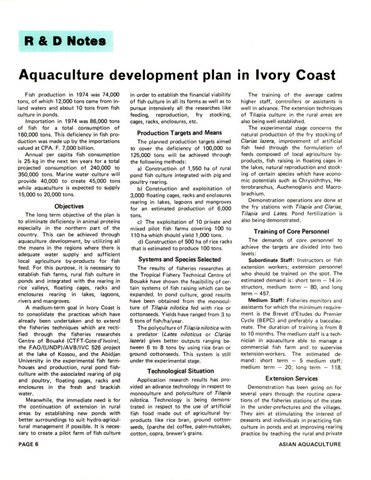
An aquaculture development plan has been formulated to eliminate, in the long term, protein deficiency especially in the northern part of the country. It is proposed to establish fish farms, rural fish culture in ponds, and integrated with the rearing in rice valleys, floating cages, racks, and enclosures rearing in lakes, lagoons, rivers, and mangroves. Tilapia nilotica, possibly combined with a predator (Lates niloticus or Clarias lazera), is the most promising species for culture. Brief details of the objectives and organization of the plan are presented in this article.
Description
The information source for the article is the report, "National Aquaculture Development Plan in Ivory Coast," which was translated from the original French text to English by Weena Sornchai of the Asian Institute of Aquaculture.
Suggested Citation
SEAFDEC/AQD (1978). Aquaculture development plan in Ivory Coast. Asian Aquaculture , 1(5), 6-7. http://hdl.handle.net/10862/6431
Type
magazineArticleISSN
0115-4974Collections
Related items
Showing items related by title, author, creator and subject.
-
Status of catfish culture
(Aquaculture Department, Southeast Asian Fisheries Development Center, 1993) -
Aquaculture in Malaysia
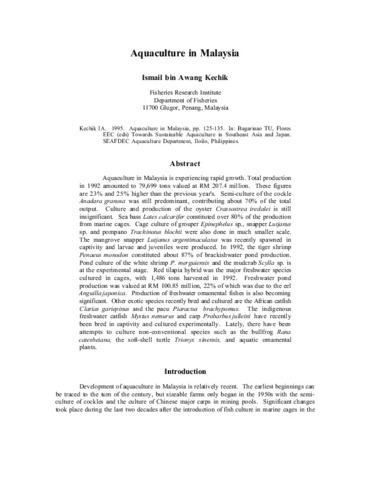
(Aquaculture Department, Southeast Asian Fisheries Development Center, 1995)Aquaculture in Malaysia is experiencing rapid growth. Total production in 1992 amounted to 79,699 tons valued at RM 207.4 million. These figures are 23% and 25% higher than the previous year's. Semi-culture of the cockle Anadara granosa was still predominant, contributing about 70% of the total output. Culture and production of the oyster Crassostrea iredalei is still insignificant. Sea bass Lates calcarifer constituted over 80% of the production from marine cages. Cage culture of grouper Epinephelus sp., snapper Lutjanus sp. and pompano Trachinotus blochii were also done in much smaller scale. The mangrove snapper Lutjanus argentimaculatus was recently spawned in captivity and larvae and juveniles were produced. In 1992, the tiger shrimp Penaeus monodon constituted about 87% of brackishwater pond production. Pond culture of the white shrimp P. merguiensis and the mudcrab Scylla sp. is at the experimental stage. Red tilapia hybrid was the major freshwater species cultured in cages, with 1,486 tons harvested in 1992. Freshwater pond production was valued at RM 100.85 million, 22% of which was due to the eel Anguilla japonica. Production of freshwater ornamental fishes is also becoming significant. Other exotic species recently bred and cultured are the African catfish Clarias gariepinus and the pacu Piaractus brachypomus. The indigenous freshwater catfish Mystus nemurus and carp Probarbus julleini have recently been bred in captivity and cultured experimentally. Lately, there have been attempts to culture non-conventional species such as the bullfrog Rana catesbeiana, the soft-shell turtle Trionyx sinensis, and aquatic ornamental plants. -
Aquaculture in the Philippines
(Aquaculture Department, Southeast Asian Fisheries Development Center, 1995)Aquaculture is regarded as the most promising source of protein food in the years ahead. Milkfish and Nile tilapia are the major fishes now produced but groupers, sea bass, rabbitfish, red snappers, carps, and catfishes are grown by some farmers. The tiger shrimp is still the most important cultured crustacean, but white shrimps and mudcrabs also have great potential. Oysters and mussels are produced in considerable amounts. Mariculture of the seaweed Eucheuma is now a well established industry, and the pond culture of Gracilaria for agar extraction is beginning to take off.