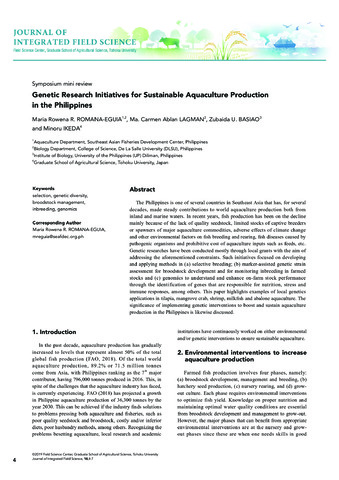
Genetic research initiatives for sustainable aquaculture production in the Philippines
Download URL
tohoku.repo.nii.ac.jpDate
2019-03
Page views
1,154
AGROVOC keyword
Geographic names

Metadata
Show full item recordShare
Abstract
The Philippines is one of several countries in Southeast Asia that has, for several decades, made steady contributions to world aquaculture production both from inland and marine waters. In recent years, fish production has been on the decline mainly because of the lack of quality seedstock, limited stocks of captive breeders or spawners of major aquaculture commodities, adverse effects of climate change and other environmental factors on fish breeding and rearing, fish diseases caused by pathogenic organisms and prohibitive cost of aquaculture inputs such as feeds, etc. Genetic researches have been conducted mostly through local grants with the aim of addressing the aforementioned constraints. Such initiatives focused on developing and applying methods in (a) selective breeding; (b) marker-assisted genetic strain assessment for broodstock development and for monitoring inbreeding in farmed stocks and (c) genomics to understand and enhance on-farm stock performance through the identification of genes that are responsible for nutrition, stress and immune responses, among others. This paper highlights examples of local genetics applications in tilapia, mangrove crab, shrimp, milkfish and abalone aquaculture. The significance of implementing genetic interventions to boost and sustain aquaculture production in the Philippines is likewise discussed.
Suggested Citation
Romana-Eguia, M. R. R., Ablan Lagman, M. C., Basiao, Z. U., & Ikeda, M. (2019). Genetic research initiatives for sustainable aquaculture production in the Philippines. Journal of Integrated Field Science , 16, 4-7. http://hdl.handle.net/10097/00125666
Type
ArticleCollections
- Journal Articles [1266]
Related items
Showing items related by title, author, creator and subject.
-
A farmer-oriented Nile tilapia, Oreochromis niloticus L., breed improvement in the Philippines
(Blackwell Publishing, 2005)Opportunities for developing small-scale tilapia industry in the Philippines is hampered by the shortage of good-quality seeds and broodstock. Most small-scale farmers are dependent on distribution centres for improved tilapia seeds that are expensive and not sufficient to meet market demands. An option would be for farmers to develop their own tilapia breeds using simple procedures within their technical and financial resources. This option will also help sustain the diversity of locally adapted domestic stocks of tilapia. The Philippine tilapia production of ~ 122 316 MT can be increased by ensuring a stable supply of quality seeds and transferring suitable technology to fish farmers. The study was carried out in a tilapia hatchery/nursery pond in the Philippines to explore the potential for a farmer-based research on tilapia breed improvement using relatively simple artificial selection procedures. One generation of size-specific mass selection based on the early culling of large fry (collimation procedure) was applied on a Nile tilapia strain, Oreochromis niloticus L., in net cages set in a small earthen pond. Two episodes of directional selection were performed after initial removal of large fry at 21 days. Selection of parents and progeny testing were conducted in hapa and B-net cages set in earthen ponds. The selection resulted in a significant response of 8% for standard length and 29% for weight relative to the control. The crude estimates of realized heritability is ~ 16% for standard length and ~26% for weight comparable with similar studies conducted by other workers. -
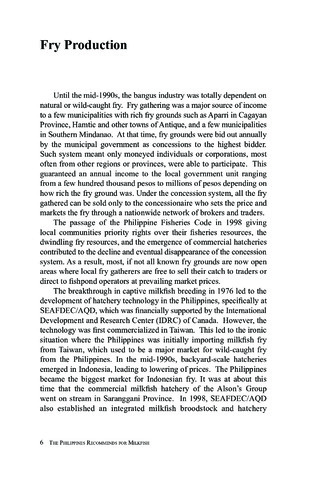
[The Philippines recommends for milkfish:] Fry production
(DOST-PCAARRD, 2016) -
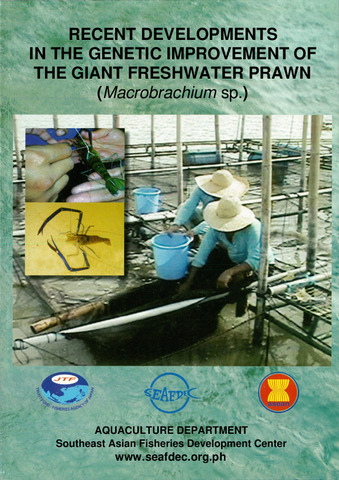
Recent developments in the genetic improvement of the giant freshwater prawn (Macrobrachium sp.)
(Aquaculture Department, Southeast Asian Fisheries Development Center, 2007)This publication contains results from the research project “Development of Genetically Improved Strain of Macrobrachium” covered by the Program on the Promotion of Sustainable Aquaculture in the ASEAN Region (previously known as Integrated Rural Aquaculture Program). It specifically includes activities from the inception of the project in 2002 up to 2005 under the Special Five-year Program on Sustainable Fisheries for Food Security in the ASEAN Region as well as research updates from 2006 to date. Project activities from 2006 to 2010 have been placed under the ASEAN-SEAFDEC Fisheries Consultative Group (FCG) collaborative mechanism with financial support from the Government of Japan Trust Fund. Dr. Koichi Okuzawa, AQD's Deputy Chief from 2005-2007, was project leader at the time the studies started until early 2007.