A special feed for maturing Penaeus indicus broodstock
View/

Downloads: 75
Downloads: 44
Downloads: 55
Downloads: 44
Downloads: 114
Date
2022-06-03Inventor
Santander-Avancena, Sheryll 
Traifalgar, Rex Ferdinand
Estante-Superio, Erish
Monteclaro, Harold
Quinitio, Gerald
Page views
786ASFA keyword

AGROVOC keyword
Taxonomic term

Metadata
Show full item recordShare
Abstract
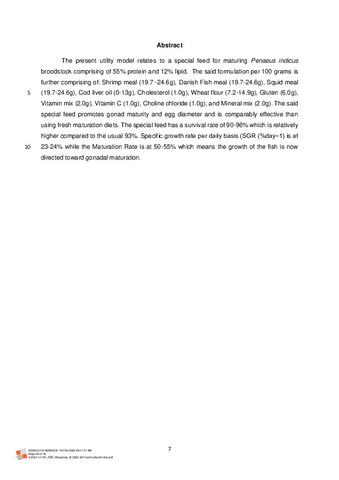
The present utility model relates to a special feed for maturing Penaeus indicus broodstock comprising of 55% protein and 12% lipid. The said formulation per 100 grams is further comprising of: Shrimp meal (19.7 -24.6g), Danish Fish meal (19.7-24.6g), Squid meal (19.7-24.6g), Cod liver oil (0-13g), Cholesterol (1.0g), Wheat flour (7.2-14.9g), Gluten (6.0g), Vitamin mix (2.0g), Vitamin C (1.0g), Choline chloride (1.0g), and Mineral mix (2.0g). The said special feed promotes gonad maturity and egg diameter and is comparably effective than using fresh maturation diets. The special feed has a survival rate of 90-96% which is relatively higher compared to the usual 93%. Specific growth rate per daily basis (SGR (%day-1) is at 23-24% while the Maturation Rate is at 50-55% which means the growth of the fish is now directed toward gonadal maturation.
Suggested Citation
Santander-Avanceña, S. S., Traifalgar, R. F., Superio, E. E., Laureta, L., Monteclaro, H., & Quinitio, G. (2022). A special feed for maturing Penaeus indicus broodstock (Intellectual Property Office of the Philippines Patent PH22021051497). https://wipopublish.ipophil.gov.ph/wopublish-search/public/detail/patents?id=PH22021051497
Type
PatentCollections
- Patents [5]
Related items
Showing items related by title, author, creator and subject.
-
Series: Aquaculture extension manual; No. 19
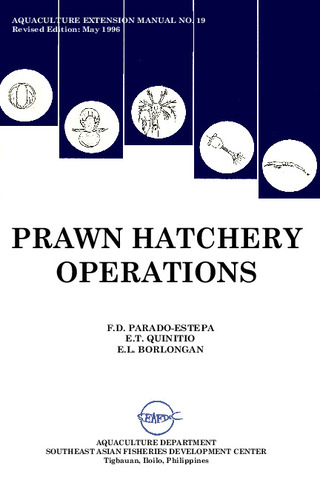
Prawn hatchery operations
; Quinitio, Emilia T.; (Aquaculture Department, Southeast Asian Fisheries Development Center, 1996-05)
The manual, an updated version of the 1984 SEAFDEC/AQD manual, presents the underlying principles and step-by-step instructions of prawn larval and post-larval rearing. The techniques described are not only applicable to Penaeus monodon, but may also be modified and applied to other penaeid and metapenaeid species. The following aspects are covered: Site selection; Life cycle; Hatchery design and planning; Hatchery operations; Diseases; and Economics. -
Series: Aquaculture extension manual; No. 19
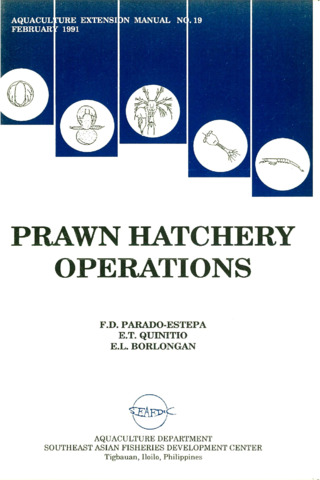
Prawn hatchery operations
; Quinitio, Emilia T.; (Aquaculture Department, Southeast Asian Fisheries Development Center, 1991-02)
The manual, an updated version of the 1984 SEAFDEC/AQD manual, presents the underlying principles and step-by-step instructions of prawn larval and post-larval rearing. The techniques described are not only applicable to Penaeus monodon, but may also be modified and applied to other penaeid and metapenaeid species. The following aspects are covered: Site selection; Life cycle; Hatchery design and planning; Hatchery operations; Diseases; and Economics. -
Evaluation of plant proteins as partial replacement for animal proteins in diets for Penaeus indicus and P. merguiensis juveniles
(Society of Israeli Aquaculture and Marine Biotechnology, 2002)The growth rate and survival of two white shrimps, Penaeus indicus and P. merguiensis, fed diets in which fishmeal was partially replaced with plant protein sources were investigated in three trials. In trial 1 with P. indicus, soybean, yeast and leaf meals of kangkong, papaya and Cassia tora L. were screened as partial substitutes for fishmeal. The total biomass of shrimp fed 20% yeast (20yeast) was highest but not significantly different than that of shrimp fed 10yeast and 10papaya. Survival was highest with 20yeast, 10papaya and 10yeast. Shrimp fed Cassia tora L. had the highest weight gain and SGR but their survival was similar to those fed poor performing diets. In trial 2 with P. merguiensis, the ingredients were modified by decreasing fishmeal and increasing the yeast and soybean substitution. The biomass of the shrimp fed 10 yeast was similar to that of the shrimp fed 20yeast and 26 soybean, the weight gain and SGR were similar to shrimp fed 20yeast while survival was highest but not different from 20yeast and 26 soybean. In trial 3 with P. indicus, weight gain and SGR were best with 20yeast and 34soybean. However, biomass and survival did not differ among replacement levels. The performance of the white shrimp varied with different levels of yeast and soybean meal incorporation. The response of P. indicus was best with 20yeast (15% by weight) or 34soybean meal (34% by weight) while that of P. merguiensis was with 10yeast (7% by weight), 20yeast (15% by weight) or 26soybean meal (26% by weight). Partial replacement of fishmeal with yeast or soybean meal would result in lower feed costs but the use of these feeds needs further refinement since survival was low in all treatments. Rearing techniques, such as increasing the feeding frequency, simulating deep pond conditions or using adequate substrates, should be refined.