
Patents
Browse by
Recent Submissions
-
A system of microalgal harvesting with reduced Pb in Chaetoceros calcitrans paste
(Intellectual Property Office of the Philippines, 2021-09-20)The invention relates to the protocol for harvesting of microalgae, Chaetoceros calcitrans by manipulation of electrolytic flocculator settings. The harvesting system comprised of a holding tank for the microalgae, a DC power supply with variable voltage selector, ammeter and voltmeter. The best settings of 6/6 units Al/Pb probes with voltage selector set at point 1 to supply 3 volts to complete the electrolytic cell. The Pb in the paste was reduced by 97% with values of 34.27 ± 0.39 ppm with 0 - 0.24 ppm Pb in the effluent discharge. The Pb content in secondary live food, Artemia salina was further reduced by 78% based on feeding trials with 7.8 ± 5.1 ppm Pb content. This system will be beneficial to hatcheries for use onsite due to its simplicity and affordability. -
A method of culturing/ growing high-quality edible oysters (Crassostrea spp. and Magallana bilineata)
(Intellectual Property Office of the Philippines, 2024-11-18)This utility model discloses a process of culturing/ growing high-quality edible oysters (Crassostrea spp. and Magallana bilineata) comprising the steps: selecting grow-out culture sites, deploying substrates for competent larvae of oysters to settle and grow, making oyster pouches while waiting for the availability of oyster spat, harvesting and stocking the oyster spat in the said pouches, hanging the pouches from rafts, and harvesting the oysters when they attain at least 80 grams of body weight. Traditional processes of producing edible oysters allow them to grow on top of each other, producing clumped oysters of varying sizes. This utility model produces larger, individual oysters of almost uniform sizes with harvest size attainable at a shorter period compared to those oysters cultured using traditional methods. -
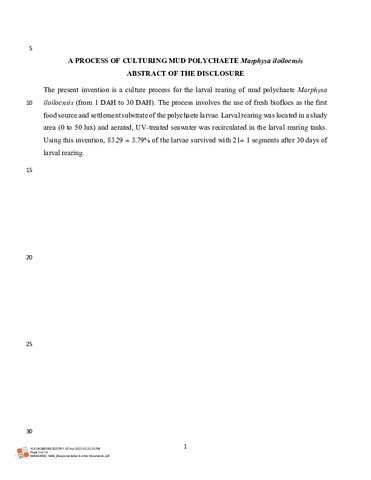
A process of culturing mud polychaete Marphysa iloiloensis
(Intellectual Property Office of the Philippines, 2021-09-20)The present invention is a culture process for the larval rearing of mud polychaete Marphysa iloiloensis (from 1 DAH to 30 DAH). The process involves the use of fresh bioflocs as the first food source and settlement substrate of the polychaete larvae. Larval rearing was located in a shady area (0 to 50 lux) and aerated, UV-treated seawater was recirculated in the larval rearing tanks. Using this invention, 83.29 ± 3.79% of the larvae survived with 21± 1 segments after 30 days of larval rearing. -
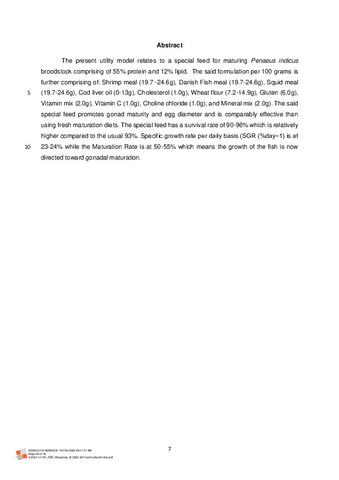
A special feed for maturing Penaeus indicus broodstock
(Intellectual Property Office of the Philippines, 2022-06-03)The present utility model relates to a special feed for maturing Penaeus indicus broodstock comprising of 55% protein and 12% lipid. The said formulation per 100 grams is further comprising of: Shrimp meal (19.7 -24.6g), Danish Fish meal (19.7-24.6g), Squid meal (19.7-24.6g), Cod liver oil (0-13g), Cholesterol (1.0g), Wheat flour (7.2-14.9g), Gluten (6.0g), Vitamin mix (2.0g), Vitamin C (1.0g), Choline chloride (1.0g), and Mineral mix (2.0g). The said special feed promotes gonad maturity and egg diameter and is comparably effective than using fresh maturation diets. The special feed has a survival rate of 90-96% which is relatively higher compared to the usual 93%. Specific growth rate per daily basis (SGR (%day-1) is at 23-24% while the Maturation Rate is at 50-55% which means the growth of the fish is now directed toward gonadal maturation. -
Hatchery protocol for silver therapon (Leiopotherapon plumbeus, Kner 1864)
(Intellectual Property Office of the Philippines, 2016-09-05)The hatchery protocol for silver therapon (Leiopotherapon plumbeus, Kner 1864) in outdoor tanks is disclosed. The process includes timed provision of preferred natural food commensurate with the age of larvae, pre-conditioning of rearing water, utilizing ambient lake water and the addition of fresh tropical almond leaves Terminalia catappa to enhance natural food supply in tanks. A stocking density of 0.1 to 1 larvae /L was used to enhance survival and growth. Survival of larvae increased to 35.41 ± 15.32 per cent using the invention.


 RSS 1.0