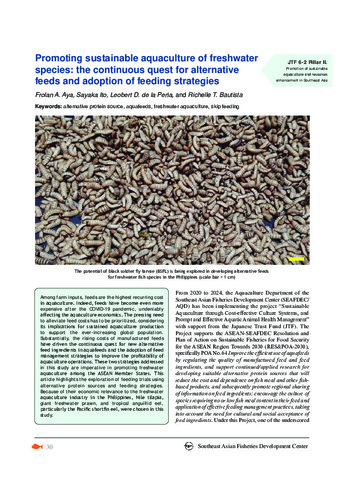
Promoting sustainable aquaculture of freshwater species: The continuous quest for alternative feeds and adoption of feeding strategies


Share
Abstract
Among farm inputs, feeds are the highest recurring cost in aquaculture. Indeed, feeds have become even more expensive after the COVID-19 pandemic, undeniably affecting the aquaculture economics. The pressing need to alleviate feed costs has to be prioritized, considering its implications for sustained aquaculture production to support the ever-increasing global population. Substantially, the rising costs of manufactured feeds have driven the continuous quest for new alternative feed ingredients in aquafeeds and the adoption of feed management strategies to improve the profitability of aquaculture operations. These two strategies addressed in this study are imperative in promoting freshwater aquaculture among the ASEAN Member States. This article highlights the exploration of feeding trials using alternative protein sources and feeding strategies. Because of their economic relevance to the freshwater aquaculture industry in the Philippines, Nile tilapia, giant freshwater prawn, and tropical anguillid eel, particularly the Pacific shortfin eel, were chosen in this study.
Suggested Citation
Aya, F., Ito, S., de la Peńa, L. D., & Bautista, R. T. (2024). Promoting sustainable aquaculture of freshwater species: The continuous quest for alternative feeds and adoption of feeding strategies. Fish for the People , 22(2), 30-34. http://hdl.handle.net/20.500.12066/7520
Type
magazineArticleCollections
- Fish for the People [41]
Related items
Showing items related by title, author, creator and subject.
-
Aquaculture development in Thailand
(Aquaculture Department, Southeast Asian Fisheries Development Center, 1988)Aquaculture practised in Thailand is in the form of pond culture and cage culture in freshwater, brackishwater and coastal areas. The main species cultured include freshwater prawns, brackishwater shrimp, cockles, mussels, and various freshwater and marine finfishes. There is good potential for increased production from freshwater, brackishwater and marine aquaculture. However, the 1983 production of 145 000 mt represents only about 6% of Thailand's total fish production and production in this subsector has fluctuated widely. It will be several years before aquaculture production will contribute substantially to total production. Nonetheless, the culture of high value species of shrimp and fish could contribute significantly to export earnings during the next 5 to 10 years. Conducted primarily by government agencies, research and development are along the lines of increasing seed supply, establishing new culture techniques or improving older ones. The Department of Fisheries (DOF) together with some private companies have ventured into the development and testing of artificial diets for the various cultured species using a variety of indigenous feed stuffs. It is estimated that with adequate investments and appropriate support, aquaculture production will increase from 145 000 mt in 1983 to 378 000 mt in 1991, showing an annual increase of about 13% over this period. Major increases would come from bivalve mariculture (131 000 mt), brackishwater ponds (36 000 mt) freshwater ponds (46 000 mt) and brackishwater cage culture (20 000 mt). -
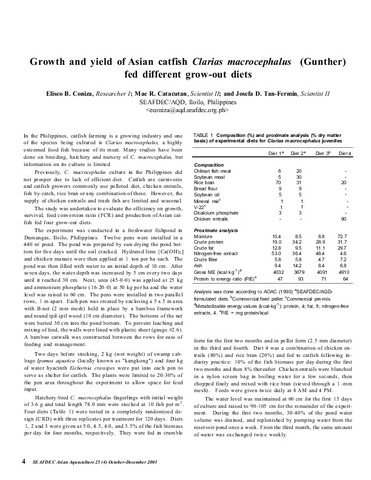
Growth and yield of Asian catfish Clarias macrocephalus (Gunther) fed different grow-out diets
(Aquaculture Department, Southeast Asian Fisheries Development Center, 2003) -
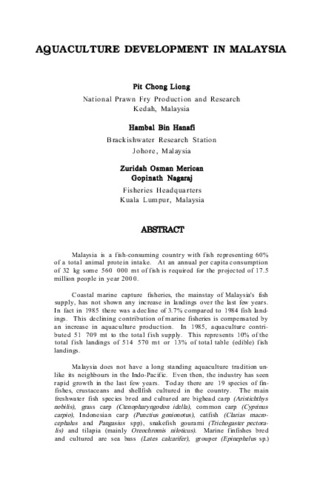
Aquaculture development in Malaysia
(Aquaculture Department, Southeast Asian Fisheries Development Center, 1988)Malaysia is a fish-consuming country with fish representing 60% of a total animal protein intake. At an annual per capita consumption of 32 kg some 560 000 mt of fish is required for the projected of 17.5 million people in year 2000. Coastal marine capture fisheries, the mainstay of Malaysia's fishsupply, has not shown any increase in landings over the last few years. In fact in 1985 there was a decline of 3.7% compared to 1984 fish landings. This declining contribution of marine fisheries is compensated by an increase in aquaculture production. In 1985, aquaculture contributed 51 709 mt to the total fish supply. This represents 10% of the total fish landings of 514 570 mt or 13% of total table (edible) fish landings. Malaysia does not have a long standing aquaculture tradition unlike its neighbours in the Indo-Pacific. Even then, the industry has seen rapid growth in the last few years. Today there are 19 species of finfishes, crustaceans and shellfish cultured in the country. The main freshwater fish species bred and cultured are bighead carp (Aristichthys nobilis), grass carp (Ctenopharyngodon idella), common carp (Cyprinus carpio), Indonesian carp (Punctius gonionotus), catfish (Clarias macrocephalus and Pangasius spp), snakefish gourami (Trichogaster pectoralis) and tilapia (mainly Oreochromis niloticus). Marine finfishes bred and cultured are sea bass (Lates calcarifer), grouper (Epinephelus sp.) and snapper (Lutjanus johni). Penaeus monodon is the dominant marine prawn species bred and cultured but culture of P. merguiensis is receiving considerable interest. Macrobrachium rosenbergii is the only freshwater prawn cultured commercially. Molluscs cultured are the blood clam (Anadara granosa) and the green mussel (Perna viridis). In 1985, blood clam and mussel culture accounted for 87% of all aquaculture production of Malaysia, freshwater fish 12%, floating cage culture of marine fish 0.7% and brackishwater pond culture 0.3%. In terms of value blood clam and mussels represented 30% (M$15M) of total value (M$49.5M), freshwater fish 57% (M$28M),cage culture of marine fin fishes 7% (M$3.4M),and brackishwater pond production 6% (M$2.1M). Aquaculture in Malaysia has considerable growth potential. It is projected that 22 000 ha of mangrove will be opened by the year 2000 for shrimp culture. Some 330 000 m2 of protected coastal waters have been identified for cage culture. Some 6500 rafts can considerably expand the present capacity. In freshwater culture about 8000 ha of land and 17 500 ha of mining pools can be developed while 200 000 ha of artificial lakes and impoundments for freshwater fish cage culture are available. Yet such development is not without constraints. Freshwater finfish culture is hampered by lack of good quality broodstock. There is also a limited market for freshwater finfishes. Marine finfish culture is limited by lack of fingerlings and good quality compounded diet to replace trash fish which is deteriorating in quality and quantity. Marine prawn culture is heavily dependent on wild spawners, the supply unpredictable and inadequate. Acid sulfate soil continues to cause the deterioration of brackishwater ponds. Cockles and mussels can be sold to export markets only if they meet specific quality standards.