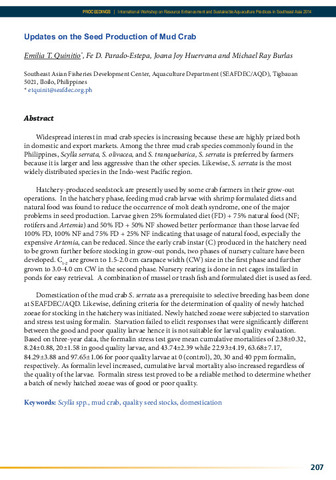
Nursery culture of mangrove crab megalopae (Scylla serrata) in pond-based net cages
| dc.contributor.author | Caballero, Pedrita | |
| dc.contributor.author | Licera, Rhiannen Marie C. | |
| dc.contributor.author | Regatalio, Kyle Dymer | |
| dc.contributor.author | Dayrit, Rheniel | |
| dc.contributor.author | Mamauag, Roger Edward | |
| dc.date.accessioned | 2025-06-24T03:18:47Z | |
| dc.date.available | 2025-06-24T03:18:47Z | |
| dc.date.issued | 2025-07 | |
| dc.identifier.isbn | 978-971-9931-16-4 (Print) | |
| dc.identifier.isbn | 978-971-9931-17-1 (PDF) | |
| dc.identifier.issn | 0115-5369 | |
| dc.identifier.uri | http://hdl.handle.net/10862/6607 | |
| dc.description.abstract | This manual, titled “Nursery Culture of Mangrove Crab Megalopae (Scylla serrata) in Pond-Based Net Cages,” is part of SEAFDEC/AQD’s effort to assess the potential of using megalopae as the starting stock in pond-based net cage nurseries. The method is intended to enhance survival rates during the grow-out stage. Given the increasing availability of hatchery-reared megalopae and the high cost of crab instars, the manual also evaluates the cost-effectiveness and practical advantages of using megalopae in nursery operations. Hatchery-sourced megalopae offer key benefits over wild-caught ones, including consistent supply, environmental sustainability, disease-free status, species certainty, and stable pricing. This approach could help increase hatchery production cycles and lower overall production expenses in the crab farming industry. The manual covers various aspects, including mangrove crab biology, site selection, pond preparation, nursery management, packing and transport procedures, and economic analysis. The authors hope this resource will serve as a practical guide for crab farmers, farm managers, aquaculture professionals, technicians, and students by providing essential knowledge on science-based aquaculture practices. | en |
| dc.description.sponsorship | The authors would like to express their sincere appreciation to the following: (1) Southeast Asian Fisheries Development Center Aquaculture Department (SEAFDEC/AQD) for funding our study with reference code: DP-03-C2024D/5309-T-TV-C0324D; (2) the mangrove crab hatchery team, previously led by Dr. Sheryll Avanceña, for providing the megalopae used in this study; (3) the staff of SEAFDEC/AQD’s Dumangas Brackishwater Station—Ms. Roselie Cabatia, Mr. Ralen Depamaylo, Mr. Nestor Ardales, Mr. Felix Javero, Mr. Efren Gonzales, Mr. Federico Sotela and Mr. Roderix Escosa—for their valuable support during the sampling, sorting, and harvesting of crablets; (4) the AQD publication review committee for their thoughtful review of the manuscript; and (5) the Development Communication team, under the leadership of Mr. Rex Delsar Dianala, for the timely editing and layout of this manual. | en |
| dc.format.extent | 34 pages : color illustrations. | en |
| dc.language.iso | en | en |
| dc.publisher | Aquaculture Department, Southeast Asian Fisheries Development Center | en |
| dc.relation.ispartofseries | Aquaculture extension manual; No. 77 | en |
| dc.rights | Attribution-NonCommercial-ShareAlike 3.0 IGO | * |
| dc.rights.uri | http://creativecommons.org/licenses/by-nc-sa/3.0/igo/ | * |
| dc.subject.lcsh | Nursery stock--Management | en |
| dc.title | Nursery culture of mangrove crab megalopae (Scylla serrata) in pond-based net cages | en |
| dc.subject.asfa | crab culture | en |
| dc.subject.asfa | nursery ponds | en |
| dc.subject.asfa | site selection | en |
| dc.subject.asfa | life cycle | en |
| dc.subject.asfa | habitats | en |
| dc.subject.asfa | feeding habits | en |
| dc.subject.asfa | pond construction | en |
| dc.subject.asfa | nursery ponds | en |
| dc.subject.asfa | economic analysis | en |
| dc.subject.asfa | aquaculture | en |
| dc.subject.asfa | aquaculture economics | en |
| dc.subject.asfa | aquaculture development | en |
| dc.subject.asfa | cage culture | en |
| dc.subject.scientificName | Scylla serrata | en |
| dc.subject.scientificName | Scylla tranquebarica | en |
| dc.subject.scientificName | Scylla olivacea | en |
| dc.subject.scientificName | Scylla paramamosain | en |
| dc.subject.sdg | SDG 14 - Life below water | en |
Files in this item
- ชื่อ:
- CaballeroPA2025-AEM77.pdf
- ขนาด:
- 8.067Mb
- รูป:
- ลักษณะ:
- AEM No. 77
- Downloads:
- NaN
- Access Status:
-

รายการนี้ปรากฏใน (s)

Except where otherwise noted, this item's license is described as Attribution-NonCommercial-ShareAlike 3.0 IGO
Related items
Showing items related by title, author, creator and subject.
-
Development of protocol for the production of hatchery-reared mud crab Scylla serrata juveniles for soft-shell crab farming
Quinitio, Emilia T. ; ; (Aquaculture Department, Southeast Asian Fisheries Development Center, 2017)
Development of economically viable techniques for growing hatchery-reared juvenile crabs to suitable sizes will address the problem on the source of seed stocks for soft-shell crab farming. This paper reports the production ...
; ; (Aquaculture Department, Southeast Asian Fisheries Development Center, 2017)
Development of economically viable techniques for growing hatchery-reared juvenile crabs to suitable sizes will address the problem on the source of seed stocks for soft-shell crab farming. This paper reports the production ... -
Updates on the seed production of mud crab
Quinitio, Emilia T.; ; ; (Aquaculture Department, Southeast Asian Fisheries Development Center, 2015)
Widespread interest in mud crab species is increasing because these are highly prized both in domestic and export markets. Among the three mud crab species commonly found in the Philippines, Scylla serrata, S. olivacea, ... -
Series: Aquaculture extension manual; No. 34
Biology and hatchery of mangrove crabs Scylla spp.
Quinitio, Emilia T.; ; (Aquaculture Department, Southeast Asian Fisheries Development Center, 2018)
This manual includes the biology of crab (Scylla serrata, S. tranquebarica, and S. olivacea), and describes principles and procedures for spawning the mature crabs and rearing the zoea to ‘fly’ size crabs. It focuses on ...