Catfish culture


Date
2025-11Page views
247ASFA keyword

AGROVOC keyword
Taxonomic term

Metadata
Perlihat publikasi penuhShare
Contributes to SDGs

Description
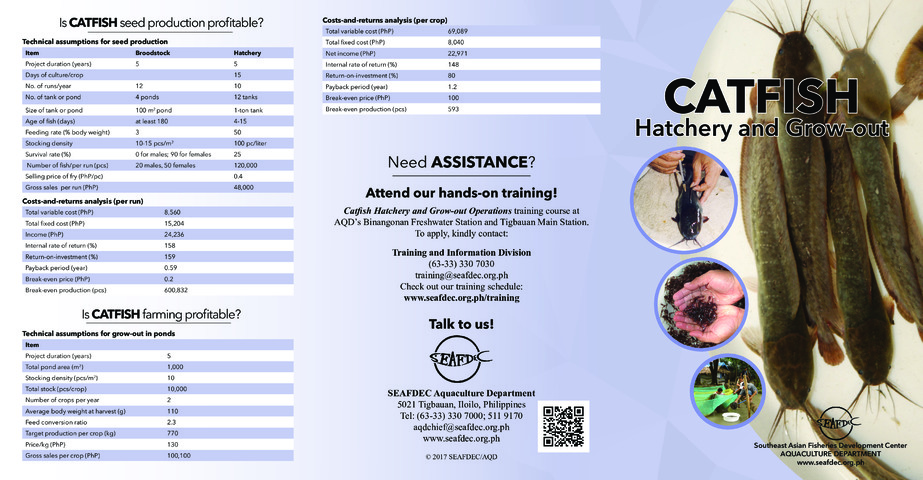
This brochure introduces the essential practices in catfish hatchery, nursery, and grow-out culture, focusing on the African catfish Clarias gariepinus, a hardy and fast-growing species suited for small-scale and commercial aquaculture. It summarizes key steps in broodstock preparation, hormone-induced breeding, egg fertilization, larval rearing, pond management, feeding, and stocking techniques. The guide also outlines proper grow-out procedures and harvest considerations, and includes a brief financial analysis showing that catfish culture can be profitable even at backyard scale.
Suggested Citation
SEAFDEC Aquaculture Department. (2025). Catfish culture [Brochure]. Tigbauan, Iloilo, Philippines: Author.
Type
BrochureKoleksi
- Brochures and flyers [57]
The following license files are associated with this item:

Except where otherwise noted, this item's license is described as Attribution-NonCommercial-ShareAlike 3.0 IGO
Related items
Showing items related by title, author, creator and subject.
-
Catfish hatchery and grow-out
(Aquaculture Department, Southeast Asian Fisheries Development Center, 2017) -
SEAFDEC/AQD's catfish hatchery specialist at work
(Aquaculture Department, Southeast Asian Fisheries Development Center, 2000) -
Aeromonas hydrophila in the epizootic ulcerative syndrome (EUS) of snakehead, Ophicephalus striatus, and catfish, Clarias batrachus: quantitative estimation in natural infection and experimental induction of dermo-muscular necrotic lesion
; ; Tendencia, Eleonor (1992)
Snakehead (Ophicephalus striatus) and catfish (Clarias batraclus) with the Epizootic Ulcerative Syndrome (EUS) were sampled for bacteria. Total bacterial counts of skin and muscle/dermal lesions revealed mean colony forming units (CFU) per gram tissue of 1.22 x 10³, 1.40 x 10⁵, 5.31 x 195 and 1.14 x 10⁷ in apparently normal, slightly lesioned, moderately lesioned and severely lesioned snakehead samples, respectively. In catfish, mean CFU per gram tissue were 4.30 x 10⁴ and 2.00 x 10⁵ in apparently normal and slightly lesioned specimens, respectively. Kidney samples likewise revealed the presence of bacteria. Bacteria isolated on trypticase soy agar and Rimler-Shotts medium were predominantly Aeromonas hydrophila occurring in 90% of snakeheads and in 33% of catfish specimens. Infection experiments of A. hydrophila injected intramuscularly into healthy snakehead and catfish induced dermo-muscular necrotic lesions. A dose of at least 106 cells of A. hydrophila was required to induce EUS-like lesions in snakehead and catfish at 21-25 degree C in 24-96 h.
(1992)
Snakehead (Ophicephalus striatus) and catfish (Clarias batraclus) with the Epizootic Ulcerative Syndrome (EUS) were sampled for bacteria. Total bacterial counts of skin and muscle/dermal lesions revealed mean colony forming units (CFU) per gram tissue of 1.22 x 10³, 1.40 x 10⁵, 5.31 x 195 and 1.14 x 10⁷ in apparently normal, slightly lesioned, moderately lesioned and severely lesioned snakehead samples, respectively. In catfish, mean CFU per gram tissue were 4.30 x 10⁴ and 2.00 x 10⁵ in apparently normal and slightly lesioned specimens, respectively. Kidney samples likewise revealed the presence of bacteria. Bacteria isolated on trypticase soy agar and Rimler-Shotts medium were predominantly Aeromonas hydrophila occurring in 90% of snakeheads and in 33% of catfish specimens. Infection experiments of A. hydrophila injected intramuscularly into healthy snakehead and catfish induced dermo-muscular necrotic lesions. A dose of at least 106 cells of A. hydrophila was required to induce EUS-like lesions in snakehead and catfish at 21-25 degree C in 24-96 h.