Aqua Farm News: Recent submissions
221-240 / 286
-
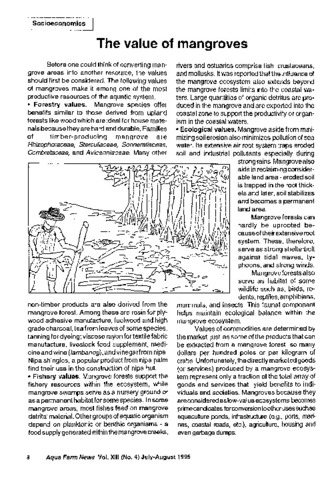
The value of mangroves
(Aquaculture Department, Southeast Asian Fisheries Development Center, 1995)The article presents the forestry, fishery and ecological values of mangroves. Studies on the measurement of the economic value of mangroves that were conducted in Thailand, Indonesia and Ecuador are also presented. -
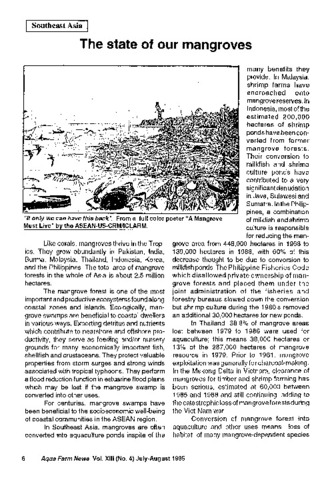
The state of our mangroves
(Aquaculture Department, Southeast Asian Fisheries Development Center, 1995)The article presents the current state of mangroves in Southeast Asia. In several countries lost mangrove areas were due to the conversion of mangrove forest into aquaculture and other uses. The ecological and socioeconomic effects of mangrove destruction are also presented. -
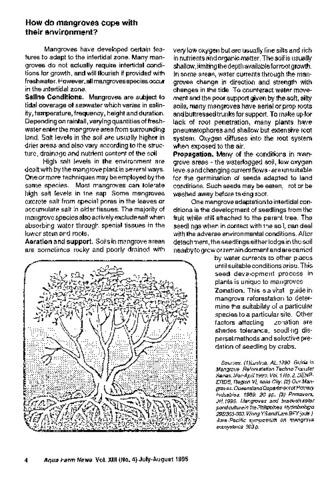
How do mangroves cope with their environment?
(Aquaculture Department, Southeast Asian Fisheries Development Center, 1995) -
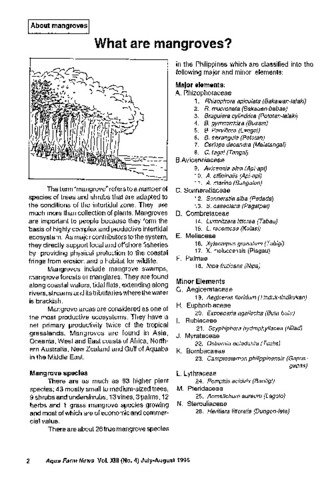
What are mangroves?
(Aquaculture Department, Southeast Asian Fisheries Development Center, 1995)The article presents about mangroves and its value to the ecosystem. The different species in the Philippines and mangroves coping mechanisms to the environment are also presented. -
Culture systems categorized: The fundamentals
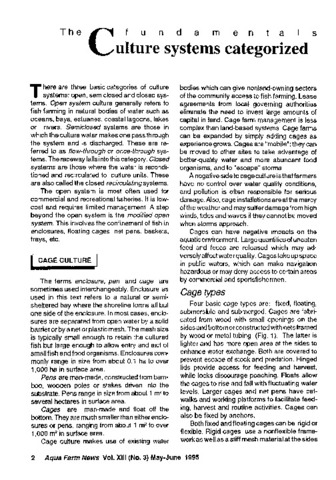
(Aquaculture Department, Southeast Asian Fisheries Development Center, 1995)The article presents the three basic categories of culture systems: open, semiclosed and closed systems. Open system culture generally refers to fish farming in natural bodies of water such as oceans, bays, estuaries, coastal lagoons, lakes or rivers. Semiclosed systems are those in which the culture water makes one pass through the system and is discharged. These are referred to as flow-through or once-through systems. The raceway falls into this category. Closed systems are those where the water is recondtioned and recirculated to culture units. These are also called the closed recirculating systems. -
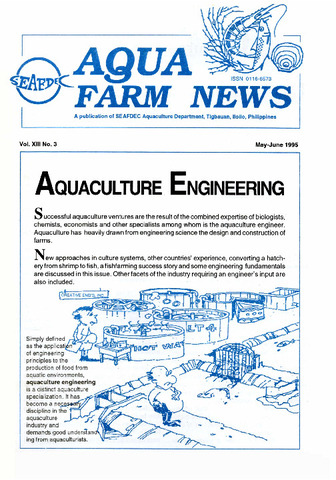
Aqua Farm News Volume 13(03) May - June 1995
(Aquaculture Department, Southeast Asian Fisheries Development Center, 1995) -
Aqua Farm News Volume 13(02) March - April 1995
(Aquaculture Department, Southeast Asian Fisheries Development Center, 1995) -
Guidelines for the development of environmentally acceptable coastal aquaculture
(Aquaculture Department, Southeast Asian Fisheries Development Center, 1995)The paper presents some recommendations for the development of the environmentally acceptable coastal aquaculture such as: 1) Formulate coastal aquaculture development and management plans, 2) Formulate integrated coastal zone management plans, 3) Apply the environmental impact assessment(EIA) process to all major aquaculture proposals, 4) Select suitable sites for coastal aquaculture, 5) Improve the management of aquaculture operations, 6) Assess the capacity of the ecosystem to sustain aquaculture development with minimal ecological change, 7) Establish guidelines governing the use of mangrove wetland for coastal aquaculture, 8) Establish guidelines for the use of bioactive compounds in aquaculture, 9) Assess and evaluate the true consequences of transfers and introductions of exotic organisms, 10) Regulate discharges from land-based aquaculture through the enforcement of effluent standards, 11) Establish control measures for aquaculture products, 12) Increase public awareness of the safety aspects of consuming seafood, 13) Apply incentives and deterrents to reduce environmental degradation from aquaculture activities, and 14). Monitor for ecological change. -
Recommendation on the effects of aquaculture on public health
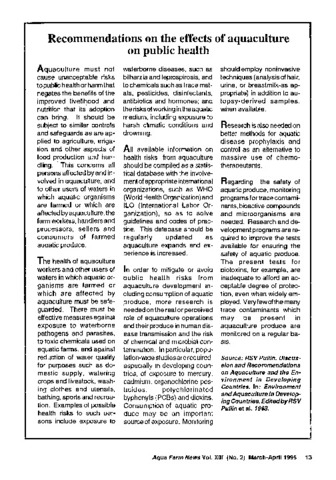
(Aquaculture Department, Southeast Asian Fisheries Development Center, 1995)The paper presents some recommendations on the effects of aquaculture on all persons affected by and involved in aquaculture, and to other users of waters in aquatic organisms are farmed or which are affected by aquaculture: the farm workers, handlers and processors, sellers and consumers of aquaculture products. -
Go for environment friendly aquaculture
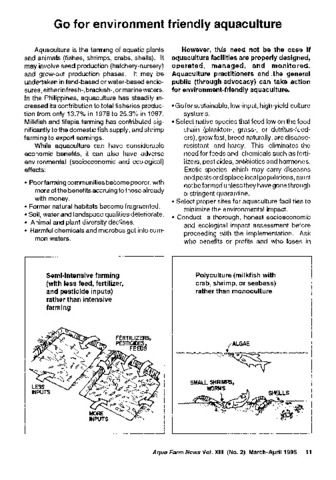
(Aquaculture Department, Southeast Asian Fisheries Development Center, 1995)The article presents environment friendly aquaculture practices such as semi-intensive aquaculture, the culture of native species, the selection of proper sites for aquaculture facilities, the conduct of thorough, honest socioeconomic and ecological impact assessment before proceeding with the implementation, and the practice and promotion of proper pond/cage/tank preparation and management among others. -
Managing environmental impacts in aquaculture
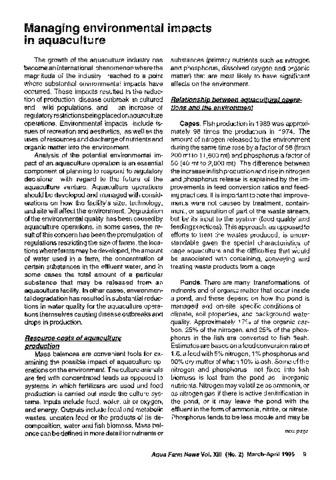
(Aquaculture Department, Southeast Asian Fisheries Development Center, 1995)The article presents the environmental impacts of aquaculture and the ways to manage them. The environmental impacts include issues of recreation and aesthetics, and the usage of resources and discharge of nutrients and organic matter into the environment. Likewise, the results are also discussed, such as reduced production, disease outbreak in cultured and wild populations, and an increase of regulatory restrictions being placed on aquaculture operations. -
Adopt sustainable development principle in aquaculture
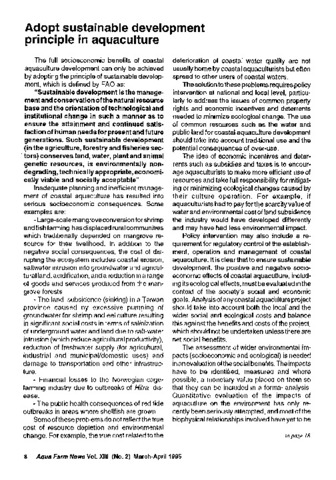
(Aquaculture Department, Southeast Asian Fisheries Development Center, 1995)The inadequate planning and inefficient management of coastal aquaculture has resulted into serious socioeconomic consequences. These are the displacement of rural communities which traditionally depended on mangroves due to large-scale mangrove conversion for shrimp and fish farming, land subsidence caused by excessive pumping of groundwater for use in aquaculture, financial losses due to disease outbreaks, and public health consequences due to red tide. In order to maximize the socioeconomic benefits of coastal aquaculture the adoption of the principles of sustainable development id recommended. Sustainable development is the management and conservation of natural resource base and the orientation of technological and institutional change in such a manner to ensure the attainment and continued satisfaction of human needs for present and future generations. -
Socioeconomic effects of intensive cage culture
(Aquaculture Department, Southeast Asian Fisheries Development Center, 1995)The paper discusses the socioeconomic effects of intensive aquaculture which is in conflict with other forms of coastal development such as, industrial development, natural fisheries, tourism and recreation, and nature conservation. -
Ecological impacts of coastal aquaculture developments
(Aquaculture Department, Southeast Asian Fisheries Development Center, 1995)The study presents the type and scale of any ecological change associated with coastal aquaculture development. These are enrichment, interaction with the food web, oxygen consumption, disturbance of wildlife and habitat destruction, interaction between escaped farmed stock and wild species, introduction and transfers, bioactive compounds (including pesticides and antibiotics), chemicals introduced via construction materials, and hormones and growth promoters. -
Aqua Farm News Volume 13(01) January - February 1995
(Aquaculture Department, Southeast Asian Fisheries Development Center, 1995) -
Fish leather, anyone?
(Aquaculture Department, Southeast Asian Fisheries Development Center, 1995)The article presents two common sources of fish leather, these are shark and barramundi. The processing and market acceptance of the products are also discussed. -
Fishy snack items
(Aquaculture Department, Southeast Asian Fisheries Development Center, 1995) -
New food processing equipment
(Aquaculture Department, Southeast Asian Fisheries Development Center, 1995)The article presents new food processing equipment for coating and frying. These are predusters, liquid enrobers and applicators for large-particle crumbs. -
Value-adding through coatings
(Aquaculture Department, Southeast Asian Fisheries Development Center, 1995)The paper presents the three categories of food coatings that are used, individually or in combination, to produce battered or breaded foods. These are predust, batters and breadcrumbs. Predusts are usually a blend of flours, starches and other functional ingredients such as proteins, vegetable gums and seasonings or flavors; batters are blends of flours, starches, leavening agents and seasonings which, when mixed with water, forms a vicous liquid used to evenly coat a food item, while breadcrumbs are baked or otherwise thermally processed cereal-based ingredients which are applied to a moistened food item prior to cooking. -
Value-added shrimp product is tops: Market potential
(Aquaculture Department, Southeast Asian Fisheries Development Center, 1995)The article discusses the potential for export of value-added shrimp products from developing countries. European Economic Community is considered to be one of the top consumers, while Thailand and India are two of the top producers.