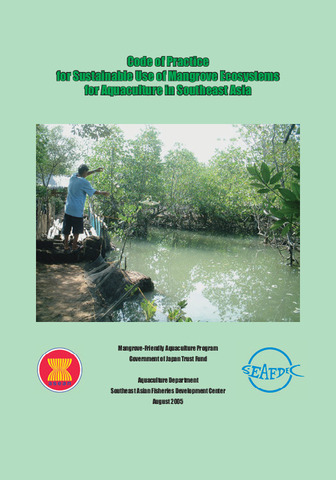
Code of practice for sustainable use of mangrove ecosystems for aquaculture in Southeast Asia


Share
Description
This 47-page guidebook presents the 22 concepts, principles or policy statements that prescribe the preferred ways of doing and acting to ensure the sustainable use of mangroves for fish farming. It is annotated with definitions, explanations and many examples. Published jointly by ASEAN and SEAFDEC, this guidebook is a result of a Southeast Asian-wide consultation with core experts and country representatives in 2004 to 2005.
Suggested Citation
Bagarinao, T. U., & Primavera, J. H. (2005). Code of practice for sustainable use of mangrove ecosystems for aquaculture in Southeast Asia. Tigbauan, Iloilo, Philippines: SEAFDEC Aquaculture Department.
Type
BookISBN
9718511768Collections
- Code of Practice [1]
Related items
Showing items related by title, author, creator and subject.
-
Wise-use technologies in mangrove-friendly aquaculture: Vietnam experience
(Aquaculture Department, Southeast Asian Fisheries Development Center, 2000)This report refers to the status of aquaculture technologies in coastal areas in general. Some mangrove-friendly aquaculture systems in Vietnam are also discussed including several measures to develop aquaculture in mangroves suitably and sustainably. -
Mangrove-friendly aquaculture studies at the SEAFDEC Aquaculture Department
; Primavera, Jurgenne (Aquaculture Department, Southeast Asian Fisheries Development Center, 2001)
The SEAFDEC Aquaculture Department studies on mangrove-friendly aquaculture (MFA) can be categorized under two models: a) mangrove filters where mangrove forests are used to absorb effluents from high-density culture ponds, and b) aquasilviculture or the low-density culture of crabs, shrimp and fish integrated with mangroves. In a study using the first model, shrimp pond effluents were retained in an enclosed mangrove area prior to release to receiving waters. Nutrients and other water quality parameters, and bacterial levels were monitored in the untreated effluents and post-mangrove water. In the second MFA model, mangrove pens and ponds installed in old growth and newly regenerating mangrove sites in Aklan, central Philippines were stocked with mud crab Scylla olivacea/S. tranquebarica and shrimp Penaeus monodon. Investment costs, survival and production, and cost-return analysis for the pens and ponds are reported in the paper. Aside from the aquasilviculture trials in collaboration with local government units, other activities in the Aklan mangrove sites are the survey and mapping of the 75-ha area in Ibajay, construction of a treehouse, and the educational use as field site by Coastal Resource Management trainees of SEAFDEC Aquaculture Department and field biology students of the University of the Philippines in the Visayas.
(Aquaculture Department, Southeast Asian Fisheries Development Center, 2001)
The SEAFDEC Aquaculture Department studies on mangrove-friendly aquaculture (MFA) can be categorized under two models: a) mangrove filters where mangrove forests are used to absorb effluents from high-density culture ponds, and b) aquasilviculture or the low-density culture of crabs, shrimp and fish integrated with mangroves. In a study using the first model, shrimp pond effluents were retained in an enclosed mangrove area prior to release to receiving waters. Nutrients and other water quality parameters, and bacterial levels were monitored in the untreated effluents and post-mangrove water. In the second MFA model, mangrove pens and ponds installed in old growth and newly regenerating mangrove sites in Aklan, central Philippines were stocked with mud crab Scylla olivacea/S. tranquebarica and shrimp Penaeus monodon. Investment costs, survival and production, and cost-return analysis for the pens and ponds are reported in the paper. Aside from the aquasilviculture trials in collaboration with local government units, other activities in the Aklan mangrove sites are the survey and mapping of the 75-ha area in Ibajay, construction of a treehouse, and the educational use as field site by Coastal Resource Management trainees of SEAFDEC Aquaculture Department and field biology students of the University of the Philippines in the Visayas. -
Mangroves as nurseries: Shrimp populations in mangrove and non-mangrove habitats
(Elsevier, 1998)A total of 4845 penaeids belonging to nine species—Metapenaeus anchistus, M. ensis, M. moyebi, M. philippinensis, Penaeus merguiensis, P. monodon, P. semisulcatus, P. latisulcatus and Metapenaeopsis palmensis—were collected by pocket seine monthly over 13 months from mangrove and non-mangrove sites in Guimaras, Philippines. The restricted distribution of the three dominant species—M. ensisandP. merguiensisto the brackish water riverine mangrove, andM. anchistusto the high-salinity island mangrove and tidal flat—is probably related to different salinity and substrate preferences. Abundance and size composition of the major species suggest a strong nursery role for the riverine mangrove (high juvenile densities, relatively small sizes year-round), limited nursery use of the island mangrove (fewer shrimps, larger size ranges, presence of maturing females) and a non-nursery use (e.g. foraging) in the tidal flat. Penaeid recruitment to the river had two peaks in November and May when the average salinity was ∼20 (Practical Salinity Scale) and water temperatures were high (30–31 °C). The spatio-temporal pattern of penaeid species in Guimaras shows partitioning across habitats and seasonal recruitment influenced by physical and biological factors.