SEAFDEC/AQD Institutional Repository: Recent submissions
Now showing items 1-20 of 4221
-
SEAFDEC/AQD
(Aquaculture Department, Southeast Asian Fisheries Development Center, 2026-03)The SEAFDEC Aquaculture Department (AQD) is a regional treaty organization established in 1973 in the Philippines with a mandate to promote sustainable tropical aquaculture through research, training, and information ... -
Bacterial microbiota of African catfish Clarias gariepinus during the hatchery and nursery phases of culture in the Philippines
Pakingking, Rolando ; ; Palma, Peter ; (Bowling Green State University, 2025-04)
The bacterial microbiota of African catfish (Clarias gariepinus) during hatchery and nursery phases were examined across eight production cycles in two commercial farms in the Philippines. Bacterial identification was performed using conventional methods and the API 20E test, with further confirmation of selected isolates via 16S rRNA gene sequencing. Heterotrophic plate count (HPC), presumptive Aeromonas count (PAC), and presumptive Vibrio count (PVC) varied in hatchery rearing water (103–105 CFU/mL for HPC; 102–104 CFU/mL for PAC and PVC) and fry samples (104–107 CFU/g for HPC; undetectable–106 CFU/g for PAC; 102–104 CFU/g for PVC). In the nursery phase, similar fluctuations were observed in rearing water, fingerlings, and sediment. Microbial diversity analysis revealed 21 species (15 genera) in hatchery rearing water and 14 species (8 genera) in fry, with Aeromonas hydrophila, A. sobria, and Vibrio cholerae as predominant species (>15%). In the nursery phase, 29 species (16 genera), 28 species (15 genera), and 21 species (14 genera) were identified from rearing water, sediment, and fingerlings, respectively, with A. hydrophila, A. sobria, and Bacillus subtilis dominating (>14%). This study highlights the dynamic composition of bacterial communities in catfish culture systems, with rearing environments shaping the microbiota of juvenile fish. The presence of opportunistic and zoonotic pathogens underscores the risk of disease outbreaks, particularly under suboptimal conditions. These findings emphasize the need for stringent biosecurity measures and improved hatchery and nursery management practices to enhance fish health, prevent economic losses, and ensure the sustainability of aquaculture production. Educating hatchery and nursery workers on safe aquaculture practices and hygiene protocols is crucial to minimizing health risks to both fish and humans while ensuring efficient and responsible catfish production.
; ; Palma, Peter ; (Bowling Green State University, 2025-04)
The bacterial microbiota of African catfish (Clarias gariepinus) during hatchery and nursery phases were examined across eight production cycles in two commercial farms in the Philippines. Bacterial identification was performed using conventional methods and the API 20E test, with further confirmation of selected isolates via 16S rRNA gene sequencing. Heterotrophic plate count (HPC), presumptive Aeromonas count (PAC), and presumptive Vibrio count (PVC) varied in hatchery rearing water (103–105 CFU/mL for HPC; 102–104 CFU/mL for PAC and PVC) and fry samples (104–107 CFU/g for HPC; undetectable–106 CFU/g for PAC; 102–104 CFU/g for PVC). In the nursery phase, similar fluctuations were observed in rearing water, fingerlings, and sediment. Microbial diversity analysis revealed 21 species (15 genera) in hatchery rearing water and 14 species (8 genera) in fry, with Aeromonas hydrophila, A. sobria, and Vibrio cholerae as predominant species (>15%). In the nursery phase, 29 species (16 genera), 28 species (15 genera), and 21 species (14 genera) were identified from rearing water, sediment, and fingerlings, respectively, with A. hydrophila, A. sobria, and Bacillus subtilis dominating (>14%). This study highlights the dynamic composition of bacterial communities in catfish culture systems, with rearing environments shaping the microbiota of juvenile fish. The presence of opportunistic and zoonotic pathogens underscores the risk of disease outbreaks, particularly under suboptimal conditions. These findings emphasize the need for stringent biosecurity measures and improved hatchery and nursery management practices to enhance fish health, prevent economic losses, and ensure the sustainability of aquaculture production. Educating hatchery and nursery workers on safe aquaculture practices and hygiene protocols is crucial to minimizing health risks to both fish and humans while ensuring efficient and responsible catfish production. -
AQD Matters 2026 January - February
(Aquaculture Department, Southeast Asian Fisheries Development Center, 2026-03)In this issue: 1) SEAFDEC/AQD launches spiny lobster farming initiative; 2) Community hatchery supplies prawn postlarvae with SEAFDEC/AQD support; 3) SEAFDEC/AQD joins aquaculture fair in Turkey; 4) Igang Marine Station ... -
Genome sequencing and genome-wide analysis uncover candidate genes and loci linked to key production traits in the Philippine black tiger shrimp (Penaeus monodon)
Cadorna, Kreighton; Aguinaldo, Zae-Zae ; ; ; ; Estepa, Fe Dolores ; Amar, Edgar ; ; (Wiley, 2026-03-16)
Penaeus monodon (black tiger shrimp) is a key species in aquaculture globally and in the Philippines. The selection and development of stocks with desirable production traits, such as enhanced growth and disease resistance, are critical for improving production. In this study, we leveraged a newly assembled, high-quality genome sequence from a Philippine population to perform genome-wide scans for SNPs associated with key production traits. Using cohort-based extreme phenotype GWAS (XP-GWAS), we identified variants linked to resistance against white spot syndrome virus (WSSV), body weight, and carapace length-to-abdomen length (CL/AL) ratio. Candidate genes previously implicated in immune defense and growth regulation were located within 1-Mb regions surrounding these variants, reinforcing their likely functional involvement and providing biological support for the associations. These findings highlight genomic loci and gene candidates of direct relevance to selective breeding, offering molecular markers with potential utility in stock improvement programs for P. monodon. These genomic data, alongside the identified polymorphisms, constitute a valuable resource for enhancement of production and selective breeding strategies in the Penaeid species, contributing to the improvement of shrimp aquaculture. -
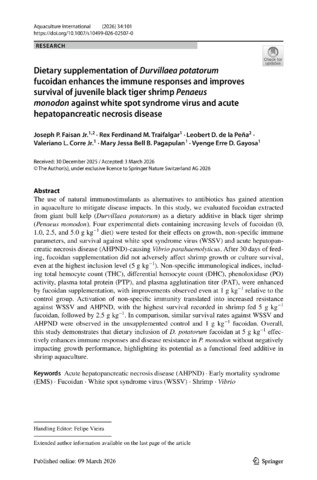
Dietary supplementation of Durvillaea potatorum fucoidan enhances the immune responses and improves survival of juvenile black tiger shrimp Penaeus monodon against white spot syndrome virus and acute hepatopancreatic necrosis disease
Faisan, Joseph P., Jr.; Traifalgar, Rex Ferdinand ; ; ; ; Gayosa, Vyenge Erre (Springer, 2026-03-09)
The use of natural immunostimulants as alternatives to antibiotics has gained attention in aquaculture to mitigate disease impacts. In this study, we evaluated fucoidan extracted from giant bull kelp (Durvillaea potatorum) as a dietary additive in black tiger shrimp (Penaeus monodon). Four experimental diets containing increasing levels of fucoidan (0, 1.0, 2.5, and 5.0 g kg−1 diet) were tested for their effects on growth, non-specific immune parameters, and survival against white spot syndrome virus (WSSV) and acute hepatopancreatic necrosis disease (AHPND)-causing Vibrio parahaemolyticus. After 30 days of feeding, fucoidan supplementation did not adversely affect shrimp growth or culture survival, even at the highest inclusion level (5 g kg−1). Non-specific immunological indices, including total hemocyte count (THC), differential hemocyte count (DHC), phenoloxidase (PO) activity, plasma total protein (PTP), and plasma agglutination titer (PAT), were enhanced by fucoidan supplementation, with improvements observed even at 1 g kg−1 relative to the control group. Activation of non-specific immunity translated into increased resistance against WSSV and AHPND, with the highest survival recorded in shrimp fed 5 g kg−1 fucoidan, followed by 2.5 g kg−1. In comparison, similar survival rates against WSSV and AHPND were observed in the unsupplemented control and 1 g kg−1 fucoidan. Overall, this study demonstrates that dietary inclusion of D. potatorum fucoidan at 5 g kg−1 effectively enhances immune responses and disease resistance in P. monodon without negatively impacting growth performance, highlighting its potential as a functional feed additive in shrimp aquaculture. -
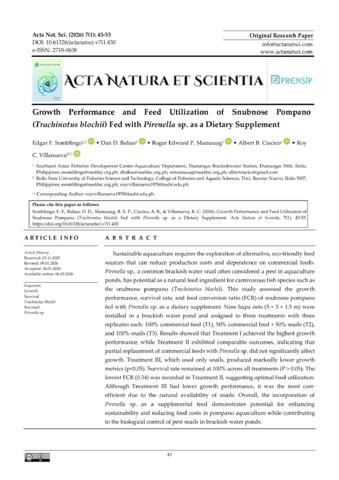
Growth performance and feed utilization of snubnose pompano (Trachinotus blochii) fed with Pirenella sp. as a dietary supplement
Somblingo, Edgar; ; Mamauag, Roger Edward ; Ciacico, Albert ; Villanueva, Roy (Prensip Publishing, 2026-03-06)
Sustainable aquaculture requires the exploration of alternative, eco-friendly feed sources that can reduce production costs and dependence on commercial feeds. Pirenella sp., a common brackish water snail often considered a pest in aquaculture ponds, has potential as a natural feed ingredient for carnivorous fish species such as the snubnose pompano (Trachinotus blochii). This study assessed the growth performance, survival rate, and feed conversion ratio (FCR) of snubnose pompano fed with Pirenella sp. as a dietary supplement. Nine hapa nets (5 × 5 × 1.5 m) were installed in a brackish water pond and assigned to three treatments with three replicates each: 100% commercial feed (T1), 50% commercial feed + 50% snails (T2), and 100% snails (T3). Results showed that Treatment I achieved the highest growth performance, while Treatment II exhibited comparable outcomes, indicating that partial replacement of commercial feeds with Pirenella sp. did not significantly affect growth. Treatment III, which used only snails, produced markedly lower growth metrics (p<0.05). Survival rate remained at 100% across all treatments (P > 0.05). The lowest FCR (0.34) was recorded in Treatment II, suggesting optimal feed utilization. Although Treatment III had lower growth performance, it was the most cost-efficient due to the natural availability of snails. Overall, the incorporation of Pirenella sp. as a supplemental feed demonstrates potential for enhancing sustainability and reducing feed costs in pompano aquaculture while contributing to the biological control of pest snails in brackish water ponds. -
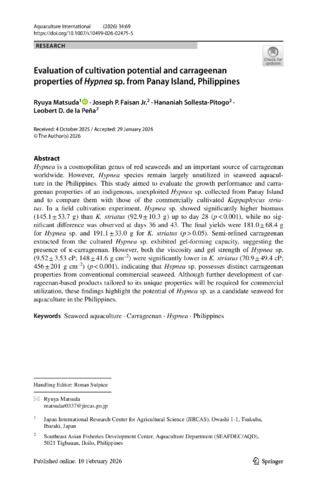
Evaluation of cultivation potential and carrageenan properties of Hypnea sp. from Panay Island, Philippines
Matsuda, Ryuya; Faisan, Jr., Joseph ; ; (Springer, 2026-02-10)
Hypnea is a cosmopolitan genus of red seaweeds and an important source of carrageenan worldwide. However, Hypnea species remain largely unutilized in seaweed aquaculture in the Philippines. This study aimed to evaluate the growth performance and carrageenan properties of an indigenous, unexploited Hypnea sp. collected from Panay Island and to compare them with those of the commercially cultivated Kappaphycus striatus. In a field cultivation experiment, Hypnea sp. showed significantly higher biomass (145.1 ± 53.7 g) than K. striatus (92.9 ± 10.3 g) up to day 28 (p < 0.001), while no significant difference was observed at days 36 and 43. The final yields were 181.0 ± 68.4 g for Hypnea sp. and 191.1 ± 33.0 g for K. striatus (p > 0.05). Semi-refined carrageenan extracted from the cultured Hypnea sp. exhibited gel-forming capacity, suggesting the presence of κ-carrageenan. However, both the viscosity and gel strength of Hypnea sp. (9.52 ± 3.53 cP; 148 ± 41.6 g cm⁻2) were significantly lower in K. striatus (70.9 ± 49.4 cP; 456 ± 201 g cm⁻2) (p < 0.001), indicating that Hypnea sp. possesses distinct carrageenan properties from conventional commercial seaweed. Although further development of carrageenan-based products tailored to its unique properties will be required for commercial utilization, these findings highlight the potential of Hypnea sp. as a candidate seaweed for aquaculture in the Philippines. -
Series: ICLARM Conf. Proc. 64
Genetic research at the Southeast Asian Fisheries Development Center/Aquaculture Department
Basiao, Zubaida (ICLARM - The World Fish Center, 2001)
Southeast Asia is endowed with a variety of species that can be cultured as food fish. Since 1973, the Southeast Asian Fisheries Development Center/Aquaculture Department (SEAFDEC/AQD) has devoted research efforts to establish broodstock for the tiger prawn (Penaeus monodon), milkfish (Chanos chanos), and other economically important fish and crustaceans in the region. The objective is to ensure the availability and reliability of seed supply for fish culture. SEAFDEC’s pioneering effort on genetics was a collaborative study with the University of the Philippines Marine Science Institute on the genetic variation of milkfish populations in the Philippines. Towards the end of the 1980s, genetic activities, co-funded by the International Development Research Centre (IDRC) of Canada in collaboration with Dalhousie University of Canada, were focused on tilapia. -
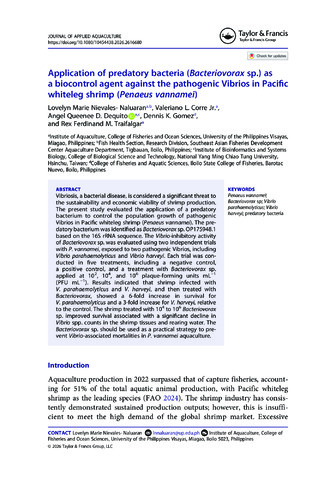
Application of predatory bacteria (Bacteriovorax sp.) as a biocontrol agent against the pathogenic Vibrios in Pacific whiteleg shrimp (Penaeus vannamei)
; ; ; ; Traifalgar, Rex Ferdinand (Taylor and Francis, 2026-01-21)
Vibriosis, a bacterial disease, is considered a significant threat to the sustainability and economic viability of shrimp production. The present study evaluated the application of a predatory bacterium to control the population growth of pathogenic Vibrios in Pacific whiteleg shrimp (Penaeus vannamei). The predatory bacterium was identified as Bacteriovorax sp. OP175948.1 based on the 16S rRNA sequence. The Vibrio-inhibitory activity of Bacteriovorax sp. was evaluated using two independent trials with P. vannamei, exposed to two pathogenic Vibrios, including Vibrio parahaemolyticus and Vibrio harveyi. Each trial was conducted in five treatments, including a negative control, a positive control, and a treatment with Bacteriovorax sp. applied at 102, 104, and 106 plaque-forming units mL−1 (PFU mL−1). Results indicated that shrimp infected with V. parahaemolyticus and V. harveyi, and then treated with Bacteriovorax, showed a 6-fold increase in survival for V. parahaemolyticus and a 3-fold increase for V. harveyi, relative to the control. The shrimp treated with 104 to 106 Bacteriovorax sp. improved survival associated with a significant decline in Vibrio spp. counts in the shrimp tissues and rearing water. The Bacteriovorax sp. should be used as a practical strategy to prevent Vibrio-associated mortalities in P. vannamei aquaculture. -
AQD Matters 2025 November – December
(Aquaculture Department, Southeast Asian Fisheries Development Center, 2026-01)In this issue: 1) SEAFDEC/AQD supports pilot oyster culture initiative in Estancia, Iloilo; 2) SEAFDEC/AQD presents updates at 32nd PTAC meeting; 3) SEAFDEC/AQD boosts rural freshwater aquaculture through training; 4) ... -
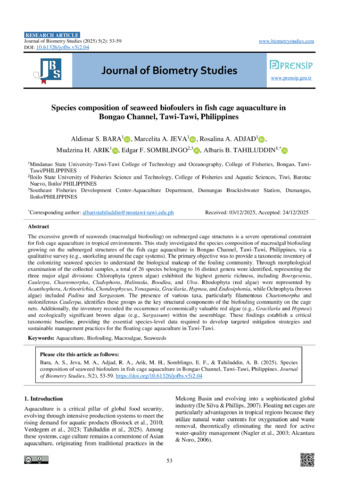
Species composition of seaweed biofoulers in fish cage aquaculture in Bongao Channel, Tawi-Tawi, Philippines
Bara, Aldimar; Jeva, Marcelita ; Adjad, Rosalina ; Arik, Mudzrina ; Somblingo, Edgar ; (Prensip Publishing, 2025-12-29)
The excessive growth of seaweeds (macroalgal biofouling) on submerged cage structures is a severe operational constraint for fish cage aquaculture in tropical environments. This study investigated the species composition of macroalgal biofouling growing on the submerged structures of the fish cage aquaculture in Bongao Channel, Tawi-Tawi, Philippines, via a qualitative survey (e.g., snorkeling around the cage systems). The primary objective was to provide a taxonomic inventory of the colonizing seaweed species to understand the biological makeup of the fouling community. Through morphological examination of the collected samples, a total of 26 species belonging to 16 distinct genera were identified, representing the three major algal divisions: Chlorophyta (green algae) exhibited the highest generic richness, including Boergesenia, Caulerpa, Chaetomorpha, Cladophora, Halimeda, Boodlea, and Ulva. Rhodophyta (red algae) were represented by Acanthophora, Actinotrichia, Chondrophycus, Yonagunia, Gracilaria, Hypnea, and Endosiphonia, while Ochrophyta (brown algae) included Padina and Sargassum. The presence of various taxa, particularly filamentous Chaetomorpha and stoloniferous Caulerpa, identifies these groups as the key structural components of the biofouling community on the cage nets. Additionally, the inventory recorded the occurrence of economically valuable red algae (e.g., Gracilaria and Hypnea) and ecologically significant brown algae (e.g., Sargassum) within the assemblage. These findings establish a critical taxonomic baseline, providing the essential species-level data required to develop targeted mitigation strategies and sustainable management practices for the floating cage aquaculture in Tawi-Tawi. -
Stocking density effects on growth performance of glass eels (Anguilla bicolor pacifica) in outdoor tank conditions
Aya, Frolan (College of Agriculture and Food Science, University of the Philippines Los Baños, 2025-12)
Optimizing stocking density is necessary to maximize the production efficiency of farmed fish. This study examined the effect of stocking density on the growth performance of the Pacific shortfin eel Anguilla bicolor pacifica reared in outdoor tank conditions. Glass eels (0.72 ± 0.03 g mean body weight [BW]) were stocked at 50 and 100 individuals m−2 in 6 4-m2 outdoor tanks with a flow-through system set up in triplicate. Eels were individually measured for total length and BW, followed by blood sampling at the end of the 286-d trial. Glass eels stocked at a density of 50 m−2 exhibited significantly higher specific growth rate, feed efficiency, and protein efficiency ratio. However, survival, final BW, percent weight gain, biomass, biometric indices, and Fulton’s condition factor were not significantly different between density groups. Although size class distribution was not significantly affected by stocking density, a higher proportion of larger eels (> 50 g) was evident at low stocking density. The coefficients of variation in both length and weight and in skewness were likewise slightly reduced at low stocking density. In contrast, high stocking density resulted in significantly elevated levels of serum total protein. Partial costs-and-returns analysis showed that 50 m−2 density resulted in higher net profit and profit index. These results suggest that under outdoor tank conditions, a stocking density of 50 m−2 will result in higher growth rate and feed utilization, less size variation, better physiological condition, and higher net returns for the culture of A. bicolor pacifica. -
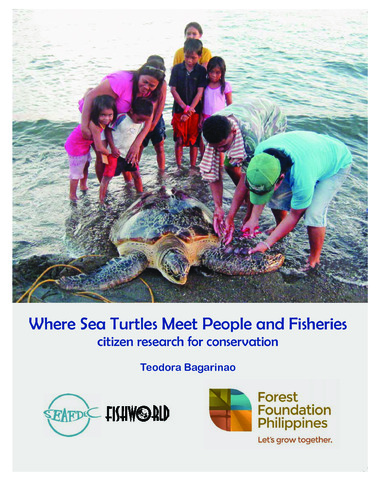
Where sea turtles meet people and fisheries: Citizen research for conservation
Bagarinao, Teodora (Aquaculture Department, Southeast Asian Fisheries Development Center; Forest Foundation Philippines, 2025)
Since 2000, SEAFDEC FishWorld has served as a focal point for community engagement in marine biodiversity conservation, with a particular emphasis on sea turtle protection in the waters surrounding Panay and Guimaras Islands. This book presents the outcomes of a long-term initiative involving the documentation, tagging, release, and care of sea turtles incidentally captured in local fisheries. It provides a permanent record of 335 sea turtles, including documentary photographs of 214 individuals, and offers extensive data and new insights into the status and ecology of these endangered species in Philippine waters. The volume details the interactions between sea turtles, fishing gear, and coastal communities, highlighting collaborative efforts among FishWorld, fishers, and government agencies to promote conservation and reduce turtle capture. Written for fishers, conservation practitioners, government officers, educators, and the general public, the book combines scientific information with accessible, pictorial presentation. It contributes significantly to national efforts to raise awareness, foster community participation, and strengthen the protection of sea turtles and the marine ecosystems that sustain them. -
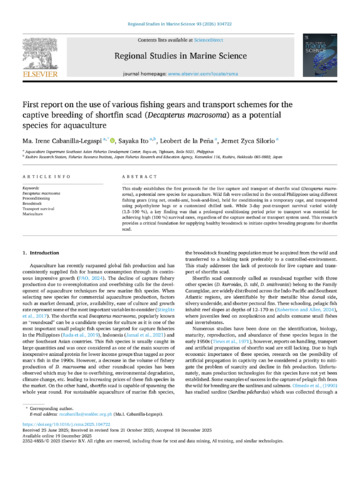
First report on the use of various fishing gears and transport schemes for the captive breeding of shortfin scad (Decapterus macrosoma) as a potential species for aquaculture
Legaspi, Ma. Irene; Ito, Sayaka ; ; (Elsevier, 2026-01)
This study establishes the first protocols for the live capture and transport of shortfin scad (Decapterus macrosoma), a potential new species for aquaculture. Wild fish were collected in the central Philippines using different fishing gears (ring net, otoshi-ami, hook-and-line), held for conditioning in a temporary cage, and transported using polyethylene bags or a customized chilled tank. While 3-day post-transport survival varied widely (1.5–100 %), a key finding was that a prolonged conditioning period prior to transport was essential for achieving high (100 %) survival rates, regardless of the capture method or transport system used. This research provides a critical foundation for supplying healthy broodstock to initiate captive breeding programs for shortfin scad. -
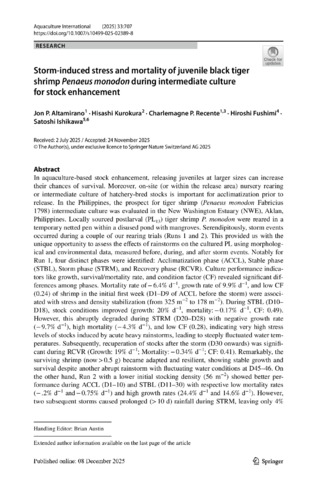
Storm-induced stress and mortality of juvenile black tiger shrimp Penaeus monodon during intermediate culture for stock enhancement
Altamirano, Jon; ; Recente, Charlemagne ; Fushimi, Hiroshi ; (Springer, 2025-12-08)
In aquaculture-based stock enhancement, releasing juveniles at larger sizes can increase their chances of survival. Moreover, on-site (or within the release area) nursery rearing or intermediate culture of hatchery-bred stocks is important for acclimatization prior to release. In the Philippines, the prospect for tiger shrimp (Penaeus monodon Fabricius 1798) intermediate culture was evaluated in the New Washington Estuary (NWE), Aklan, Philippines. Locally sourced postlarval (PL13) tiger shrimp P. monodon were reared in a temporary netted pen within a disused pond with mangroves. Serendipitously, storm events occurred during a couple of our rearing trials (Runs 1 and 2). This provided us with the unique opportunity to assess the effects of rainstorms on the cultured PL using morphological and environmental data, measured before, during, and after storm events. Notably for Run 1, four distinct phases were identified: Acclimatization phase (ACCL), Stable phase (STBL), Storm phase (STRM), and Recovery phase (RCVR). Culture performance indicators like growth, survival/mortality rate, and condition factor (CF) revealed significant differences among phases. Mortality rate of − 6.4% d−1, growth rate of 9.9% d−1, and low CF (0.24) of shrimp in the initial first week (D1–D9 of ACCL before the storm) were associated with stress and density stabilization (from 325 m−2 to 178 m−2). During STBL (D10–D18), stock conditions improved (growth: 20% d−1, mortality: − 0.17% d−1, CF: 0.49). However, this abruptly degraded during STRM (D20–D28) with negative growth rate (− 9.7% d−1), high mortality (− 4.3% d−1), and low CF (0.28), indicating very high stress levels of stocks induced by acute heavy rainstorms, leading to steeply fluctuated water temperatures. Subsequently, recuperation of stocks after the storm (D30 onwards) was significant during RCVR (Growth: 19% d−1; Mortality: − 0.34% d−1; CF: 0.41). Remarkably, the surviving shrimp (now > 0.5 g) became adapted and resilient, showing stable growth and survival despite another abrupt rainstorm with fluctuating water conditions at D45–46. On the other hand, Run 2 with a lower initial stocking density (56 m−2) showed better performance during ACCL (D1–10) and STBL (D11–30) with respective low mortality rates (− .2% d−1 and − 0.75% d−1) and high growth rates (24.4% d−1 and 14.6% d−1). However, two subsequent storms caused prolonged (> 10 d) rainfall during STRM, leaving only 4% survival at D38 with no RCVR phase. We showed that acute (~ 2 d) intense rainstorms can be detrimental to young (< 0.2 g) PL, but the stable environmental conditions after storms can allow the surviving stocks to recuperate, grow fast (> 0.5 g), then become quite resilient even to a subsequent acute (2 d) rainfall. However, extended rainstorms (> 10 d) cause continuous decline in salinity and temperature, leading to high mortality of shrimp. Therefore, careful programming of future on-site intermediate culture activities is important, considering the space and duration required for culture, initial densities and target sizes of PL, and cautious account of rainstorm seasonality. -
Gleaning of fishery of conch (Gastropoda: Strombidae) in seagrass beds of Guimaras Island, the Philippines
; Monteclaro, Harold; Altamirano, Jon ; Santander - de Leon, Sheila Mae (Department of Science and Technology, 2025-12)
Gleaning is a subsistence fishery vital to the lives of coastal communities. The gastropod conch is among those found abundant in gleaners’ catch, particularly observed in Nueva Valencia, Guimaras, the Philippines. Three adjacent barangays with a wide expanse of seagrass intertidal area were studied for aspects of conch gleaning fishery through a structured questionnaire and the conduct of an actual catch survey. Results showed that conch gleaning is a secondary source of income (80%), mainly conducted by women (85%) during low tide. It contributes to their food consumption and additional income, where a kilo of conch is sold fresh and unprocessed at PHP 50–60, contributing to their monthly income at PHP 500–1000 maximum and PHP 100–200 minimum. Six species of conch were identified from the actual catch survey. Gleaning time ranges 2–4 h/d at 0.2–0.6 kg/h CPUE. An estimated 1,728–5,184 kg of conch, or around 180,000–550,000 individuals, may be exploited annually based on actual catch calculations. These levels of exploitation may pose a risk to the sustainability of the resource. An observed decline in the abundance of conch for the past 20 years, where management measures such as limitations on conch size and collection volume were indicated by the respondents. As an undocumented fishery in the Philippines, this study presented the importance of conch gleaning in the livelihood of coastal residents and may serve as vital information for fishery policy recommendations. This study also showed that the use of an actual catch survey, aside from a questionnaire, enhanced the data and earned better interpretation of results. -
Hatchery production of sea cucumbers: Status, problems and directions
Altamirano, Jon (Mindanao State University at Naawan, 2025)
Sea cucumbers are ecologically and economically important marine invertebrates, whose wild populations have been threatened by overfishing in recent decades. The rapid decline in wild stocks was driven by high market prices of sea cucumber products for food and medicine. Fortunately, recent developments in hatchery seed production technologies have paved the way towards establishing a more sustainable sea cucumber industry through aquaculture without dependence on massive collections from natural populations. -
AQD Matters 2025 September - October
(Aquaculture Department, Southeast Asian Fisheries Development Center, 2025-12)In this issue: 1) Baliao continues tenure as SEAFDEC/AQD Chief; 2) SEAFDEC/AQD highlights aquaculture advances at Agrilink 2025; 3) SEAFDEC/AQD reviews 2025 progress, plans future research development initiatives; 4) ... -
Catfish culture
(Aquaculture Department, Southeast Asian Fisheries Development Center, 2025-11)This brochure introduces the essential practices in catfish hatchery, nursery, and grow-out culture, focusing on the African catfish Clarias gariepinus, a hardy and fast-growing species suited for small-scale and ... -
SEAFDEC/AQD highlights 2024
(Aquaculture Department, Southeast Asian Fisheries Development Center, 2025-11)SEAFDEC/AQD highlights 2024 is SEAFDEC/AQD's annual report updating on its accomplishments and progress for the year 2024.