Fish breeding and seed production research in the Philippines: Status, constraints and prospects

View/
Date
1995Page views
1,361ASFA keyword

Taxonomic term

Geographic names

Metadata
Show full item recordShare
Abstract
Five marine fish species (milkfish, Chunos chanos; Asian sea bass, Lates calcarifer; grouper, Epinephelus coioides; rabbitfish, S&anus guttatus; snapper, Lutjanus argentimuculatus) and three freshwater fish species (tilapia, Oreochromes niloticus; bighead carp, Aristichthys nobilis; Asian catfish, Clarias macrocephalus) of commercial importance are currently the subjects of breeding and seed production research in the Philippines, primarily at the SEAFDEC Aquaculture Department.
Natural and induced spawning of milkfish have been achieved. Although seed production is now a commercial enterprise, work on hormonal induction of off-season maturation is being pursued to obtain fry during periods when these are scarce. Hormone regimes to manipulate spawning and advance maturation in sea bass have been developed, while hormone-induced spawning of rabbitfish and snapper have been achieved. Studies on hormonal induction of sex inversion in juvenile and adult groupers are being undertaken. Research programs to develop and select improved tilapia strains and chromosomal manipulation for production of all-male tilapia hybrids are under way in several aca- demic and research institutions. Work on induced and spontaneous spawning of the Asian catfish, an endangered species in the Philippines, has recently started while research on bighead carp addresses problems such as alternative agents for spawning and declining reproductive performance of inbred stocks.
With few exceptions, fish breeding research in the Philippines is production-oriented and empha- sizes development of practical methods adapting those developed for other fish species. Because of technical, institutional, and funding constraints, very limited work can be done to investigate the physiological mechanisms regulating reproduction, development and growth in any of these species. Attempts to apply information gathered from other species to our local species have met with both success and failure, and reasons to explain these results have been mainly speculative. Because of the varied species available for research, there is a wide room in which to investigate specific problems that are currently of interest to comparative endocrinologists. This can only be done in collaboration with other institutions in developed countries carrying out similar research.
Description
Abstract only.
Suggested Citation
Marte, C. L. (1995). Fish breeding and seed production research in the Philippines: Status, constraints and prospects. Aquaculture , 135(1-3), 215. https://doi.org/10.1016/0044-8486(96)81305-6
Type
ArticleISSN
0044-8486Collections
- Journal Articles [1263]
Related items
Showing items related by title, author, creator and subject.
-
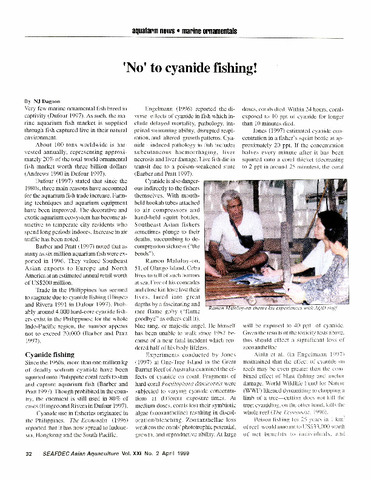
'No' to cyanide fishing!
(Aquaculture Department, Southeast Asian Fisheries Development Center, 1999) -
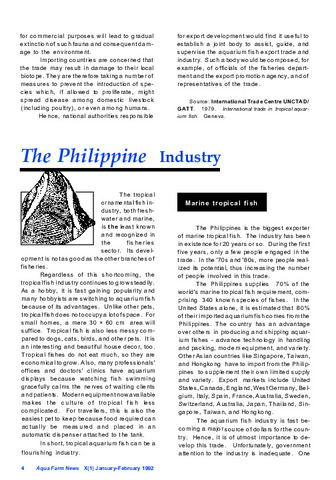
The Philippine industry: Marine tropical fish
(Aquaculture Department, Southeast Asian Fisheries Development Center, 1992) -
CRM in the Philippines: Lessons learned
(Aquaculture Department, Southeast Asian Fisheries Development Center, 1996)Philippine coastal communities can become capable fishery resource managers and that their management practices can become largely self-sustaining if the project approach focuses on assisting fishermen to learn how to help ...