SEAFDEC/AQD Institutional Repository: Recent submissions
Now showing items 1921-1940 of 4221
-
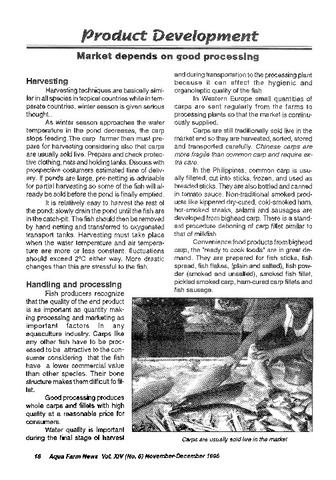
Product development: Market depends on good processing
(Aquaculture Department, Southeast Asian Fisheries Development Center, 1996)The article presents the harvesting techniques, and handling and processing of cultured carps. Carps are harvested similarly with all other species in tropical countries while temperate countries, winter season is much considered. Water quality is an important factor to be considered because it can affect the hygienic and organoleptic quality of fish. Carps were commonly sold live, filleted, cut into sticks, frozen, used as breaded sticks, canned, bottled, and smoked. -
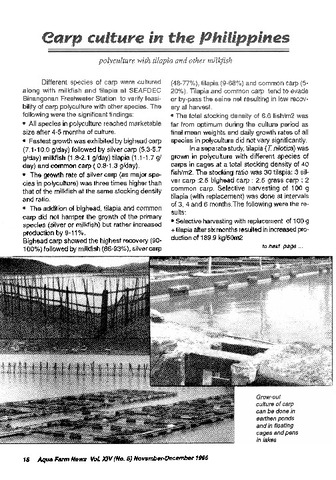
Carp culture in the Philippines: polyculture with tilapia and other milkfish
(Aquaculture Department, Southeast Asian Fisheries Development Center, 1996)The paper presents the result of the study on the polyculture of the different species of carp with tilapia and milkfish. Polyculture does not hamper the growth of primary species but rather increased the production. However, bighead carp and silver grow faster compared to other species. -
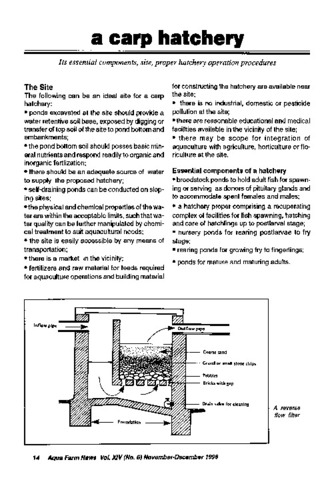
A carp hatchery: Its essential components, site, proper hatchery operation procedures
(Aquaculture Department, Southeast Asian Fisheries Development Center, 1996)The paper presents the essential components, ideal site, and proper hatchery operation procedures of a carp hatchery. -
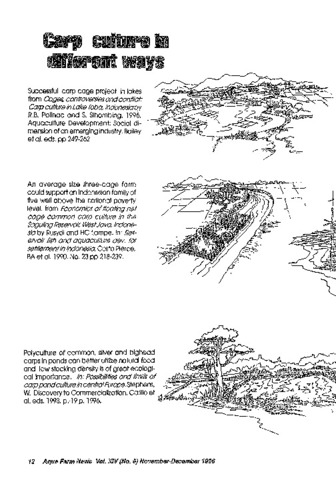
Carp culture in different ways
(Aquaculture Department, Southeast Asian Fisheries Development Center, 1996)The paper illustrates the different carp culture techniques based on six published papers from different countries. It also notes the economic and ecological importance of carp aquaculture. -
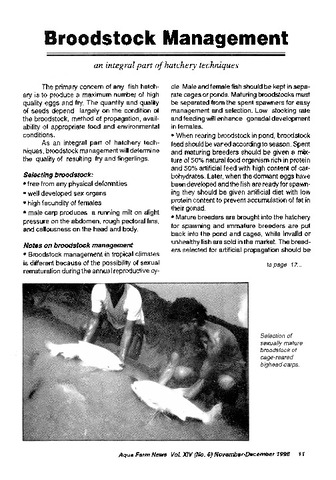
Broodstock management: an integral part of hatchery techniques
(Aquaculture Department, Southeast Asian Fisheries Development Center, 1996)The paper presents bighead carp broodstock management, an integral part of hatchery techniques as it will determine the quality of resulting fry and fingerlings. Proper methods on the selection and management of broodstock were discussed. -
Bighead carp - its maturation and ovulation
(Aquaculture Department, Southeast Asian Fisheries Development Center, 1996)The paper investigates the effects of intraperitoneal injections of LHRH-a and domperidone (DOM), given singly or in combination at two injections, on oocyte maturation and spawning in bighead carp, Aristichthys nobilis. -
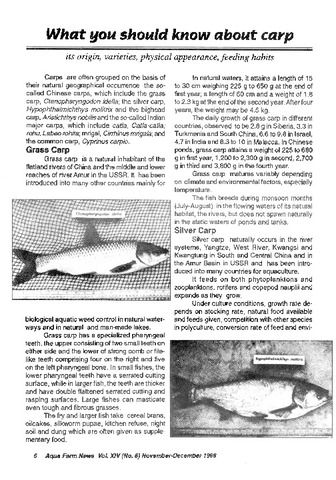
What you should know about carp: its origin, varieties, physical appearance, feeding habits
(Aquaculture Department, Southeast Asian Fisheries Development Center, 1996)The article discusses the different varieties of carps, their origin, physical appearance and feeding habits. The species discussed were grass carp (Ctenopharyngodon idella), silver carp (Hypophthalmichthys molitrix), bighead carp (Aristichthys nobilis), catla (Catla catla), rohu (Labeo rohita), mrigal (Cirrhinus mrigala, and common carp (Cyprinus carpio). -
A perspective of the carp industry in the Philippines
(Aquaculture Department, Southeast Asian Fisheries Development Center, 1996)Fish farmers in Laguna de Bay are facing conflict of the use of the lake which is being tapped as freshwater source for domestic use. The article documents the perspectives of some fish farmers and researchers on the development of carp aquaculture industry in the lake. According to carp farmers and researchers, the industry is profitable however, marketing, post harvest and processing strategies remain poor. In these regard, Southeast Asian Fisheries Development Center, Aquaculture Department (SEAFDEC/AQD) should be the frontline ally of carp growers since SEAFDEC/AQD developed the technology for lake culture. -
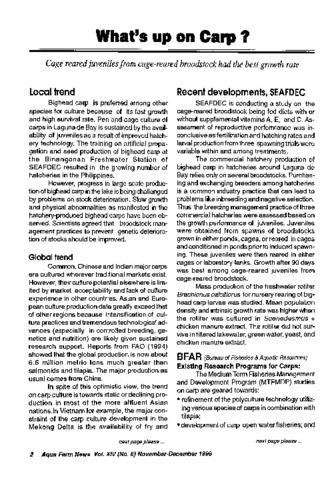
What's up on carp?
(Aquaculture Department, Southeast Asian Fisheries Development Center, 1996)Bighead carp is preferred among other species for culture because of its fast growth and high survival rate. Pen and cage culture of carps in Laguna de Bay is sustained by the availability of juveniles as a result of improved hatchery technology. Southeast Asian Fisheries Development Center and the Bureau of Fisheries and Aquatic Resources have been conducting research programs to enhance the carp culture industry in the country. -
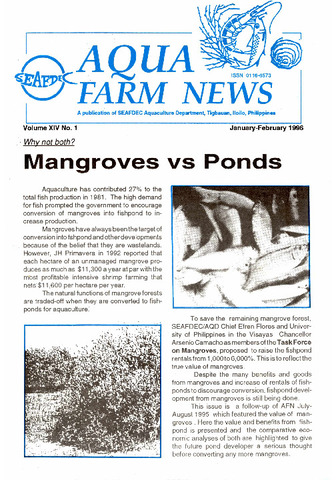
Aqua Farm News Volume 14(01) January - February 1996
(Aquaculture Department, Southeast Asian Fisheries Development Center, 1996)This issue focuses on the value and benefits of fishponds and the comparative economic analyses of mangroves and fishponds. Shrimp farms are used to illustrate the benefits and hazards from aquaculture. It is evident that ... -
The Oplan Sagip-Sugpo
(Aquaculture Department, Southeast Asian Fisheries Development Center, 1996) -
Working together to save shrimp
(Aquaculture Department, Southeast Asian Fisheries Development Center, 1996) -
A shrimp cooperative in action
(Aquaculture Department, Southeast Asian Fisheries Development Center, 1996)The paper presents the success story of the Bacolod, Negros Occidental based shrimp cooperative, the Negros Prawn Producers’ Marketing Cooperative, Inc. (NPPMCI) in integrating prawn production and marketing, and providing services to their members. -
Grouper, mudcrab and company
(Aquaculture Department, Southeast Asian Fisheries Development Center, 1996)The paper discusses aquaculture practices on the three other high-value commodities which can be cultured as an alternative to shrimp. These species are grouper, mud crab and sea bass, it also discusses milkfish aquaculture practices. -
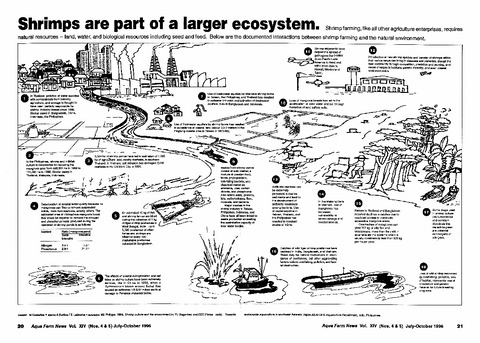
Shrimps are part of a larger ecosystem
(Aquaculture Department, Southeast Asian Fisheries Development Center, 1996)The document illustrates the interactions between shrimp farming and the environment. -
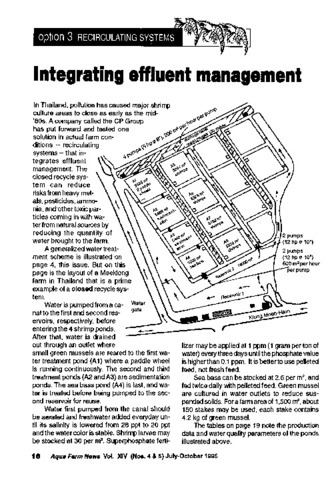
Integrating effluent management
(Aquaculture Department, Southeast Asian Fisheries Development Center, 1996)The paper discusses a closed recycle shrimp farm in Thailand which integrates effluent management. The closed recycle system can reduce risk of heavy metals, pesticides, ammonia, and other toxic particles coming in with water from natural sources by reducing the quantity of water brought to the farm. -
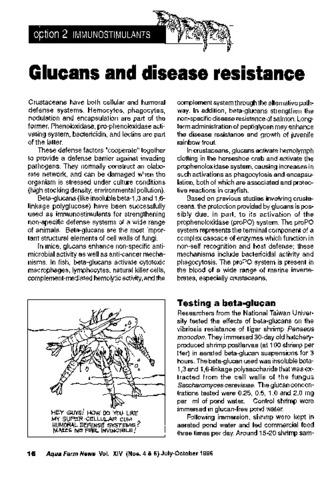
Glucans and disease resistance
(Aquaculture Department, Southeast Asian Fisheries Development Center, 1996)The paper presents the usefulness of beta-glucans as immunostimulants for strengthening the non-specific defense system of a wide range of animals. In Taiwan, researchers tested the effects of beta-glucans on the vibriosis resistance of tiger shrimp Penaeus monodon which yield promising results. They suggest that supplementation of beta-glucan at 0.5 mg per ml is sufficient in strengthening the non-specific defense mechanism of postlarval shrimp. -
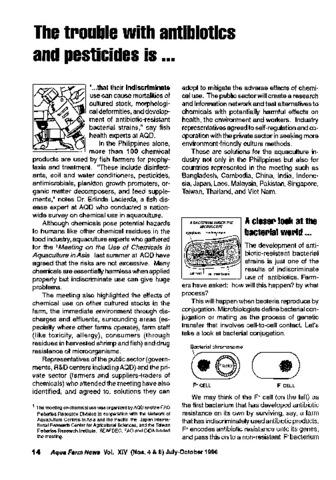
The trouble with antibiotics and pesticides is...
(Aquaculture Department, Southeast Asian Fisheries Development Center, 1996)The paper discusses the output of the meeting on the use of chemicals in aquaculture in Asia. The effects of chemical use on cultured stocks in the farm, the immediate environment through discharges and effluents, surrounding areas, farm staff, consumers and drug resistance organisms are also discussed. It also shows how an antibiotic-resistant microorganism develops as the result of indiscriminate use of antibiotics. -
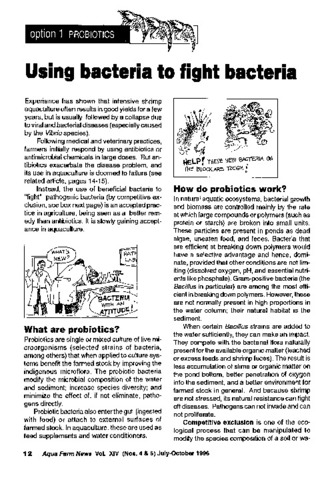
Using bacteria to fight bacteria
(Aquaculture Department, Southeast Asian Fisheries Development Center, 1996)The paper discusses about probiotics and its possible use in shrimp aquaculture. The paper also provides information on how the probiotics work and presents the preliminary results of the field tests conducted by Southeast Asian Fisheries Development Center, Aquaculture Department and BIOPOND Systems. The general characteristics of Bacillus are also discussed. -
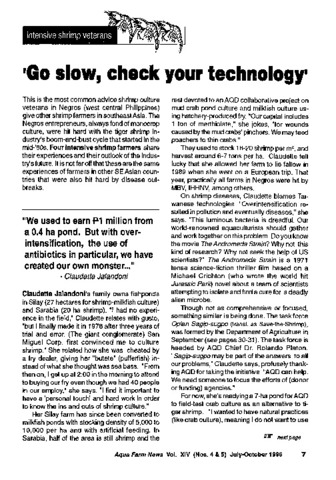
Go slow, check your technology
(Aquaculture Department, Southeast Asian Fisheries Development Center, 1996)The paper presents the outlooks and experiences of veteran shrimp farmers from Negros, west central Philippines after its collapse in the late 1980s due to the luminous bacteria.