SEAFDEC/AQD Institutional Repository: Recent submissions
Now showing items 1941-1960 of 4221
-
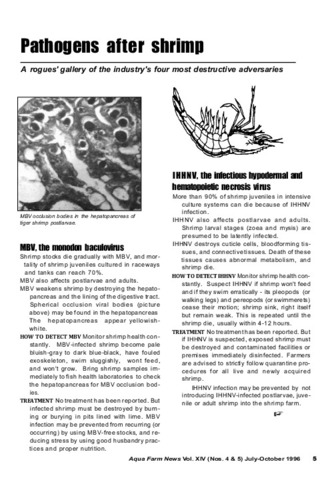
Pathogens after shrimp: A rogue's gallery of the industry's four most destructive adversaries
(Aquaculture Department, Southeast Asian Fisheries Development Center, 1996)The paper discusses the four most destructive shrimp pathogens, such as MBV, the monodon baculovisrus, IHHNV, the infectious hypodermal and hematopoietic necrosis virus, Vibrio harveyi, the luminous bacteria, and WSBV, the white spot syndrome-associated baculovirus. The effects, detection method and treatment for the four pathogens were also briefly discussed. -
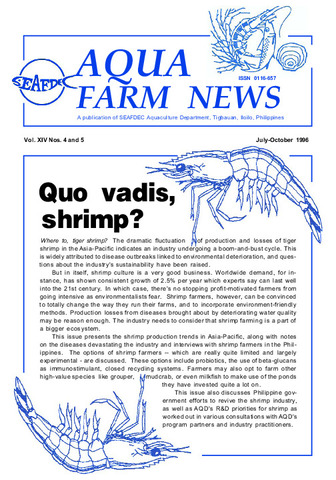
Quo vadis, shrimp?
(Aquaculture Department, Southeast Asian Fisheries Development Center, 1996)The paper discusses the shrimp culture practices of Thailand, the top producing country of cultured shrimp. These shrimp culture techniques include the use of reservoirs for better waste management, utilization of undiluted seawater for culture, low-cost pumping systems, measures to neutralize acid sulfate soils, proper treatment of pond bottom, and solutions to disease problems. -
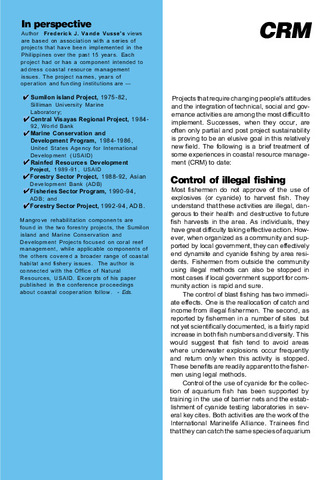
CRM in the Philippines: Lessons learned
(Aquaculture Department, Southeast Asian Fisheries Development Center, 1996)Philippine coastal communities can become capable fishery resource managers and that their management practices can become largely self-sustaining if the project approach focuses on assisting fishermen to learn how to help themselves. Community organization is an essential part of the process and should not be viewed as an end product in itself. There are also no quick fixes, and projects require a complex array of activities if large numbers of coastal residents are to be assisted. In some of these projects, the control of illegal fishing combined with limiting of commercial fishing to offshore areas and good coastal habitat management resulted in a doubling of daily fish catch and income for small-scale fishermen. However, even with the best of management, the total fishery harvest is limited and further increases in individual fishing income can only come from reducing total fishing effort. This will require a system of control on access to the resource to limit the number and kind of fishing gears and to divide the resource equitably. Assisting coastal communities to devise and implement realistic equitable access controls is the major challenge facing coastal resource co-management. -
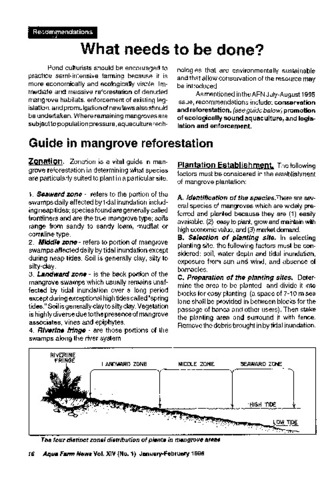
What needs to be done?: Guide in mangrove reforestation
(Aquaculture Department, Southeast Asian Fisheries Development Center, 1996)The article presents a two-part guideline in mangrove reforestation. The first part is zonation, which is the process of determining what species are particularly suited to plant in a particular site. While, plantation establishment is the second part, it includes guides in the identification of species, selection of planting site, preparation of the planting sites, seed collection, handling and transporting of seeds, and planting. -
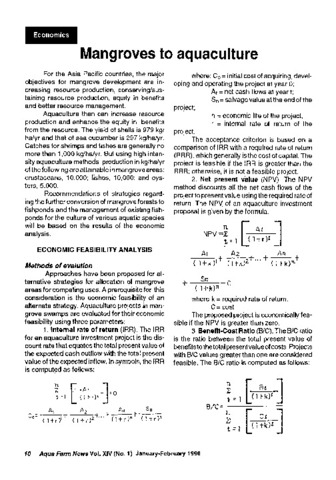
Mangroves to aquaculture
(Aquaculture Department, Southeast Asian Fisheries Development Center, 1996)The paper discusses the recommended strategies regarding the further conversion of mangrove forests to fishponds and the management of existing fishponds for the culture of various aquatic species based on economic feasibility analysis. Strategy for the management of Philippine mangrove and the guidelines for the selection of mangrove areas for preservation, conservation and fishpond development are also presented. -
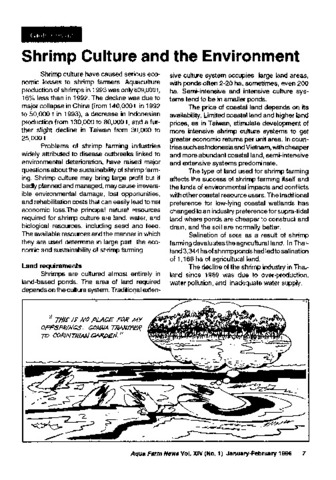
Shrimp culture and the environment
(Aquaculture Department, Southeast Asian Fisheries Development Center, 1996)The paper discusses the impacts of shrimp culture to the environment in some countries in Asia. Specifically, it highlights the land requirements suitable for shrimp farming and the impacts of shrimp culture on mangroves. The positive effects of mangroves such as its filtering capacity and as a protective buffer are also discussed. -
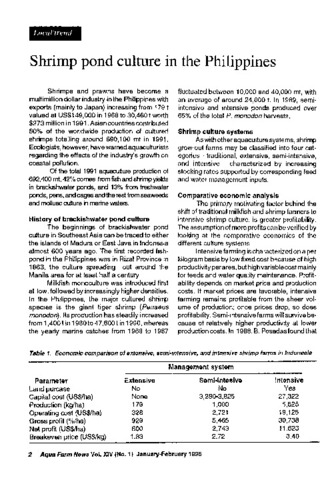
Shrimp pond culture in the Philippines
(Aquaculture Department, Southeast Asian Fisheries Development Center, 1996)The document reviews and evaluates the development of shrimp culture in the Philippines. It also discusses the ecological and socioeconomic effects of shrimp culture industry in the country. -
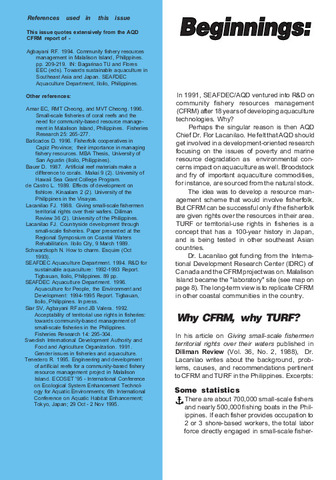
Beginnings: SEAFDEC/AQD, CFRM, and Malalison Island
(Aquaculture Department, Southeast Asian Fisheries Development Center, 1996)The paper documents the community fishery resources management activities of Southeast Asian Fisheries Development Center, Aquaculture Department (SEAFDEC/AQD) in Malalison Island, Antique, Philippines. -
Potential use of the sea lettuce Ulva lactuca replacing soybean meal in the diet of the black tiger shrimp Penaeus monodon juvenile
(Bioflux, 2015)To evaluate the biological value of incorporating the sea lettuce Ulva lactuca meal in the diet of the black tiger shrimp (Penaeus monodon), 3 diets were fed to groups of shrimps containing two levels (15% and 30% replacement of soybean meal) of the sea lettuce for 90 days. Biological parameters were determined either periodically or at the termination of the experiment. Specific growth rate (SGR) of shrimp fed the control diet and those fed with the diet containing 15% replacement were not significantly different from each other while that of shrimp fed 30% soybean replacement was slightly but significantly inferior. All other parameters such as survival rate, feed intake, food conversion efficiency, protein efficiency ratio protein and lipid deposited and body composition were all statistically similar between the experimental groups of shrimp. Thus, the 30% replacement level or 10.5% inclusion level could be used in the diet of the shrimp P. monodon. When performances were compared with the best result in incorporating U. lactuca protein concentrate from a previous study and that in the present study (both were 30% replacement or 10.5 inclusion level), they were statistically similar. Thus, the raw U. lactuca meal is recommended because it did not require additional processing to produce the concentrated seaweed. -
Low-cost production of the marine thraustochytrid isolate, Schizochytrium sp. LEY7 as larval live feed enrichement for the mangrove snapper, Lutjanus sp.
Ludevese-Pascual, Gladys ; de la Peña, Milagros R. ; ; (Laboratory of Aquaculture & Artemia Reference Center, Ghent University, 2013)
This study demonstrates the potential of low-cost production substrates in mass producing the Schizochytrium sp. LEY7 for maximum DHA production. High biomass yield was achieved by optimizing the culture conditions particularly the incubation temperature and salinity levels. Preliminary data on feeding trials have shown promising results and therefore confirmatory experiments need to be conducted to verify the results obtained.
; de la Peña, Milagros R. ; ; (Laboratory of Aquaculture & Artemia Reference Center, Ghent University, 2013)
This study demonstrates the potential of low-cost production substrates in mass producing the Schizochytrium sp. LEY7 for maximum DHA production. High biomass yield was achieved by optimizing the culture conditions particularly the incubation temperature and salinity levels. Preliminary data on feeding trials have shown promising results and therefore confirmatory experiments need to be conducted to verify the results obtained. -
Series: Aquaculture extension manual; No. 54
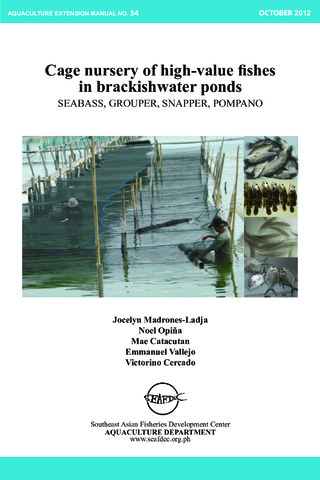
Cage nursery of high-value fishes in brackishwater ponds: Seabass, grouper, snapper, pompano
(Aquaculture Department, Southeast Asian Fisheries Development Center, 2012)This extension manual describes nursery pond requirements, nursery rearing procedures, common diseases of young marine fish, and economic analysis of cage nursery as an enterprise separate from hatchery and grow-out culture. -
Series: Aquaculture extension manual; No. 52
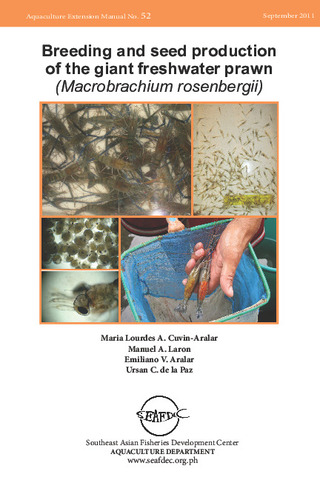
Breeding and seed production of the giant freshwater prawn (Macrobrachium rosenbergii)
(Aquaculture Department, Southeast Asian Fisheries Development Center, 2011)An extension manual describing biology, broodstock management, hatchery and nursery operations, feeding management, packing and transport, and health management of the giant freshwater prawn. -
Series: Aquaculture extension manual; No. 51
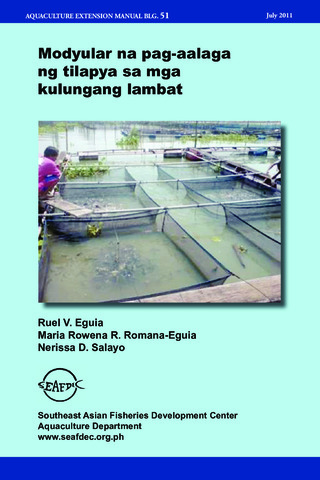
Modyular na pag-aalaga ng tilapya sa mga kulungang lambat
; Romana-Eguia, Maria Rowena R.An extension manual detailing traditional cage culture method, concept of modular cage culture, economic feasibility of modular cage culture, and post harvest processing.; (Aquaculture Department, Southeast Asian Fisheries Development Center, 2011)
-
Series: ACIAR Monograph 110
Development of formulated feeds for grow-out culture of grouper (Epinephelus coioides) - tank and field studies
(Australian Centre for International Agricultural Research, 2004)The objectives of this study were to compare the performance of a Southeast Asian Fisheries Development Centre (SEAFDEC) formulated diet with a commercial feed for growout culture of grouper and to transfer technology on grouper diet developed at SEAFDEC to the industry. In the tank study, Epinephelus coioides juveniles were reared in 12 units of 150-litre tanks at 15 fish/tank with 4 replicates per treatment. Fish were fed the diets at a feeding rate of 5-6% of body weight (BW) and trash fish at 10-12% BW per day for 60 days. In the feeding trial, treatments were arranged in a randomized complete block design with size groups as block. 36 fish were stocked per size group. Formulated feeds were given twice a day for 120 days. In the tank study, the commercial feed resulted to significantly lower growth, survival and food conversion ratio (FCR) compared with the SEAFDEC diet and trash fish control. Results of the field trials at growout ponds did not show significant differences in growth performance, survival and FCR of grouper juveniles fed with the diets. Both the SEAFDEC diet and commercial feed conformed to the established protein requirement of juvenile grouper. In tank trials, the poor performance of commercial feed was attributed to the low protein content and deficiencies in essential amino acids as confirmed by analysis of the amino acid composition. Improvement in growth performance of fish given the commercial feed was achieved in field trials by increasing the dietary protein level and improving the amino acid composition to match that of the grouper juveniles. -
Series: ACIAR Monograph 110
Replacement of fish meal by animal by-product meals in a practical diet for growout culture of grouper (Epinephelus coioides)
(Australian Centre for International Agricultural Research, 2004)This study was conducted to develop compounded feeds having a low content of fish meal for juvenile grouper and as an alternative to trash fish feeding. Epinephelus coioides juveniles were stocked in 36 units of 250-litre tanks at 25 fish/tank. Eight dietary treatments representing increasing (0, 10, 20, 30, 40, 60, 80 and 100%) percentage replacements of fish meal protein with 4:1 combination of meat meal and blood meal were tested in quadruplicate groups of fish arranged in a completely randomized design. Weight gain and specific growth rate (SGR), survival, food conversion rate (FCR) and body composition of fish were determined. Up to 80% of fish meal protein could be replaced by processed meat meal and blood meal, with no adverse effects on growth, survival and feed conversion efficiency of E. coioides juveniles. Use of animal byproduct meals as protein source substantially lowered the level of fish meal required in the juvenile grouper diet. The diet could be effectively used as a substitute for trash fish feeding, thereby reducing the requirements for fishery resource. From an economic standpoint, replacement of fish meal with cheaper animal byproduct meals in a practical diet for grouper could alleviate the problem of low fish meal availability and high cost. -
Evaluation of some terrestrial proteins in complete diets for grouper (Epinephelus coioides) juveniles
; ; Mamauag, Roger Edward (Australian Centre for International Agricultural Research, 2004)
This study was undertaken to determine the nutritive value of some of the more widely available protein sources in the diets for grouper juveniles, based on apparent digestibility coefficients for dry matter (ADMD) and crude protein (APD), feed conversion ratio (FCR), specific growth rate (SGR) and survival. A series of feeding experiments were conducted to determine the growth performance of grouper juveniles. Test diets were formulated for growth (4 replications/treatment) and digestibility experiments (3 replications/treatment). Each diet contained a test ingredient: white fish meal, white cowpea meal and ipil-ipil leaf meal (experiment 1); local meat and bone meal, soya protein concentrates and meat solubles (experiment 2); and imported meal and bone meal, blood meal and maize gluten meal (experiment 3). A feeding trial for each experiment was conducted for 85 days in a flow-through system with filtered and aerated seawater. 10 and 20 juveniles were stocked in each of 60- and 250-litre fibreglass tanks, respectively. White cowpea meal (20.5% incorporation), local (16% incorporation) and imported (19% incorporation) meat and bone meals could partially replace fish meal in the diets for grouper juveniles without affecting their growth. Low ADMD and APD values for the processed feed ingredients (meat and bone meal, soya protein concentrates and blood meal-based diets) could be associated with the processing methods used in its preparation, which could damage the amino acids and contribute to low nitrogen digestibility. Apparent digestibility coefficients and growth could be used as indicators of the nutritional value of the feed ingredients. However, the availability and optimal balance of amino acids must also be considered. -
Series: ACIAR Monograph 110
Apparent digestibility of selected feed ingredients in diets for grouper (Epinephelus coioides) juveniles
; ; Mamauag, Roger Edward (Australian Centre for International Agricultural Research, 2004)
This study was conducted to determine the quality of selected feed ingredients as protein sources in grouper diets, based on their nutrient composition and apparent digestibility coefficients for dry matter (ADMD) and crude protein (APD). A total of 56 juveniles were used for the 1st batch of test ingredients (Chilean fish meal, white fish meal, shrimp meal, defatted soyabean oilmeal, white cowpea meal and ipil-ipil leaf meal). 54, 72 and 48 juveniles were used for the 2nd, 3rd and 4th batches of test ingredients (squid meal, local meat and bone meal, meat solubles, soya protein concentrates and rice bran; tuna fish meal, imported meat and bone meal, blood meal, maize gluten meal and wheat flour; and poultry feather meal, lupin seed meal and maize germ meal, respectively). Apparent digestibility coefficients were measured in vivo. The apparent digestibility coefficients for ADMD ranged from 37-99%. Squid meal and meat solubles had the highest coefficients, whereas blood meal had the lowest. The APD of all feed ingredients tested were relatively high (79-99%), except for rice bran (43%) and blood meal (15%). ADMD values varied with the levels of fibre and other carbohydrate substances in the feed ingredients. Groupers could utilize dietary protein efficiently regardless of whether it was of animal or plant origin. High APD values were generally obtained in feed ingredients with high protein content. Low digestibility coefficients for feed ingredients could also be attributed to the processing methods used in their preparation. -
Series: ACIAR Monograph 110
Studies on semi-intensive seed production of grouper (Epinephelus coioides)
(Australian Centre for International Agricultural Research, 2004)This study was conducted to improve the hatchery survival of Epinephelus coioides by verifying and incorporating laboratory-scale experimental results to a hatchery-scale operation. Nine units of 200 m2 ponds were used to verify mass culture techniques for zooplankton. Three fertilization schemes were tested with 3 replicate ponds per fertilization treatment. To test copepod production in tanks, adults and copepodids were transferred into 6 production tanks at a density of 60 individuals/litre. Zooplankton in 3 of the tanks were fed daily with Nannochloropsis sp., Tetraselmis sp. and Chaetoceros sp., whereas zooplankton in the remaining 3 tanks were fed daily with half the amount of the mixture of algae and bread yeast. Larval rearing runs were performed from 2000-2002 to verify earlier experimental results. To propagate copepod nauplii in larval tanks, Acartia were inoculated in 4 larval rearing tanks, 2-3 days before stocking of grouper eggs or newly hatched larvae. Brachionus were added daily from day 2 to 18 at increasing densities. Artemia nauplii and metanauplii were fed to satiation from day 15 until metamorphosis. Pond-grown zooplankton was added in separate tanks from day 15 onwards as a supplement to Artemia. The population of copepods in ponds fertilized with various combinations of organic and inorganic fertilizers increased a week after flooding of ponds and fertilization. Zooplankton compositions in the treatments were Apocyclops, Oithona sp., Brachionus rotundiformis, Penilia and Pseudodiaptomus sp. Copepodids and adults of Acartia tsuensis fed a mixture of algae alone or in combination with bread yeast seemed to propagate well in tank conditions. Results suggested that bread yeast could be used in combination with algae for nauplii production of Acartia in tanks. Verification runs indicated that pond-grown copepods could be used as a supplement to Artemia. Larvae fed copepods and Artemia showed similar survival rates to those fed only with Artemia. Larval survival from days 5-15 was higher in larvae reared in 20-25 ppt compared to those reared in normal seawater. 39 out of 71 tanks were discarded in 2000, whereas 3 out of 12 and 8 out of 26 production runs were aborted in 2001 and 2002, respectively. Mean survival at harvest increased from 3.06% in 2000 to 5.33 and 10.39% in 2001 and 2002, respectively. Larvae in discarded or aborted tanks were positive for viral nervous necrosis (VNN). -
Series: ACIAR Monograph 110
Amino and fatty acid profiles of wild-sourced grouper (Epinephelus coioides) broodstock and larvae
(Australian Centre for International Agricultural Research, 2004)This study was undertaken to provide information on the levels of amino acids in the muscle, liver and gonad of wild-sourced broodstock and larvae, as well as in neurula eggs and day 35 larvae from a hatchery. The fatty acid composition of grouper broodstock tissues was also determined. Samples were analysed for crude protein, amino acids, total lipids and fatty acid contents. Muscle contained higher levels of crude protein and amino acids than the ovary and liver. At the early maturing stage, the grouper ovarian protein was 73.3% and lipid was 19.3%, indicating the high dietary requirements of these nutrients for ovarian development. The crude protein and amino acid contents in wild-sourced larvae were higher than that in eggs and larvae from the hatchery. -
Series: ACIAR Monograph 110
Lipid nutrition studies on grouper (Epinephelus coioides) larvae
(Australian Centre for International Agricultural Research, 2004)The main objectives of this project were to study the lipid chain transfer from the egg stage through hatching and the patterns of lipid conservation or loss during starvation and feeding of larvae in order to elucidate the lipid metabolism of grouper (Phase 1); to determine the fatty acid composition of highly unsaturated fatty acid (HUFA) boosters and enriched live food organisms to enable the possibility of choosing food organisms that provide various dietary levels and ratios of docosahexaenoic acid (DHA), eicosapentaenoic acid (EPA) and arachidonic acid (ARA, Phase 2); and to determine the effect of Brachionus and Artemia, containing different levels and ratios of DHA:EPA:ARA, on the growth and survival of grouper larvae (Phase 3). Total lipids (TL) of samples were extracted and separated into neutral (NL) and polar lipids (PL). The samples collected in Phase 1 were floating neurula eggs, newly hatched (NHL) and unfed 4-day larvae; larvae fed with live food organisms for 25 and 35 days or starved for 3 days; and wild-sourced larvae starved for a week. In Phase 2, the samples collected were phytoplanktons, Brachionus cultured in phytoplankton for 4 days, Diaphanosoma celebensis and Pseudodiaptomus annandalei. In phase 3, larvae were fed Brachionus until day 14 and at day 25 with Artemia. E. coioides eggs contained high DHA, EPA and ARA, demonstrating their importance in larval development. Larvae primarily spent NL as energy, whereas PL was generally conserved. Wild grouper larvae had higher levels of PL than NL, whereas hatchery-sourced eggs and larvae contained higher levels of NL than PL. Based on the lipid content of wild larvae, high phospholipid diets were essential for larvae survival and normal development. A variety of products were effective in enriching the HUFA content (particularly ratios of DHA, EPA and ARA) of live food organisms. HUFA-enriched live food organisms enhanced the growth, survival and pigmentation in grouper larvae.