SEAFDEC/AQD Institutional Repository: Recent submissions
Now showing items 3461-3480 of 4221
-
A brief review of the larval rearing techniques of penaeid prawns
(Aquaculture Department, Southeast Asian Fisheries Development Center, 1985)As early as half a century ago, Hudinaga successfully spawned and attempted to rear the larvae of Penaeus japonicus. Publications in the 1960 s, 70's and 80's on breakthroughs in larval rearing of one penaeid species after another indicated that practical prawn farming had become a reality. At present, there are 24 Penaeus species and seven Metapenaeus species whose larval rearing techniques are partially or fully established. Among them, only nine species are propagated on a large commercial scale. The other species are now produced only on a small scale or experimentally. There are many published papers dealing with larval rearing techniques of penaeid prawns. However, it is recognized that numerous details and problems remain unsolved pending further investigation and improvement. P. japonicus is the species which boasts the longest research history and the most successful larval rearing techniques. Nevertheless, there is little which scientists are able to do with the serious "white-turbid midgut gland disease" which has plagued the postlarvae of P. japonicus for the past several years. Similarly. P. monodon larval culture in the Philippines was once seriously affected by a fungus disease cause by Lagenidium sp., which resulted in poor survival rate. Suitable larval rearing methods differ from one species to another, all showing varying degrees of modification from the major principles of larval rearing techniques of penaeid prawns. For example, a hatchery can easily obtain several hundred spawners of P. japonicus, but this is never the case with P. monodon. Therefore, the community culture method for rearing larvae in large tanks is preferred for the former species, while the separate tank method, also called the monoculture method, is best for the latter. In general, larval rearing techniques of prawns is at its rapid growing stage. The status of larval rearing including rearing methods, feeding regimes and rearing systems, are herein summarized and introduced. The high priority problems to be solved, such as 1) selection of spawners, 2) improvement of rearing techniques, 3) larval diseases, 4) shipping methods, and 5) social impact are discussed and the prospects of larval rearing are described. -
An ecological approach to mariculture of shrimp: Shrimp ranching fisheries
(Aquaculture Department, Southeast Asian Fisheries Development Center, 1985)Mariculture production in Japan has grown recently to nearly one million tons per year. Mariculture production in the shallow coastal waters of Japan mainly consists of eight species of finfish, six species of shellfish, and three species of algae. Kuruma shrimp culture techniques are highly developed. Nevertheless, only 1,800 tons of kuruma shrimp can be produced yearly. There is a demand for this species but culture grounds have become limited and there is not enough space to raise shrimp. In 1980, 600 million postlarvae were produced but one-half had to be released to the sea. The released shrimp that survived and grew have formed a new basis for the "Sea Ranching Fisheries" industry. The trial releases of postlarvae have proven that sea ranching of shrimp can be successful. To strengthen the foundation of sea ranching fisheries, there must be future research on ecological impact, as well as on physico-chemical water parameters. The life cycle, feeding habits, and predators of the shrimp must also be studied. Recent releases in Hamana-ko Lagoon, Shizuoka Prefecture, made by the research group of the Hamana-ko Substation of the Shizuoka Prefectural Fisheries Research Station have demonstrated the possibilities of sea ranching. This report discusses the research studies obtained at Hamana-ko Lagoon and the main problems of the use of this sea ranching method in mangrove swamp areas of Southeast Asia. -
Biology and ecology of Penaeus monodon
(Aquaculture Department, Southeast Asian Fisheries Development Center, 1985)The giant tiger prawn, Penaeus monodon, the largest and most commercially important species among penaeids reaching 270 mm in body length or 260 g in weight, is suitable for culture in ponds and offers high market prices. This species occurs mainly in Southeast Asian waters, though it is quite widely distributed from 30°E to 155°E longitude and 35°N to 35°S latitude. Mating and spawning generally take place at night. The maximum number of eggs spawned at a time is more than 800,000. The life history is classified into six phases: embryo, larva, juvenile, adolescent, Subadult, and adult. The biological minimum size is 37 mm carapace length for males and 47 mm CL for females. The food consists mainly of small crustacea, mollusks and annelids. The adult is a predator of slow-moving benthic macroinvertebrates, or opportunistic in feeding behavior. This prawn is relatively eurythermal and euryhaline, growing rapidly to a large size. The life span may be one and a half to two years, and the female may live for a longer period than the male. In general, the female is larger than the male. -
Overview of penaeid culture in the Americas
(Aquaculture Department, Southeast Asian Fisheries Development Center, 1985)The paper discusses the reasons behind the farming success of Ecuador, as well as the limitations associated with farming throughout the rest of the Americas. Emphasis is given to specific farming practices, management techniques, and physical design characteristics. Through improved techniques the farmer is approaching the point where he can reliably manage his crop size and harvest time as dictated by market trends and postlarval supply. Until recently, pond production has been characterized by relatively small-scale operations often experimental in origin. Due to the farming success in one country, production output has risen from 4,800 tons in 1978 to 23,390 tons in 1983. As evidenced by this dramatic rise in production, Ecuador is in a period of expansion and increasing technical awareness, the combined results of which have led it to become the production leader in pond-grown shrimp. The economic pull towards Ecuador is now slowly giving way to shrimp development in other parts of the Americas. Owing to the technical gains brought about by government programs, universities and private industries, shrimp farming has become a potential activity in many areas previously thought inadequate. Production methods have progressed from the traditional extensive method to sophisticated closed system raceways. All but the latter method are exemplified by the techniques used throughout Ecuador. Presently, Ecuador has in production 50,000 ha of ponds. Of these, 30,000 ha are farmed using the extensive method characterized by low cost and low output. The successful approach referred to as the semi-extensive method occupies approximately 15,000 ha. This style of farming, while requiring increased cost, leads to a proportionately higher production output. The third approach is the semi-intensive method under which an estimated 5,000 ha are in production. Increasingly higher production rates are being achieved through improvements in physical pond design, pond maintenance and preparation, feeding and fertilization regimes, technical management, and control. -
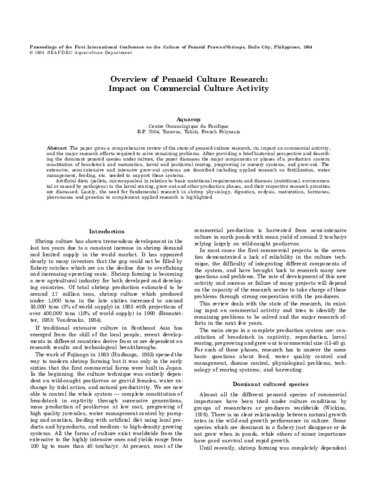
Overview of penaeid culture research: Impact on commercial culture activity
(Aquaculture Department, Southeast Asian Fisheries Development Center, 1985)The paper gives a comprehensive review of the state of penaeid culture research, its impact on commercial activity, and the major research efforts required to solve remaining problems. After providing a brief historical perspective and describing the dominant penaeid species under culture, the paper discusses the major components or phases of a production system: constitution of broodstock and maturation, larval and postlarval rearing, pregrowing in nursery systems, and grow-out. The extensive, semi-intensive and intensive grow-out systems are described including applied research on fertilization, water management, feeding, etc. needed to support these systems. Artificial diets (pellets, microcapsules) in relation to basic nutritional requirements and diseases (nutritional, environmental or caused by pathogens) in the larval rearing, grow-out and other production phases, and their respective research priorities are discussed. Lastly, the need for fundamental research in shrimp physiology, digestion, ecdysis, maturation, hormones, pheromones and genetics to complement applied research is highlighted. -
Prawn grow-out practices in the Philippines
(Aquaculture Department, Southeast Asian Fisheries Development Center, 1988)A review is made of the current situation regarding Penaeus monodon pond culture in the Philippines, examining in particular pond management practices, including site suitability, engineering design, and harvest and post-harvest handling. Problems and prospects in the industry are also discussed, together with some recommendations. -
Hatchery operations and management
(Aquaculture Department, SEAFDEC, 1988)A review is made of hatchery technology regarding the culture of Penaeus monodon , describing the results of research in the following areas: site selection; hatchery design; larval rearing techniques, particularly in the development of live and artificial feed; water management; and, nursery practices for postlarvae. -
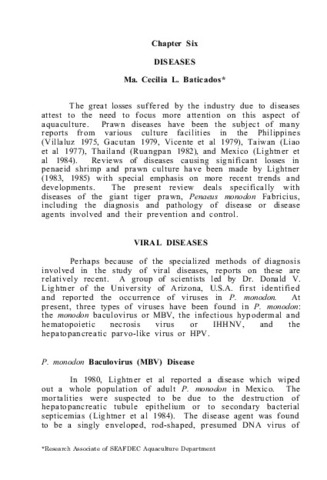
Diseases
(Aquaculture Department, Southeast Asian Fisheries Development Center, 1988)A review is made of diseases of cultured Penaeus monodon , examining the diagnosis and pathology of the disease or disease agents involved and their prevention and control. Both infectious (viral, bacterial, fungal and protozoan) and other (nutritional, toxic and environmental) diseases are considered. -
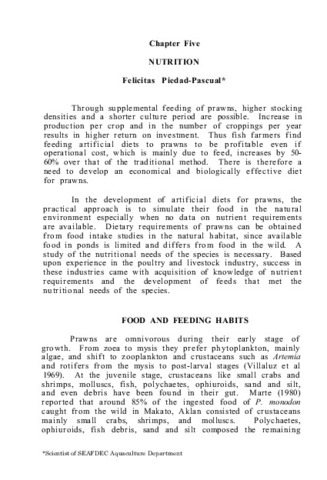
Nutrition
(Aquaculture Department, Southeast Asian Fisheries Development Center, 1988)A discussion is presented on dietary requirements of Penaeus monodon during culture operations. Food and feeding habits are described and nutrient requirements detailed, examining proteins and amino acids, lipids and fatty acids, carbohydrates and vitamins and minerals. The development of diets is discussed briefly and the physical characteristics of pellets outlined. Anti-nutritive factors, feed and feedstuff resources, and feeding practices are also considered. -
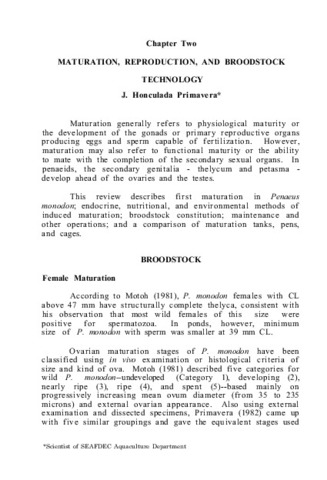
Maturation, reproduction, and broodstock technology
Primavera, Jurgenne (Aquaculture Department, Southeast Asian Fisheries Development Center, 1988)
Following a review of first maturation in Penaeus monodon , details are given of endocrine, nutritional and environmental methods of induced maturation used in aquaculture. Broodstock constitution and maintenance operations are discussed and a comparison made of maturation tanks, pens and cages.
(Aquaculture Department, Southeast Asian Fisheries Development Center, 1988)
Following a review of first maturation in Penaeus monodon , details are given of endocrine, nutritional and environmental methods of induced maturation used in aquaculture. Broodstock constitution and maintenance operations are discussed and a comparison made of maturation tanks, pens and cages. -
Biology and ecology
(Aquaculture Department, Southeast Asian Fisheries Development Center, 1988)A review is made of current information on Penaeus monodon covering various aspects, including taxonomy, morphology, distribution, bionomics and life history. Reproduction, embryonic development, larval stages, spawning, food and feeding, and physiology are described and applications of such information to culture of the species are considered. -
Series: BRAIS state-of-the-art series; no. 2
Biology and culture of Penaeus monodon
(Aquaculture Department, Southeast Asian Fisheries Development Center, 1988)Abstracts of the 6 chapters included in this publication are cited individually. -
Series: Technical report / SEAFDEC Aquaculture Department; 4
Artificial fertilization of eggs and early development of the milkfish Chanos chanos (Forskal)
; ; Primavera, Jurgenne; ; ; ; ; (Aquaculture Department, Southeast Asian Fisheries Development Center, 1977)
Hydrated eggs obtained from a female milkfish were artificially fertilized with the milt collected from a male injected with acetone-dried pituitaries of salmon. The fertilized eggs (1.1 to 1.25 mm in diameter) developed normally in seawater in basins and Petri dishes at a salinity of 30-34 ppt and successfully hatched in 25 to 28½ hours at a temperature of 26.4-29.9°C. The yolk was completely absorbed in about 2½ days and at this period many postlarvae died. A few larvae were reared up to 5 days but all died within 6 days. Effects of feeding the postlarvae from the third day with freshly hatched trochophore larvae of oysters obtained from eggs artificially fertilized in the laboratory could not be ascertained. -
Series: Technical report / SEAFDEC Aquaculture Department; 4
Breeding and larval rearing of the milkfish Chanos chanos (Pisces: Chanidae)
(Aquaculture Department, Southeast Asian Fisheries Development Center, 1977)Two sexually maturing female milkfish were captured in April 1977 and induced to spawn by means of acetone-dried Pacific salmon pituitary powder. The eggs were fertilized and incubated and the resultant young reared to 74-day old, 11 cm long fingerlings. Newly fertilized eggs averaged 1.16 mm in diameter and each had a narrow perivitelline space containing several cortical granules which disappeared within a few minutes. The yolk was slightly yellowish, devoid of oil globules and very finely granulated. Embryonic development was very similar to that of other pelagic fish eggs and hatching occurred between 35 to 36 hr at a salinity of 32 ppt and a temperature range of 28.4-29.2°C. -
Series: Technical report / SEAFDEC Aquaculture Department; No. 7
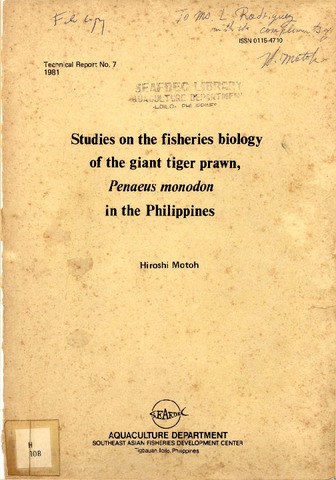
Studies on the fisheries biology of the giant tiger prawn, Penaeus monodon in the Philippines
(Aquaculture Department, Southeast Asian Fisheries Development Center, 1981)The present study was carried out primarily by means of field surveys and secondarily by laboratory and pond experiments to reveal the fisheries biology of the giant tiger prawn, Penaeus monodon Fabricius, in the Philippines during the period from March 1975 to June 1980. The topics covered in this technical report include: (1) taxonomy and morphology; (2) geographical and ecological distribution; (3) reproduction; (4) spawning; (5) development; (6) growth; (7) migration; (8) conclusions and recommendations. -
Series: Technical report / SEAFDEC Aquaculture Department; No. 9
Milkfish fry and fingerling industry of the Philippines: methods and practices
(Aquaculture Department, Southeast Asian Fisheries Development Center; International Development Research Centre, 1983)Milkfish fry catch from Philippine waters can still be increased. Intensified collections in traditional fry grounds and exploitation of new areas may lead to a reduction of adult stock and the possible collapse of the milkfish fry fishery. The implementation of rational conservation and management measures are of immediate concern not only to increase the productivity and number of fry grounds but also to conserve this important aquatic resource. The present methods of catching milkfish fry involve fry filtration by mobile or stationary devices. The design, construction, area and time of operation of the gears are primarily dictated by the bottom topography of the fry grounds, wind direction, local current patterns and tidal fluctuations. Catching, handling, storage and transport activities expose the fish to undue stress which contribute to poor survival. The simple method of lowering the salinity of the water medium considerably reduces mortality. High mortality in nursery ponds has aggravated the seed shortage problem of the milkfish industry. The development of an efficient mass-production technology in rearing milkfish fry to fingerlings and in stunting fingerlings for longer periods could offer the solution not only in meeting the requirements for milkfish seed but also provide part of the fry requirements of other countries in the region. -
SEAFDEC Asian Aquaculture Volume 16(4) December 1994
(Aquaculture Department, Southeast Asian Fisheries Development Center, 1994) -
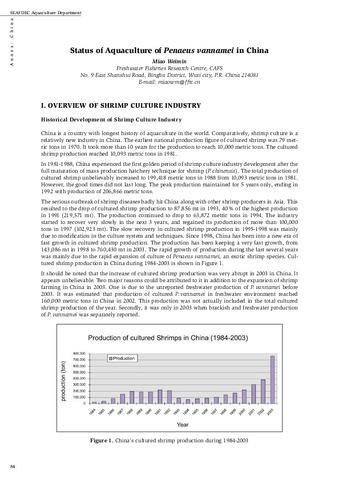
Status of aquaculture of Penaeus vannamei in China.
(Aquaculture Department, Southeast Asian Fisheries Development Center, 2005)China is a country with longest history of aquaculture in the world. Comparatively, shrimp culture is a relatively new industry in China. The earliest national production figure of cultured shrimp was 79 metric tons in 1970. It took more than 10 years for the production to reach 10,000 metric tons. The cultured shrimp production reached 10,093 metric tons in 1981. In 1981-1988, China experienced the first golden period of shrimp culture industry development after the full maturation of mass production hatchery technique for shrimp (P. chinensis). The total production of cultured shrimp unbelievably increased to 199,418 metric tons in 1988 from 10,093 metric tons in 1981. However, the good times did not last long. The peak production maintained for 5 years only, ending in 1992 with production of 206,866 metric tons. The serious outbreak of shrimp diseases badly hit China along with other shrimp producers in Asia. This resulted to the drop of cultured shrimp production to 87,856 mt in 1993, 40% of the highest production in 1991 (219,571 mt). The production continued to drop to 63,872 metric tons in 1994. The industry started to recover very slowly in the next 3 years, and regained its production of more than 100,000 tons in 1997 (102,923 mt). The slow recovery in cultured shrimp production in 1995-1998 was mainly due to modification in the culture system and techniques. Since 1998, China has been into a new era of fast growth in cultured shrimp production. The production has been keeping a very fast growth, from 143,086 mt in 1998 to 760,430 mt in 2003. The rapid growth of production during the last several years was mainly due to the rapid expansion of culture of Penaeus vannamei, an exotic shrimp species. Cultured shrimp production in China during 1984-2003. It should be noted that the increase of cultured shrimp production was very abrupt in 2003 in China. It appears unbelievable. Two major reasons could be attributed to it in addition to the expansion of shrimp farming in China in 2003. One is due to the unreported freshwater production of P. vannamei before 2003. It was estimated that production of cultured P. vannamei in freshwater environment reached 160,000 metric tons in China in 2002. This production was not actually included in the total cultured shrimp production of the year. Secondly, it was only in 2003 when brackish and freshwater production of P. vannamei was separately reported. -
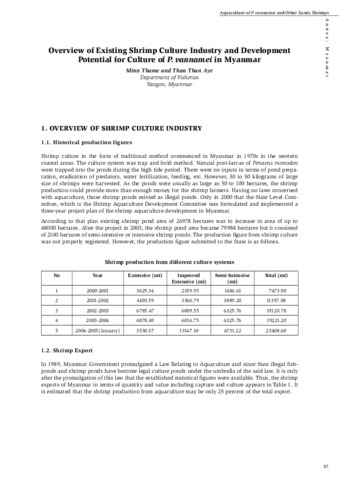
Overview of existing shrimp culture industry and development potential for culture of P. vannamei in Myanmar.
(Aquaculture Department, Southeast Asian Fisheries Development Center, 2005)Shrimp culture in the form of traditional method commenced in Myanmar in 1970s in the western coastal areas. The culture system was trap and hold method. Natural post-larvae of Penaeus monodon were trapped into the ponds during the high tide period. There were no inputs in terms of pond preparation, eradication of predators, water fertilization, feeding, etc. However, 30 to 50 kilograms of large size of shrimps were harvested. As the ponds were usually as large as 50 to 100 hectares, the shrimp production could provide more than enough money for the shrimp farmers. Having no laws concerned with aquaculture, those shrimp ponds existed as illegal ponds. Only in 2000 that the State Level Committee, which is the Shrimp Aquaculture Development Committee was formulated and implemented a three-year project plan of the shrimp aquaculture development in Myanmar. According to that plan existing shrimp pond area of 26978 hectares was to increase in area of up to 48000 hectares. After the project in 2003, the shrimp pond area became 79984 hectares but it consisted of 2100 hectares of semi-intensive or intensive shrimp ponds. The production figure from shrimp culture was not properly registered. -
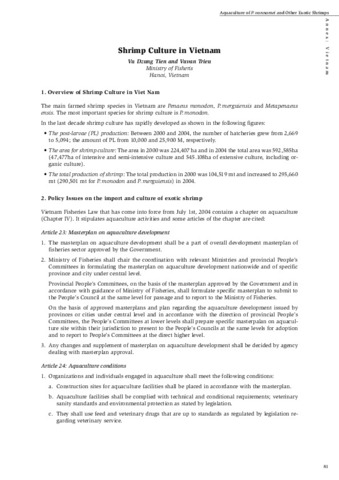
Shrimp culture in Vietnam.
(Aquaculture Department, Southeast Asian Fisheries Development Center, 2005)