SEAFDEC/AQDINSTITUTIONAL REPOSITORY
    • English
    • 日本語
    • ไทย
    • Bahasa Indonesia
  • English 
    • English
    • 日本語
    • ไทย
    • Bahasa Indonesia
  • Login
View Item 
  •   SEAFDEC/AQD Institutional Repository Home
  • 03 SEAFDEC/AQD External Publications
  • Journal Articles, Conference Papers and Book Chapters by SEAFDEC Staff
  • Journal Articles
  • View Item
  •   SEAFDEC/AQD Institutional Repository Home
  • 03 SEAFDEC/AQD External Publications
  • Journal Articles, Conference Papers and Book Chapters by SEAFDEC Staff
  • Journal Articles
  • View Item
JavaScript is disabled for your browser. Some features of this site may not work without it.

Studies on the chronic soft-shell syndrome in the tiger prawn, Penaeus monodon Fabricius, from brackishwater ponds

  • Global styles
  • MLA
  • Vancouver
  • Elsevier - Harvard
  • APA
  • Help
Thumbnail
View/Open
Date
1986
Author
Baticados, Ma. Cecilia L.
Coloso, Relicardo M.
Duremdez, Roselyn C.
Page views
2,836
ASFA keyword
water quality ASFA
brackishwater aquaculture ASFA
deficiency diseases ASFA
prawn culture ASFA
aquaculture ASFA
dietary deficiencies ASFA
pond culture ASFA
exoskeleton ASFA
AGROVOC keyword
Vibrio AGROVOC
Aeromonas AGROVOC
Penaeus monodon AGROVOC
Taxonomic term
Penaeus monodon GBIF
Metadata
Show full item record


Share 
 
Abstract
Prawn culture is becoming more widespread in the Philippines. In recent years, prawn production in brackishwater ponds has been adversely affected by a chronic soft-shell syndrome. A field survey of prawn ponds in the island of Panay showed that occurrence of soft-shelled prawns could be predicted with 98% accuracy under poor soil and water conditions in the ponds. Some management practices were also highly correlated with the soft-shell syndrome.

Soft- and hard-shelled prawns collected during the survey were analyzed for calcium and phosphorus levels. In soft-shelled prawns, calcium and phosphorus levels were significantly higher in the hepatopancreas, and phosphorus was significantly lower in the exoskeleton than in hardshelled prawns. Chitinoclastic bacteria, Vibrio and Aeromonas, were isolated from soft-shelled prawns but experimental infection with these species to induce soft-shelling gave largely negative results. Laboratory experiments using an organostannous pesticide revealed that a 96-h exposure to at least 0.0154 ppm of the pesticide could result in soft-shelling of 47-60% of the prawns.

Soft-shelled prawns were fed various quantities of frozen mussel meat for 4 weeks to find out if soft-shelling could be reversed by dietary manipulation. Successful reversal of soft-shelling, general improvement of shell quality, and best growth and survival rates were observed in prawns fed a 14% mussel meat diet.
Description
SEAFDEC Contribution No. 182.
URI
http://hdl.handle.net/10862/1060
Suggested Citation
Baticados, M. C. L., Coloso, R. M., & Duremdez, R. C. (1986). Studies on the chronic soft-shell syndrome in the tiger prawn, Penaeus monodon Fabricius, from brackishwater ponds. Aquaculture, 56(3-4), 271-285. https://doi.org/10.1016/0044-8486(86)90342-X 
DOI
10.1016/0044-8486(86)90342-X
Type
Article
ISSN
0044-8486
Collections
  • Journal Articles [1267]

Related items

Showing items related by title, author, creator and subject.

  • Thumbnail

    An overview of the nutrition, feed and feeding techniques of prawn penaeid/shrimps 

    Piedad-Pascual, Felicitas (Philippine Council for Aquatic and Marine Research and Development, 1989)
    This paper echoes what transpired during the first International Conference of Penaeid Prawns/Shrimps held in Iloilo City in December 4-7, 1984, particularly on the Nutrition nd Feed Development. Around 25 papers were presented during the conference. The nutrient requirements of P. japonicus and to some extent, P. monodon have been studied quite extensively compared to other penaeid species. Requirements for protein, carbohydrates fats, amino acids and essential fatty acids for juveniles and larvae have been defined compared to those of the broodstock. Optimum protein levels for prawn juveniles vary from 28-38% for P. kerathurus, 40-46% for P. monodon, 43% for P. indicus and 50-54% for P. japonicus. Dissacharides like sucrose and trehalose have been found to be good source of carbohydrates at 20-25% in the diet. Crustacean diets require around 0.5% cholesterol. There are few studies on vitamine and mineral requirements. There are artificial diets for juveniles and microencapsulated diets that can completely replace live organisms as larval feed. Microencapsulated diets have been field-tested for P. vannamei, P. stylirostris, P. monodon, P. indicus and P. merguiensis in Ecuador, Taiwan, Malaysia, Thailand and the Philippines. When a commercial diet for the broodstock becomes available ther will be an artificial diet for athe life cycle of tha prawn.
  • Thumbnail
    Series: Aquaculture extension manual; No. 19

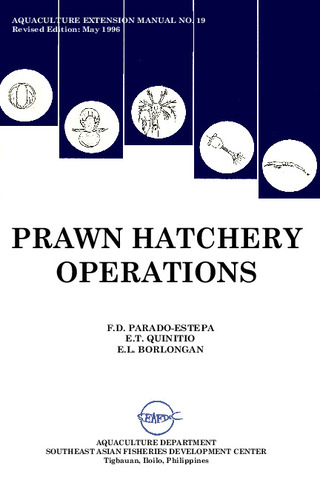
    Prawn hatchery operations 

    Parado-Estepa, Fe D.; Quinitio, Emilia T. ORCID; Borlongan, Emeterio L. (Aquaculture Department, Southeast Asian Fisheries Development Center, 1996-05)
    The manual, an updated version of the 1984 SEAFDEC/AQD manual, presents the underlying principles and step-by-step instructions of prawn larval and post-larval rearing. The techniques described are not only applicable to Penaeus monodon, but may also be modified and applied to other penaeid and metapenaeid species. The following aspects are covered: Site selection; Life cycle; Hatchery design and planning; Hatchery operations; Diseases; and Economics.
  • Thumbnail

    The lowdown on world shrimp culture - II 

    Yap, Wilfredo G. (INFOFISH, 2001)
    This paper introduces some new members of the international shrimp culture club and goes on to discuss some recent technological innovations in the industry, particularly the polyculture of tilapia (mainly Oreochromis mossambicus) and shrimp.

© SEAFDEC/AQD  2026
Send Feedback | Subscribe


Browse

All of SAIRCommunities & CollectionsBy Issue DateAuthorsTitlesSubjectsThis CollectionBy Issue DateAuthorsTitlesSubjects

My Account

LoginRegister

Statistics

View Usage Statistics

© SEAFDEC/AQD  2026
Send Feedback | Subscribe


Export citations

Export the current results of the search query as a citation list. Select one of the available citation styles, or add a new one using the "Citations format" option present in the "My account" section.

The list of citations that can be exported is limited to items.

Export citations

Export the current item as a citation. Select one of the available citation styles, or add a new one using the "Citations format" option present in the "My account" section.

Export Citations

DOCUMENT REQUEST NOT AVAILABLE

This publication is still available (in PRINT) and for sale at AQD bookstore. The library is currently restricted to send PDF of publications that are still for sale.

You may contact bookstore@seafdec.org.ph or visit AQD bookstore for orders.

FILE UNDER EMBARGO

This file associated with this publication is currently under embargo. This will be available for download after the embargo date.