Occurrence of milkfish, Chanos chanos (Forsskal) eggs around Panay Island, Philippines

Download URL
naosite.lb.nagasaki-u.ac.jpDate
1980Page views
2,389ASFA keyword

AGROVOC keyword
Metadata
Show full item recordShare
Abstract
A total of 551 milkfish eggs was collected by horizontal tows with a fish larval net in the waters around Panay island during the period from April 1976 to June 1979. The maximum number obtained by a single tow was 33 eggs. Most of the eggs were collected from Cuyo East Pass, with some from the waters around the Cagayan Islands and a single egg from the Sibuyan Sea. Almost all the eggs were collected during the period frim March to June, with a peak in April, one month ahead of the peak of fry occurrence.
Very often milkfish eggs occurred in shallow waters around islands or close to the coasts, while they were sometimes found at locations remote from land and as deep as 900 m. Water temperatures and salinities at locations shere milkfish eggs were found ranged from 26.7 to 30.8°C and from 32.9 to 34.5 ppt. The eggs were rather evenly distributed from the surface to at least 20 m down. The eggs found in the early morning collections were in the early stages of development; those found later in the day were more advanced. It seems that spawning of mikfish takes place at midnight, and that the incubation period of eggs in the wild is about 20 hours.
Description
Contribution No. 42 of the Aquaculture Department Southeast Asian Fisheries Development Center.
Suggested Citation
Senta, T., Kumagai, S., & Castillo, N. M. (1980). Occurrence of milkfish, Chanos chanos (Forsskal) eggs around Panay Island, Philippines. Bulletin of the Faculty of Fisheries, Nagasaki University , (48), 1-11. http://hdl.handle.net/10862/1100
Type
ArticleISSN
0547-1427Collections
- Journal Articles [1267]
Related items
Showing items related by title, author, creator and subject.
-
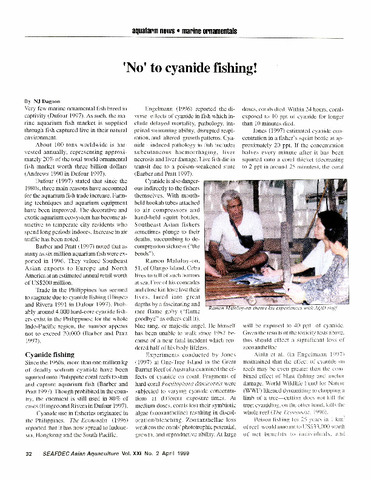
'No' to cyanide fishing!
(Aquaculture Department, Southeast Asian Fisheries Development Center, 1999) -
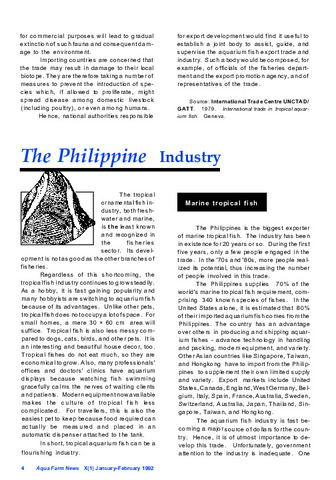
The Philippine industry: Marine tropical fish
(Aquaculture Department, Southeast Asian Fisheries Development Center, 1992) -
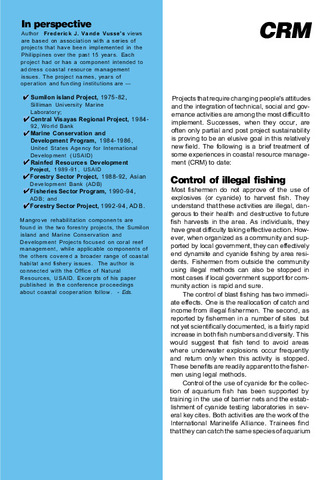
CRM in the Philippines: Lessons learned
(Aquaculture Department, Southeast Asian Fisheries Development Center, 1996)Philippine coastal communities can become capable fishery resource managers and that their management practices can become largely self-sustaining if the project approach focuses on assisting fishermen to learn how to help themselves. Community organization is an essential part of the process and should not be viewed as an end product in itself. There are also no quick fixes, and projects require a complex array of activities if large numbers of coastal residents are to be assisted. In some of these projects, the control of illegal fishing combined with limiting of commercial fishing to offshore areas and good coastal habitat management resulted in a doubling of daily fish catch and income for small-scale fishermen. However, even with the best of management, the total fishery harvest is limited and further increases in individual fishing income can only come from reducing total fishing effort. This will require a system of control on access to the resource to limit the number and kind of fishing gears and to divide the resource equitably. Assisting coastal communities to devise and implement realistic equitable access controls is the major challenge facing coastal resource co-management.