Duration of feeding and indirect selection for growth of tilapia


Share
Abstract
Duration of spontaneous feeding was observed at three times each day in a laboratory population of nine juvenile tilapia (Oreochromis mossambicus). Growth of the fish was measured as change in length and weight, and also as uptake of 14C-labelled glycine by isolated scales. Duration of the first morning feeding was highly correlated with all measures of growth and was independent of initial size. Later feedings were not correlated with growth. Selection on feeding duration could be used to select indirectly for growth rate; this might be a valuable procedure where individuals in the population are not exactly the same age (i.e., where size-at-age is an inaccurate measure of growth).
Description
Contribution No. 155 of the SEAFDEC Aquaculture Department.
Suggested Citation
Villegas, C. T., & Doyle, R. W. (1986). Duration of feeding and indirect selection for growth of tilapia. Aquaculture , 57(1-4), 89-92. https://doi.org/10.1016/0044-8486(86)90184-5
Type
ArticleISSN
0044-8486Collections
- Journal Articles [1266]
Related items
Showing items related by title, author, creator and subject.
-
Processing of feedstuffs and aquafeeds
(Aquaculture Department, Southeast Asian Fisheries Development Center, 2002)This chapter will help the reader understand and appreciate the basic principles of processing, preparation, storage, and quality control in the preparation of aquafeeds. The material in this section is presented in sequence beginning with the processing of basic ingredients to remove antinutritional factors, followed by steps in feed preparation, from the easiest to the more complex processes, and storage. This chapter presents methods and equipment that are useful not only for feed millers, but also for extension workers and fish farmers. -
Management of feeding aquaculture species
(Aquaculture Department, Southeast Asian Fisheries Development Center, 2002)This chapter teaches the reader to: differentiate the different feeding strategies in pond culture; learn feeding management methods such as stock sampling and record keeping, calculating daily feed ration, choosing appropriate feed size, and methods of applying feeds; understand the impact of feeding management on water quality and environment and on the cultured animal’s growth, survival, and feed conversion ratio; and describe the different feeding schemes used to culture fishes (milkfish, tilapia, rabbitfish, bighead carp, native catfish, sea bass, orange-spotted grouper, and mangrove red snapper; and crustaceans (tiger shrimp and mud crab). Other species for aquaculture stock enhancement (donkey’s ear abalone, seahorses, window-pane oyster) are also discussed. -
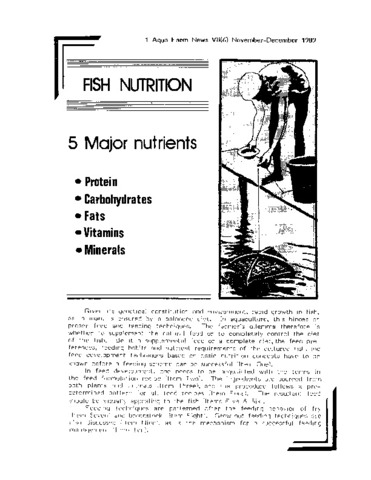
Fish nutrition
(Aquaculture Department, Southeast Asian Fisheries Development Center, 1989)