Spawning response of mature female sea bass, Lates calcarifer (Bloch), to a single injection of luteinizing hormone-releasing hormone analogue: effect of dose and initial oocyte size


Share
抄録
The effect of various doses of luteinizing hormone-releasing hormone analogue (LHRHa) ranging from 1 to 100 μg/kg body weight on the spawning response of mature female sea bass, Lates calcarifer (Bloch) was tested. A single intramuscular injection of LHRHa resulted in a dose-related increase in the spawning rate (number of spawnings of each fish over four consecutive days) of mature fish. An LHRHa dose of 5 μg/kg and less induced low spawning rates of 16.7% to 37.5% or at least one spawning every four days. However, mature sea bass spawned more than once (43.8–58.3%) in four days at dose levels of 10 μg/kg and above. Hormone treatment within the dose range tested did not influence the number, fertilization and hatching rates of spawned eggs.
The influence of initial oocyte size on the LHRHa-induced spawning response of mature sea bass was also examined. Sea bass with an initial oocyte diameter of 0.30–0.39 mm did not respond to the single injection of 100 μg LHRHa/kg. In contrast, LHRHa induced spawning among sea bass with an initial egg size of 0.40–0.49 mm, although two of four sea bass of the same stage of ovarian maturity spawned spontaneously. Fish having an initial oocyte size of 0.50–0.55 mm spawned with and without LHRHa treatment. Spontaneous spawning among saline-injected sea bass occurred at a later time (24–58 h post-injection) compared to fish induced to spawn by a single injection of LHRHa (8–36 h post-injection). The initial spawning response time interval for fish with an initial egg size of 0.50 mm or greater was further reduced to 8–9 h by LHRHa. These results indicate that LHRHa can successfully induce spawning in mature female sea bass which have attained a critical oocyte diameter and that the spawning response interval is reduced with a further increase in egg size beyond the critical oocyte diameter limit.
記述
Presented in part at the Second Asian Fisheries Forum in Tokyo, Japan, 17–21 April 1989 (Abstract No. 226).
Suggested Citation
Garcia, L. M. (1989). Spawning response of mature female sea bass, Lates calcarifer (Bloch), to a single injection of luteinizing hormone-releasing hormone analogue: effect of dose and initial oocyte size. Journal of Applied Ichthyology , 5(4), 177-184. https://doi.org/10.1111/j.1439-0426.1989.tb00490.x
Type
ArticleISSN
1439-0426Collections
- Journal Articles [1267]
Related items
Showing items related by title, author, creator and subject.
-
Influence of LHRHa and methyltestosterone on milt production of sea bass Lates calcarifer (Bloch)
(Aquaculture Department, Southeast Asian Fisheries Development Center, 1996)Milt volume, sperm density, and number of spermatozoa were determined to quantify milt production of mature sea bass after a single injection of LHRHa [(D-Ala6,Pro9-N-ethylamiide)LHRH] in saline solution and 17α-methyltestosterone in corn oil (MT). Two measures of sperm density, sperm count and spermatocrit, were highly correlated (r=0.85). Compared with control, milt volume and the number of spermatozoa collected increased but sperm count decreased (24% at 24 h) after a LHRHa (20 µg/kg body weight treatment, suggesting a stimulation of spermatozoa production and not merely milt dilution. Further milt dilution (44%) was induced by 80 µg/kg LHRHa (LHRHa80) at 12 h post-treatment but not by 200 µg/kg MT (MT200) alone. A milt dilution of only 27% at 12 h after simultaneous injections of LHRHa80 and MT200 may indicate some inhibitory effect of MT on the efficiency of LHRHa. These results demonstrate that the stimulation of milt production by LHRHa involves testicular hydration resulting in milt dilution. -
Milt production of sea bass Lates calcarifer Bloch administered an analogue of luteinizing hormone-releasing hormone and 17α-methyltestosterone
(Society of Israeli Aquaculture and Marine Biotechnology, 2002)The milt production responses of sexually mature sea bass Lates calcarifer to (D-Ala6, Pro9-N- ethylamide) luteinizing hormone-releasing hormone (LHRHa) and 17α-methyltestosterone injections were examined. At 24 h after injection of a low dose of LHRHa (20 μg/kg BW), the sperm count decreased significantly compared to saline-treated fish, but it returned to pre-treatment levels 48 h after injection, suggesting a possible hydration of the milt. Other milt parameters (milt volume, spermatocrit, sperm production) in LHRHa-treated fish did not vary from their controls at 24 or 48 h after injection but the overall pattern suggested a reduction in milt viscosity. Total expressible milt and spermatozoa collected over the 48-h experiment was approximately three-fold higher in LHRHa-injected fish than in saline-injected fish, indicating a stimulation of spermatozoa production, not merely milt dilution due to hydration. In a second experiment, sperm count and spermatocrit were significantly lower than those of saline-injected fish at 17 and 48 h after a single injection of a high dose of LHRHa (80 μg/kg BW). A methyltestosterone injection combined with the LHRHa injection also resulted in a significantly lower sperm count, but the spermatocrit remained comparable to the control group, suggesting a suppression of the LHRHa-induced milt hydration response. Results demonstrate that LHRHa stimulates milt hydration and spermatozoa production in milting sea bass and that a simultaneous methyltestosterone injection partially suppresses this response. -
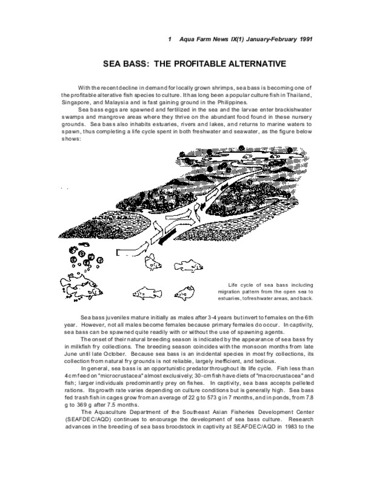
Sea bass: The profitable alternative
(Aquaculture Department, Southeast Asian Fisheries Development Center, 1991)