Development of the digestive tract of milkfish, Chanos chanos (Forsskal): Histology and histochemistry


Share
抄録
The digestive tract of the newly hatched milkfish larva is a simple undifferentiated tube. Three days after hatching, differentiation of the esophagus begins with development of mucous-secreting cells. At this time, the intestine can be distinguished from the anterior portion of the digestive tract by its tall columnar cells with centrally located nuclei and brush border with cytoplasmic projections. After 14 days, mucosal folds develop in the esophagus. In 21-day-old larvae, the stomach differentiates into the cardiac and pyloric regions while goblet cells start to develop in the intestine. In fish undergoing metamorphosis (≥ 42 days old), the mucosal cells of the cardiac stomach develop into two distinct cell types: the columnar cells which make up the folds nearest the lumen, and the cuboidal cells which constitute the gastric glands. The cardiac stomach is the only region in the digestive tract where mucus secretion is not acidic. From 3-day-old larvae up to the older stages, alkaline phosphatase is localized only at the brush border of the intestinal epithelial cells. Aminopeptidase is also found only in the brush border of enterocytes, but only in 21-day and older milkfish. Intestinal esterases are present not only in the brush border but are also diffusely distributed in the cytoplasm of enterocytes of 3-day or older fish. Esterase is also found in both the columnar and gland cells of the cardiac stomach, but only in postmetamorphic (60-day or older) fish. These morphological and histochemical changes of the gut seem to parallel dietary and habitat shifts throughout development, which encompasses life stages spent in pelagic, coastal or inland waters.
記述
SEAFDEC Aquaculture Department Contribution No. 192.
Suggested Citation
Ferraris, R. P., Tan, J. D., & de la Cruz, M. C. (1987). Development of the digestive tract of milkfish, Chanos chanos (Forsskal): Histology and histochemistry. Aquaculture , 61(3-4), 241-257. https://doi.org/10.1016/0044-8486(87)90153-0
Type
ArticleISSN
0044-8486Collections
- Journal Articles [1262]
Related items
Showing items related by title, author, creator and subject.
-
Series: Aquaculture extension manual; No. 25
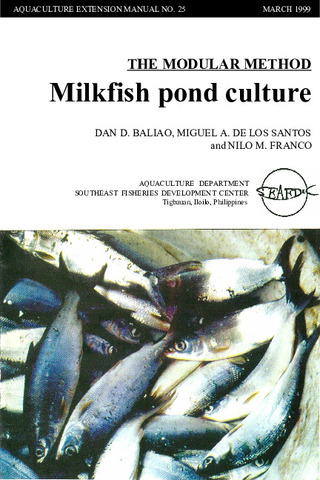
The modular method: Milkfish pond culture
(Aquaculture Department, Southeast Asian Fisheries Development Center, 1999)The modular method of milkfish culture (Chanos chanos) described in the manual is an improvement over the traditional extensive method. The manual is intended for the use of fish farmers and aquaculturists, extensionists, ... -
Evaluation of organic and inorganic fertilizers in brackishwater milkfish ponds
(Elsevier, 1989)The study was conducted in twelve 144-m2 ponds to evaluate the effect of different organic and inorganic fertilizers on the growth, survival, gross production, and profitability of marketable milkfish. The ... -
Milkfish breeding and hatchery technology at SEAFDEC/AQD
(Aquaculture Department, Southeast Asian Fisheries Development Center, 1999)Describes the techniques already adopted by the private sector: broodstock management, broodstock diet, commercial fry production, live transport, and larval diet. A list of AQD research publications on milkfish is included.