Daily amount of rotifers taken by a sea bass Lates calcarifer larvae

View/
Date
1990Page views
3,674ASFA keyword

AGROVOC keyword
Taxonomic term

Metadata
Perlihat publikasi penuhShare
Abstract
The amount of rotifers consumed by a single sea bass Lates calcarifer larva per day (R) was examined by both the direct and by the satiation-digestion methods. In the direct method, R is estimated by the number of rotifers left in the larval tanks and larval density in the tanks, while in the satiation-digestion method R is estimated by the amount of rotifers found in the digestive tract of the larvae. In both methods, the amount of rotifers consumed by the larvae increased exponentially with larval growth. The relationship between the total length (TL) and the log-log plots of the maximum amount of rotifers eaten by a larva can be expressed by the following equations; \(R=1.799 \times TL^{4.398} (r=0.975)\) for the direct method and \(R = 4.861 \times TL^{3.432} (r = 0.907)\) for the satiation-digestion method. The relationship between TL and body wet weight (BW) can be expressed as: \(BW = 2.607 \times 10^{-4} \times TL^{3.786} (r=0.960)\) for larvae smaller than 6.5 mm TL and \(BW = 15.053 \times 10^{-3} \times TL^{2.855} (r = 0.916)\) for those larger than 6.5 mm TL.
The index of satiation was almost the same for day 6(0-6), D-9 and D-12 (8.3-23%), higher range was observed in D-15 larvae. The index of daily feeding amount was comparatively higher in D-12 larvae compared to D-6, D-9 or D-15 larvae.
Suggested Citation
Kohno, H., & Duray, M. (1990). Daily amount of rotifers taken by a sea bass Lates calcarifer larvae. Philippine Journal of Science , 119(3), 247-255. http://hdl.handle.net/10862/1313
Type
ArticleISSN
0031-7683Koleksi
- Journal Articles [1258]
Related items
Showing items related by title, author, creator and subject.
-
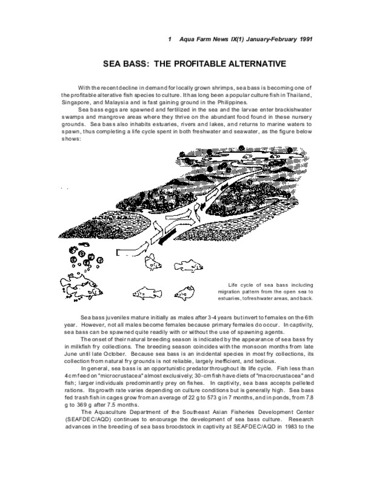
Sea bass: The profitable alternative
(Aquaculture Department, Southeast Asian Fisheries Development Center, 1991) -
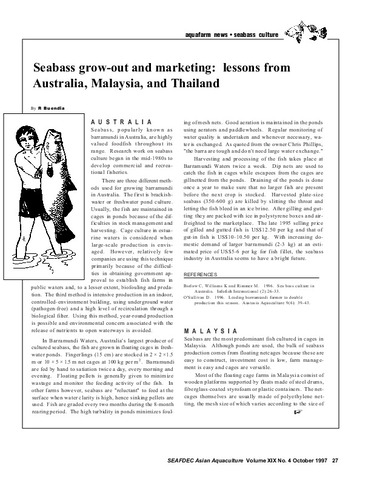
Seabass grow-out and marketing: lessons from Australia, Malaysia, and Thailand
(Aquaculture Department, Southeast Asian Fisheries Development Center, 1997) -
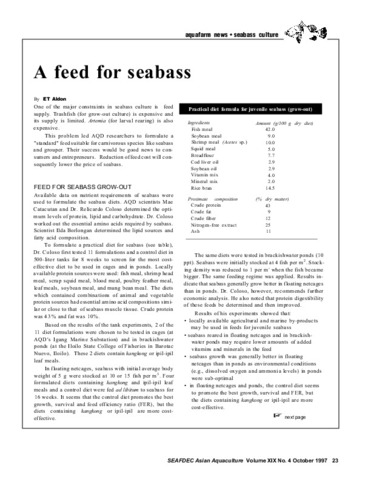
A feed for seabass
(Aquaculture Department, Southeast Asian Fisheries Development Center, 1997)One of the major constraints in seabass (Lates calcarifer) culture is feed supply. Details are given of work conducted at AQD regarding the formulation of a 'standard' feed suitable for carnivorous species like the seabass ...