Food value of Brachionus plicatilis fed three selected algal species as live food for milkfish, Chanos chanos Forsskal, fry production


Share
抄録
The effects of three selected algal species, Tetraselmis tetrahele, Isochrysis galbana and marine Chlorella sp. on the population growth of Brachionus plicatilis was evaluated after 3, 5 and 7 days of culture. The rotifers fed on T. tetrahele showed superior growth with mean peak density of 92.5 individuals per ml to those fed on I. galbana (48.2 individuals per ml) and Chlorella sp. (47.2 individuals per ml) in 5 days.
In another experiment, milkfish. Chanos chanos Forsskal, fry with initial mean body weight and standard length of 6.26 ± 1.07mg and 13.04 ± 1.40mm, respectively, were fed B. plicatilis reared on the three algal species for 30 days. Results showed that growth, measured in terms of gain in weight and length, was significantly different (P > 0.05) among treatments. Fastest growth was obtained in fry fed B. plicatilis cultured on T. tetrahele with mean gains in weight and length of 61.48 ± 8.40mg and 9.37 ± 1.68 mm, respectively, followed by fry fed B. plicatilis reared on I. galbana (43.56 ± 8.35mg and 6.25 ± 0.48mm). Milkfish fry fed B. plicatilis cultured on Chlorella sp. gave the poorest growth with mean gains in weight and length of 11.05 ± 1.82mg and 2.33 ± 0.29mm, respectively. Percentage survival ranged from 93.1 to 95.3 percent and was not significantly different between treatments (P < 0.05).
The differences in population growth of B. plicatilis and consequently growth of milkfish fry was almost certainly attributed to the differences observed in the biological values of their algal diet, and in particular their protein and lipid contents. T. tetrahele and I. galbana improved the food value of B. plicatilis as live food for the milkfish fry. Their high dietary value was related to the higher algal protein and fat levels and contents of n-3 HUFA particularly 20:5n-3 and 22:6n-3 compared to B. plicatilis cultured on Chlorella sp. The results of the present study point to T. tetrahele as the most suitable food for the mass culture of the rotifer, B. plicatilis.
記述
Villegas, C. T., Millamena, O., & Escritor, F. (1990). Food value of Brachionus plicatilis fed three selected algal species as live food for milkfish, Chanos chanos Forsskal, fry production. Aquaculture Research, 21(2), 213–220. (new journal title)
Suggested Citation
Villegas, C. T., Millamena, O., & Escritor, F. (1990). Food value of Brachionus plicatilis fed three selected algal species as live food for milkfish, Chanos chanos Forsskal, fry production. Aquaculture and Fisheries Management , 21(2), 213-219. https://doi.org/10.1111/j.1365-2109.1990.tb00458.x
Type
ArticleISSN
0266-996XCollections
- Journal Articles [1262]
Related items
Showing items related by title, author, creator and subject.
-
Series: Aquaculture extension manual; No. 25
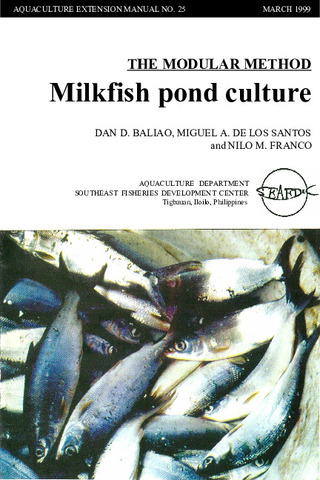
The modular method: Milkfish pond culture
(Aquaculture Department, Southeast Asian Fisheries Development Center, 1999)The modular method of milkfish culture (Chanos chanos) described in the manual is an improvement over the traditional extensive method. The manual is intended for the use of fish farmers and aquaculturists, extensionists, ... -
Evaluation of organic and inorganic fertilizers in brackishwater milkfish ponds
(Elsevier, 1989)The study was conducted in twelve 144-m2 ponds to evaluate the effect of different organic and inorganic fertilizers on the growth, survival, gross production, and profitability of marketable milkfish. The ... -
Milkfish breeding and hatchery technology at SEAFDEC/AQD
(Aquaculture Department, Southeast Asian Fisheries Development Center, 1999)Describes the techniques already adopted by the private sector: broodstock management, broodstock diet, commercial fry production, live transport, and larval diet. A list of AQD research publications on milkfish is included.