Influence of stocking density and fertilization regime on growth, survival and gross production of Penaeus monodon Fabricius in brackishwater ponds

View/
Date
1991Page views
2,172ASFA keyword

AGROVOC keyword
Taxonomic term

Metadata
Show full item recordShare
Abstract
Twelve 0.1 ha earthen ponds were stocked at 3,500 or 7,000/ha with 1-month old nursery reared Penaeus monodon Fabricius (1.73 g). Fertilizer treatments were 125 kg chicken manure plus 4.1 kg diammonium phosphate (18-46-0) and 6.56 kg urea (45-0-0) per application for treatments U3500 and U7000 and 125 kg chicken manure plus 8.15 kg diammonium phosphate and 0.89 kg urea per application for treatments P3500 and P7000. Fertilizers were broadcast 10 days after pest eradication and every two weeks thereafter. Water was exchanged (20%) one day before fertilization throughout the 86-day culture period. Shrimp yields at harvest were: P7000, 193.6 kg/ha; P3500, 119.4 kg/ha; U3500, 97.5 kg/ha; and U7000, 82.4 kg/ha. Mean survival for each treatment was 96.2%, 97%, 89.3% and 75%, respectively. There were significant differences in shrimp yields at harvest among treatments (p < 0.05).
Suggested Citation
Subosa, P. F., & Bautista, M. N. (1991). Influence of stocking density and fertilization regime on growth, survival and gross production of Penaeus monodon Fabricius in brackishwater ponds. The Israeli Journal of Aquaculture-Bamidgeh , 43(2), 69-76. http://hdl.handle.net/10862/1356
Type
ArticleISSN
0792-156XCollections
- Journal Articles [1266]
Related items
Showing items related by title, author, creator and subject.
-
A brief account of the experience of Sabah Fisheries Department in fish larval rearing
(Aquaculture Department, Southeast Asian Fisheries Development Center, 1996)Venturing into the aquaculture sector especially in pond and cage culture is a step that has been taken up by entrepreneurs and traditional fishermen of Sabah. However, shortage in the supply of fish fry is a stumbling block to the progress of the industry. The Sabah Fisheries Department has taken steps to overcome this problem by setting up a hatchery with the objectives to transfer know-how on hatchery technologies to the private sector besides producing fry for distribution. The Tanjong Badak multi-species hatchery is a newly established hatchery, completed in mid-1990. The species reared for production purposes are tiger shrimp and finfish which include red snapper, grouper, sea bass and polkadot grouper. The Department has not close to producing sea bass fry. Shrimp fry at juvenile stages (PL 40) are distributed as subsidies to local fish farmers while some are reared at the Department's various cage and pond culture projects. Limited success in producing grouper and red snapper fry have been achieved to date. The incidence of very low fertilization rates of eggs coupled with low survival rates are major problems facing the hatchery. In conclusion, the Sabah Fisheries Department's experience in fish larval rearing is still limited. Greater scientific research and studies need to be carried out to improve further the performance of the hatchery to achieve the target of fry sufficiency for the aquaculture industry. -
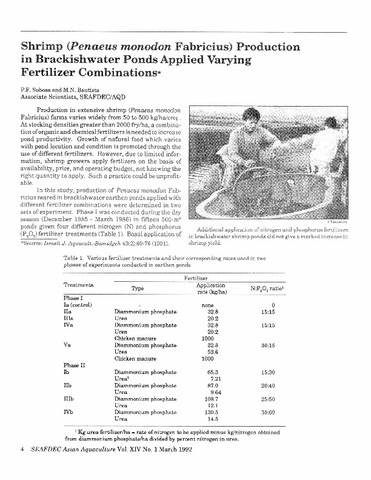
Shrimp (Penaeus monodon Fabricius) production in brackishwater ponds applied varying fertilizer combinations
(Aquaculture Department, Southeast Asian Fisheries Development Center, 1992)Details are given of the production of Penaeus monodon in the Philippines reared in brackishwater earthen ponds applied with different fertilizer combinations, namely diammonium phosphate, urea and chicken manure. Results show that the shrimp showed higher yields in fertilized ponds, but increasing the concentration of fertilizers did not give a marked increase in yield - the excess fertilizer was wasted. -
Nursery and grow-out operation and management of Penaeus monodon (Fabricius)
(Aquaculture Department, Southeast Asian Fisheries Development Center, 1988)The results of research on nursery and grow-out rearing of prawn conducted by the SEAFDEC Aquaculture Department for over a decade are reviewed. Different rearing facilities designed to accommodate hatchery-produced prawn fry are presented with corresponding data on growth, survival and production. Studies on stocking density, fertilization/natural food production, water management, feeds and feeding schemes and harvest/post-harvest handling are evaluated and viable technology identified. Diseases, pests and predators and other factors considered as production constraints are also mentioned. The success in hatchery operation for prawn coupled by the gradual emergence of nursery and grow-out rearing technology have triggered off a technology-dependent prawn industry. When SEAFDEC AQD was established in 1973, there were very few commercial prawn monoculture ventures in the country. Prawn pond production was mostly an incidental crop in milkfish culture. At present, various prawn grow-out techniques ranging from extensive, semi-intensive and intensive culture systems are in practice. SEAFDEC AQD focused its research on the extensive and semi-intensive culture systems which are within the reach of most farmers in contrast to the intensive system that is highly capital-intensive. There have been much work done in nursery and grow-out operations, but much remains to be done in research, among which are the development of nutritionally-efficient and low-cost feed, control of diseases, etc.