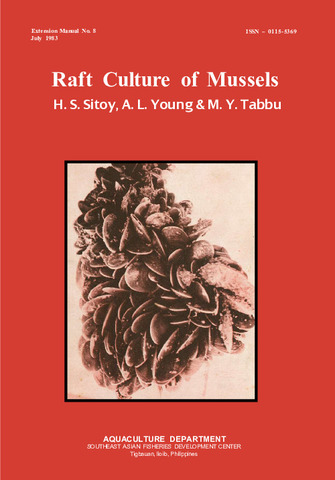
Raft culture of mussels


Share
Suggested Citation
Sitoy, H. S., Young, A. L., & Tabbu, M. Y. (1983). Raft culture of mussels. Tigbauan, Iloilo, Philippines: Aquaculture Department, Southeast Asian Fisheries Development Center.
Type
BookISSN
0115-5369Series
Aquaculture extension manual; No. 8Format
12 p. : ill.
Collections
Related items
Showing items related by title, author, creator and subject.
-
A comparison of macronutrient levels in green mussel (Perna viridis) and brown mussel (Modiolus metcalfei Hanley)
(The Science Society of Thailand, 1980)Two species of mussel from Panay Island, Philippines, have been analyzed for moisture, crude protein, crude fat, ash, carbohydrated, crude fibre and minerals (calcium and phosphrus). Results showed that the brown mussel (Modiolus metcalfei), both the marketable size and the small ones, have higher protein content (71.49 and 67.10% dry weight) than the marketable-size green mussel (Perna viridis ), 63.94%. The green mussel contained more fat but less ash, crude fibre and minerals than the brown mussel. -
Polyculture of green mussels, brown mussels and oysters with shrimp control luminous bacterial disease in a simulated culture system
Tendencia, Eleonor (Elsevier, 2007)
Shrimp mortality due to luminous bacteria has been a problem of the shrimp industry worldwide. Polyculture of shrimp with finfish, such as grouper, seabass, snapper, siganid, Tilapia hornorum, and the Genetically Improved Farmed Tilapia (GIFT), could control the growth of luminous bacteria. One way to reduce adverse environmental impact and to reduce bacterial count is through the use of bivalves to filter pond effluents. This study investigated the effect of several bivalves on the growth of luminous bacteria in a simulated shrimp culture environment using concrete tanks. Tanks were stocked with shrimp at a biomass of 100 g/m3 and with brown mussel (158 pcs/m3), green mussel (137 pcs/m3), or oyster (376 pcs/m3). Growth of luminous bacteria decreased to below 101 cfu/ml in tanks with green mussel after 5 d, brown mussel after 16 d, and oyster after 17 d. Bivalves, such as green and brown mussels, and oyster, could be used as an alternative species for polyculture with shrimp to control disease due to luminous bacteria.
(Elsevier, 2007)
Shrimp mortality due to luminous bacteria has been a problem of the shrimp industry worldwide. Polyculture of shrimp with finfish, such as grouper, seabass, snapper, siganid, Tilapia hornorum, and the Genetically Improved Farmed Tilapia (GIFT), could control the growth of luminous bacteria. One way to reduce adverse environmental impact and to reduce bacterial count is through the use of bivalves to filter pond effluents. This study investigated the effect of several bivalves on the growth of luminous bacteria in a simulated shrimp culture environment using concrete tanks. Tanks were stocked with shrimp at a biomass of 100 g/m3 and with brown mussel (158 pcs/m3), green mussel (137 pcs/m3), or oyster (376 pcs/m3). Growth of luminous bacteria decreased to below 101 cfu/ml in tanks with green mussel after 5 d, brown mussel after 16 d, and oyster after 17 d. Bivalves, such as green and brown mussels, and oyster, could be used as an alternative species for polyculture with shrimp to control disease due to luminous bacteria. -
Bacteria and toxin isolated from the dinoflagellate Pyrodinium bahamense var. compressum and production of monoclonal antibodies and diagnostic kits to monitor red tide and toxic mussels
(Bureau of Agricultural Research, Department of Agriculture, 2007)Six bacterial isolates obtained from the red tide dinoflagellate Pyrodinium bahamense var. compressum were found to be toxic. The most toxic isolate MM-11 was cultured, characterized, and identified to be Micrococcus luteus. MM-11 and M. luteus had similar DNA bands on agarose gel, and contained 70.0–75.5% mole G+C. Several Micrococcus species were isolated from pure culture and field samples of Pyrodinium and from red tide affected mussels. MM-11 and the other Micrococcus isolates tested positive for saxitoxin. MM-11 was grown on seawater agar; peak cell density of 1.36 x 10¹⁰ cells/ml occurred after 3 days of incubation. Toxin production was directly proportional to cell density. The crude toxin from the optimized culture of MM-11 resulted in death of mice in only 1.8–2.4 min, equivalent to a toxicity of 5.9–13.4 mouse units. MM-11 was inoculated into healthy mussels and yielded bacterial isolates that had characteristics of MM-11, and extracts of toxin similar to MM-11 toxin. Mice injected with extracts from the inoculated mussels showed symptoms of paralytic shellfish poisoning (dyspnea 12–15 min after injection), but did not die. Partially purified extracts from red tide affected mussels killed mice in 3.4 min, equivalent to a toxicity of 3.4 mouse units. Addition of 5, 25 and 50% coconut milk to this toxin extract reduced the toxicity to only 34%, 29%, and 25% of that without coconut milk. The ELISA test similarly showed reduction of saxitoxin concentration from 4.78 g toxin/g at 5% added coconut milk to 3.62 g toxin/g at 50% added coconut milk. PSP toxins were extracted from bacteria and red tide affected mussels. The 24 purified extracts of MM-11 toxin were shown by mouse bioassay to have concentrations from 0.6 to 71.6 μg toxin/g bacteria. Green mussels sampled from Bataan and Zambales during incidence of red tides from 1994 to 1998 contained lower amounts of toxin per unit weight than the bacterial extracts. Analysis of the MM-11 toxin by HPLC-fluorometry showed two fractions similar to those of standard gonyautoxin 1 and gonyautoxin 3.