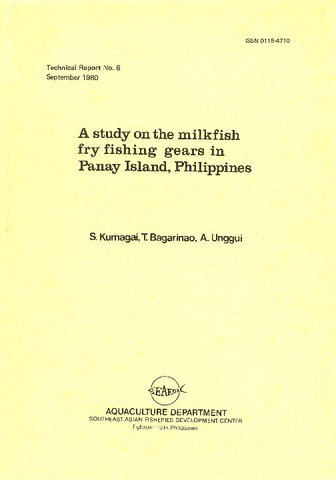
A study on the milkfish fry fishing gears in Panay Island, Philippines

Date
1980Author
Page views
6,254ASFA keyword

AGROVOC keyword
Taxonomic term

Metadata
Show full item recordShare
Abstract
This study was conducted to obtain information for evaluating the present fry fishing practices and for understanding the behaviour of the fry. A description of the milkfish, Chanos chanos, fry fishing gears is presented. Each gear is illustrated and its operation explained.
Description
This study was partially supported by the International Development Research Centre (Canada) through a grant to the SEAFDEC Aquaculture Department under Project No. 3-P-78-0033.
Suggested Citation
Kumagai, S., Bagarinao, T., & Unggui, A. (1980). A study on the milkfish fry fishing gears in Panay Island, Philippines. (Technical Report No. 6). Tigbauan, Iloilo, Philippines: Aquaculture Department, Southeast Asian Fisheries Development Center.
Contents
Introduction -- Passive filtering gears -- Active filtering gears -- Discussion and Conclusion -- Literature cited
Type
Technical ReportISSN
0115-4710Series
Technical report / SEAFDEC Aquaculture Department; no. 6Format
34 p. : ill., map
Collections
- Technical Reports [13]
Related items
Showing items related by title, author, creator and subject.
-
Fundamental study on the behavior of milkfish fry for the evaluation of the efficiency of traditional fry collecting gears in the Philippines
; ; Bagarinao, Teodora (Aquaculture Department, Southeast Asian Fisheries Development Center, 1980)
The response of Chanos chanos fry to moving and stationary nets of different mesh size and colour, underwater visibility of the nets and water filtration were studied. Results indicate that milkfish fry may be driven by nets of mesh size larger than that presently used; larger mesh size decreases the net resistance in the water so that collectors may move the equipment easily. The large mesh nets should be of a dark colour, preferably black for effective driving; bowever white mosquito net is best for the core end, since the fry are more easily visible on a white background.
(Aquaculture Department, Southeast Asian Fisheries Development Center, 1980)
The response of Chanos chanos fry to moving and stationary nets of different mesh size and colour, underwater visibility of the nets and water filtration were studied. Results indicate that milkfish fry may be driven by nets of mesh size larger than that presently used; larger mesh size decreases the net resistance in the water so that collectors may move the equipment easily. The large mesh nets should be of a dark colour, preferably black for effective driving; bowever white mosquito net is best for the core end, since the fry are more easily visible on a white background. -
Nutrient flow and physicochemical profile studies of an integrated poultry-salt-Artemia-milkfish-sea bass-shrimp pond production system
(Wetteren, Belgium: Universal Press, 1987)The physicochemical and biological parameters of an integrated flow-through poultry-salt-Artemia-milkfish-sea bass-shrimp pond production system were monitored for 6 months to determine the pattern of nutrient changes and associated plankton communities as water passed through the system. A 20 ha salt farm in Negros Oriental, Philippines, was used as a model of the integrated system. The construction of a poultry farm at the inlet reservoir provides continuous fertilization and allows considerable control of nutrient inputs to the pond system. Nutrients increase markedly in the chicken pond and in subsequent ponds undergo cycles of biological assimilation and bacterial mineralization. Principal component analysis ordinates temporal and spatial changes in 33 variables that were monitored. Using scatter diagrams of the principal components enabled separation of ponds adjacent to the crystallization bed and ponds high in fish biomass from the rest of the system. Variables that served to numerically delineate the ponds in this manner were salinity, phosphate, ammonia, alkalinity, turbidity, acidity, microplants, pico- and nannoplankton. The implications of this ordination in relation to pond management techniques is discussed. -
Reaching the poor through aquaculture: The case of technology adoption in rural communities at west central Philippines
(Aquaculture Department, Southeast Asian Fisheries Development Center, 2015)Aquaculture is promoted for food security and poverty alleviation in developing countries. This study examines the socio-economic impact of aquaculture technologies extended to calamitystricken rural communities in Nueva Valencia, Guimaras, representing the marine water fishery and in Dumarao, Capiz, representing the inland freshwater fishery at west central Philippines. The adoption pathway employed in both sites was community-based and participatory. The survey was conducted among cooperators and non-cooperators, randomly selected in equal numbers in two sites with 60 respondents each per site using a pre-tested interview schedule. Results showed that aquaculture is an acceptable technology both for cooperators and noncooperators. The venture is a profitable business either done individually or collectively through an association, if managed properly. Milkfish cage culture, however, needs big capital that technology adoption among local fisherfolk (Guimaras) is limited. In contrast, tilapia cage culture enables small farmers/fishers in Dumarao to venture on their own. Dumarao growers were able to innovate using local materials like bamboo poles to make their cages afloat instead of drums or plastic containers as buoys. There were, however, environmental, technological and institutional issues deterring technology adoption in both sites. Climate change and institutional issues were the more prevalent concerns of Dumarao growers. The technological issues like fluctuating market price, cost of feeds, and fry supply were more enunciated in Guimaras.