The effect of background color and rotifer density on rotifer intake, growth and survival of the grouper (Epinephelus suillus) larvae


Share
Abstract
Rotifer intake and early growth and survival of Epinephelus suillus larvae were determined in terms of rotifer visibility against the background color of rearing tanks and density. The larvae were stocked at 30 l−1 in 200-l fiberglass tanks with phytoplankton (green water). Larvae were fed rotifers at densities of 5, 10 and 20 ml−1. Growth and survival were comparable among larvae in both tan and black tanks with green water. Rotifer intake was significantly higher in larvae in tan tanks. In black tanks, the survival of larvae at Day 14 was enhanced by the high rotifer density of 20 ml−1. Rotifer intake and growth of larvae were similar at all densities.
Suggested Citation
Duray, M. N., Estudillo, C. B., & Alpasan, L. G. (1996). The effect of background color and rotifer density on rotifer intake, growth and survival of the grouper (Epinephelus suillus) larvae. Aquaculture , 146(3-4), 217-224. https://doi.org/10.1016/S0044-8486(96)01375-0
Type
ArticleISSN
0044-8486Collections
- Journal Articles [1267]
Related items
Showing items related by title, author, creator and subject.
-
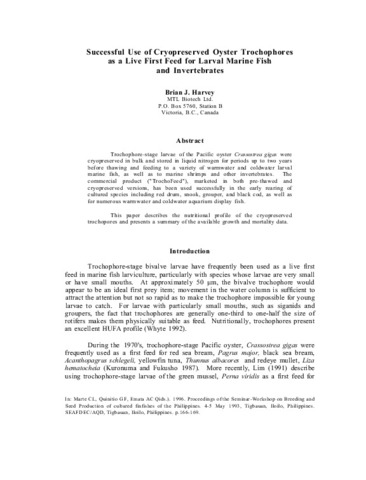
Successful use of cryopreserved oyster trocophores as a live first feed larval marine fish and invertebrates
(Aquaculture Department, Southeast Asian Fisheries Development Center, 1996)Trochophore-stage larvae of the Pacific oyster Crassostrea gigas were cryopreserved in bulk and stored in liquid nitrogen for periods up to two years before thawing and feeding to a variety of warmwater and coldwater larval marine fish, as well as to marine shrimps and other invertebrates. The commercial product ("TrochoFeed"), marketed in both pre-thawed and cryopreserved versions, has been used successfully in the early rearing of cultured species including red drum, snook, grouper, and black cod, as well as for numerous warmwater and coldwater aquarium display fish. This paper describes the nutritional profile of the cryopreserved trochopores and presents a summary of the available growth and mortality data. -
Larviculture of marine species in Southeast Asia: current research and industry prospects
(Elsevier, 2003)The increased requirement for food fish, the lucrative market for expensive seafood, and the need to conserve marine resources, have motivated the rapid pace of larviculture research in Southeast Asia. Various research and academic institutions in Southeast Asia such as the Southeast Asian Fisheries Development Center Aquaculture Department (SEAFDEC AQD) are carrying out research on commercially important marine species including 10 fish, 6 crustacean, and 7 mollusk species. Since fry availability is a major constraint in the development of culture systems, a major research thrust of SEAFDEC AQD is the development of commercially viable technologies for breeding and seed production of commercially important marine fish and crustaceans such as milkfish, groupers, snappers and mud crabs, in addition to the production of fry and juveniles of endangered and depleted species such as the sea horse and the tropical abalone for stock enhancement and sea ranching. Although hatchery production of milkfish and sea bass are now commercially viable enterprises, research is being pursued to improve fry quality through feed supplementation and to lower production cost by using alternative live or artificial feeds. Larviculture techniques are being developed for technically demanding species such as groupers and snappers. The recent success in larviculture of the mud crab Scylla serrata is expected to stimulate the growth of the mud crab industry in the region. Similarly, encouraging developments in the breeding and larviculture of the sea horse and mollusks such as the tropical abalone will provide the necessary support to carry out future stock enhancement and sea ranching programs for these species. -
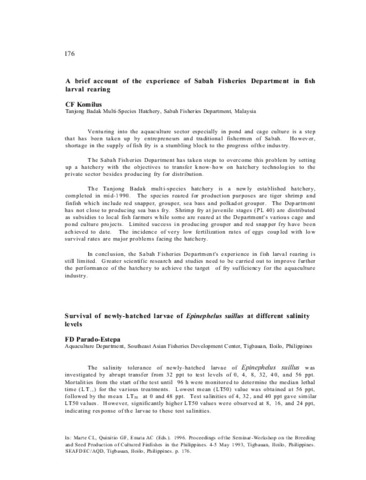
A brief account of the experience of Sabah Fisheries Department in fish larval rearing
(Aquaculture Department, Southeast Asian Fisheries Development Center, 1996)Venturing into the aquaculture sector especially in pond and cage culture is a step that has been taken up by entrepreneurs and traditional fishermen of Sabah. However, shortage in the supply of fish fry is a stumbling block to the progress of the industry. The Sabah Fisheries Department has taken steps to overcome this problem by setting up a hatchery with the objectives to transfer know-how on hatchery technologies to the private sector besides producing fry for distribution. The Tanjong Badak multi-species hatchery is a newly established hatchery, completed in mid-1990. The species reared for production purposes are tiger shrimp and finfish which include red snapper, grouper, sea bass and polkadot grouper. The Department has not close to producing sea bass fry. Shrimp fry at juvenile stages (PL 40) are distributed as subsidies to local fish farmers while some are reared at the Department's various cage and pond culture projects. Limited success in producing grouper and red snapper fry have been achieved to date. The incidence of very low fertilization rates of eggs coupled with low survival rates are major problems facing the hatchery. In conclusion, the Sabah Fisheries Department's experience in fish larval rearing is still limited. Greater scientific research and studies need to be carried out to improve further the performance of the hatchery to achieve the target of fry sufficiency for the aquaculture industry.