Preliminary studies on the rearing of the red-spotted grouper, Epinephelus coioides larvae using copepod nauplii as initial food


Share
Abstract
One day old red-spotted grouper (Epinephelus coioides) larvae from SEAFDEC, Iloilo, were packed at 3.300 ind/L and transported to Dagupan, Pangasinan for larval rearing. Transport time was about 10 hours. More than 90% of the larvae were active after transport. These were reared in two 7-on tanks (Tanks 1 and 2) using Acartia nauplii and rotifers as a initial food and in one 10-ton tank (Tank 3) provided with rotifers only. Feeding incidence at the onset of feeding (Day 3) was higher (90-95%) in Tanks 1 and 2 than in tank 3 (85%). All larvae sampled from days 4 – 10 in Tanks 1 and 2 had food in the gut while feeding incidence in Tank 3 was variable (75-100%). Larvae in Tanks 1 and 2 showed consistently higher food electivity for Acartia nauplii than rotifers. Higher survival rates were observed in Day 13 in tanks provided with copepod nauplii (16-18%) than with the rotifers only (2%). Average total length on Day 13 was higher in copepod-fed larvae (4.5 ± 0.5 mm) than larvae fed with rotifers only (3.0 ± 0.3mm). All larvae fed with rotifers alone died on Day 15. A total of 675 larvae were harvested on Day 45 from Tanks 1 and 2. These results indicate the feasibility of transporting one day old E. coioides larvae for at least 10 h and of using copepod nauplii as food for the first feeding E. coioides larvae.
Suggested Citation
Toledo, J. D., Golez, S. N., Doi, M., Bravo, R. S., & Hara, S. (1996). Preliminary studies on the rearing of the red-spotted grouper, Epinephelus coioides larvae using copepod nauplii as initial food. UPV Journal of Natural Sciences , 1(2), 119-129. http://hdl.handle.net/10862/1574
Type
ArticleISSN
0118-461XCollections
- Journal Articles [1267]
Related items
Showing items related by title, author, creator and subject.
-
Philippine National Standard: Live, chilled/frozen grouper
(Bureau of Agriculture and Fisheries Standards, 2009)This Philippine National Standard for live, chilled/frozen grouper identifies the Philippine species of grouper, specifies their essential composition and quality factors (including size classification and quality characteristics), provides the presentation, packaging and labeling requirements, indicates the methods sampling, examination and analyses, and defines the types of defectives. It is hoped that this standard accomplishes our two pronged goal of protecting consumer health and making the Philippine fish and fishery products globally competitive. -
Collection of the orange-spotted grouper Epinephelus coioides from Tinagong Dagat and Sapian Bay in northern Panay
(Bureau of Agricultural Research, Department of Agriculture, 2007)In Capiz, northern Panay, grouper catches by hand picking, hook and line, shelters, and fish corral were low throughout the year, on average 1-3 fish from each fishing operation, but higher in Tinagong Dagat than in Sapian Bay. Epinephelus coioides was the most common of the three grouper species collected; E. quoyanus and E. malabaricus were not numerous. The 882 specimens of E. coioides from Tinagong Dagat measured from 3.6 to 39 cm in standard length; the 250 E. coioides from Sapian Bay were between 1.7 and 31.2 cm SL. The size distribution showed a modal length of about 17 cm SL (21% of the fish) in Tinagong Dagat, and 11 cm (26%) in Sapian Bay. Small juveniles 2–8 cm were collected from Tinagong Dagat in January-April 1993, but not in Jan-Apr 1994. Such small juveniles were also collected from Sapian Bay in January and in April–August 1993. Groupers 9–23 cm occurred year round, but the 9–15 cm group was more abundant from January to June. At both sites, groupers >30 cm could hardly be found. Both grouper habitats experienced wide ranges of water temperature, salinity, and dissolved oxygen during the year. -
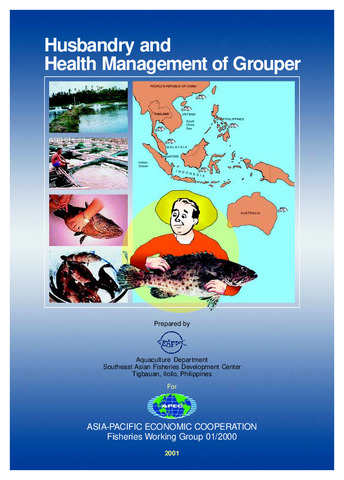
Husbandry and health management of grouper
(Asia-Pacific Economic Cooperation; Aquaculture Department, Southeast Asian Fisheries Development Center, 2001)The groupers (Family Serranidae) are among the most popular species in the live reef food fish industry in the Asia-Pacific region. Groupers are generally fast growing, hardy, suitable for intensive culture, and with excellent characteristics for processing. The high demand for these fishes is due to their unique culinary attributes and scarcity. In 1997, the Asia-Pacific region contributed about 90% to the total world aquaculture production. The regional production of farmed grouper was estimated at 15,000 tons, with China as the biggest producer contributing 8,000 tons followed closely by Indonesia. Other countries in the region commonly produce 1,000-2,000 tons annually in 1990- 1997. Groupers are generally cultured in floating net cages or earthen ponds, but cage culture is more common in Southeast Asia. Grouper pond production is becoming an attractive alternative to intensive shrimp culture in countries where management problems have forced growers to abandon shrimp farming. Although grouper culture is widespread in Asia and the Pacific, its continued development is constrained by the limited availability of fingerlings. Most economies, with the recent exception of Chinese Taipei, rely almost totally on wild-caught fry and fingerlings for stocking. This demand for wild seeds has led to unsustainable and illegal collection practices such as the use of cyanide to capture large numbers of seed with relatively less investment in time and effort. The inadequate supply of seed is further aggravated by the lack of appropriate handling techniques during collection, transport and storage of collected fish, and sometimes by an unregulated management of the wild stocks. There is also the lack of appropriate techniques for efficient grouper culture to marketable sizes. A major production constraint is heavy mortality of groupers during the collection and culture phases due to handling stress and diseases. The utilization of non-destructive devices for grouper collection, proper fish handling and increased efficiency in culture management can result to socio-economic and environmental benefits. A well-developed grouper culture operation complemented by appropriate wild grouper fishery management can provide sustainable employment to many people – from marginal fishers to farmers to traders. Grouper fisheries based on illegal or destructive fishing practices underlines the urgent need for habitat protection and sustainable utilization of natural resources. The objective of this manual is to provide a farmer-friendly practical guide for grouper farmers in the Asia-Pacific economies. It is hoped that this manual will enhance farmers’ ability to culture and handle grouper, as well as to prevent and manage disease outbreaks.