Milkfish grow-out culture in ponds

Date
2003Page views
11,949ASFA keyword

AGROVOC keyword
Taxonomic term

Metadata
Show full item recordShare
Abstract
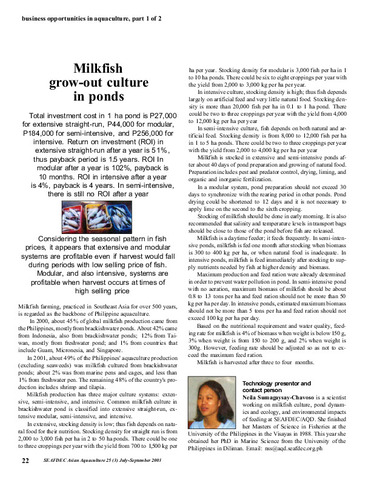
Milkfish farming is regarded as the backbone of Philippine aquaculture. In 2001, nearly 50% of the Philippines' aquaculture production was milkfish cultured from brackishwater ponds. It has 3 major culture systems: extensive; semi-intensive and intensive. A brief outline is given of the stocking and feeding procedures, providing also some details as to investment costs and returns.
Suggested Citation
Sumagaysay-Chavoso, N. (2003). Milkfish grow-out culture in ponds. SEAFDEC Asian Aquaculture , 25(3), 22. http://hdl.handle.net/10862/1622
Type
magazineArticleISSN
0115-4974Collections
Related items
Showing items related by title, author, creator and subject.
-
Management of feeding aquaculture species
(Aquaculture Department, Southeast Asian Fisheries Development Center, 2002)This chapter teaches the reader to: differentiate the different feeding strategies in pond culture; learn feeding management methods such as stock sampling and record keeping, calculating daily feed ration, choosing appropriate feed size, and methods of applying feeds; understand the impact of feeding management on water quality and environment and on the cultured animal’s growth, survival, and feed conversion ratio; and describe the different feeding schemes used to culture fishes (milkfish, tilapia, rabbitfish, bighead carp, native catfish, sea bass, orange-spotted grouper, and mangrove red snapper; and crustaceans (tiger shrimp and mud crab). Other species for aquaculture stock enhancement (donkey’s ear abalone, seahorses, window-pane oyster) are also discussed. -
Research on marine and freshwater fishes
(Aquaculture Department, Southeast Asian Fisheries Development Center, 1995)Most of the fish research at SEAFDEC AQD in 1992-1994 was on milkfish. Studies were conducted on year-round spawning through hormonal or environmental manipulation; optimum lipid and protein levels and ration size for captive broodstock; and the influence of spawner age on reproductive performance. The economics of hatchery operations, alone or integrated with broodstock as a commercial enterprise, was assessed. Mass production of larvae was refined with the use of commercial or SEAFDEC-formulated larval diets. Alternative rearing schemes in large tanks and ponds were tried. Hatcheryproduced and wild-caught larvae were compared in terms of growth and production in experimental nursery and grow-out ponds. Supplemental diets for brackishwater grow-out culture were formulated. Studies on broodstock management of grouper Epinephelus spp. included lipid enrichment of the diet and hormonal induction of sex inversion. Seed production techniques were developed but survival rates were low. Grouper culture was found economically feasible in experimental ponds with 'trash' fish as feed. The mangrove red snapper Lutjanus argentimaculatus was successfully induced to spawn with injection of human chorionic gonadotropin. Initial larval rearing trials were successful but survival rates must be improved. Hormonal manipulation of spawning of the Asian sea bass Lates calcarifer allows seed production during most of the year. Photoperiod manipulation leads to maturation of females, but not males, beyond the natural breeding season (April-November). Nursery rearing of 9 mm juveniles is feasible in floating net cages with night lights that attract food zooplankton. The requirements of sea bass for lipid, protein, carbohydrates, and essential amino acids were determined. In the rabbitfish Siganus guttatus, weekly injections of luteinizing hormone releasing hormone analogue (LHRHa) sustains milt production for three weeks. Thyroid hormones injected into broodstocks improved the growth of larvae to day 7. Induced spawning techniques for the Asian catfish Clarias macrocephalus were refined by determining the seasonal responsiveness to LHRHa and pimozide injections and testing for pheromonal induction of spontaneous spawning. The optimum insemination rate was determined and egg hatchability was enhanced by removal of the adhesive coat before incubation. Several practical diets for catfish during grow-out culture were tested against 'trash' fish. The broodstock management for bighead carp Aristichthys nobilis was studied. Cage-reared juveniles from cage-reared broodstock showed the best growth. To improve the reproductive performance, the broodstock diets were supplemented with vitamins A, C, and E. Research on tilapias focused on genetics and strain selection. Several strain testing procedures for Nile tilapia were evaluated in their efficiency to detect economically important strain differences. Reference lines were developed from two existing red tilapia strains to measure and reduce the effects of uncontrolled nongenetic variables in strain evaluation experiments with Nile tilapia. The tolerance of two Nile tilapia strains to heavy metals was similar when gauged by the 24-hour and 96-hour lethal concentration and by fish growth, survival, and reproductive performance. In a separate study, four strains of red tilapia showed generally higher seed production when reared in tanks than in cages. Improvements in the feed and feeding management for Nile tilapia were also studied. Intensive tilapia farming and feeding have led to oxygen depletion and fish kills in Sampaloc Lake. To rehabilitate the lake, it is imperative to reduce the farming area from 30 to 6 hectares; stop the use of commercial feeds; and remove the water hyacinths and other debris. Fish kills in Laguna de Bay have also become serious in recent years, and a review of the occurrences, losses, and possible causes is currently being conducted. Studies on the epizootic ulcerative syndrome of snakeheads in Laguna de Bay have yet to pinpoint the pathogen. Skin lesions in tilapias in several ponds and lakes in the country were found to be due to bacteria. -
[The Philippines recommends for milkfish:] Pond culture
(DOST-PCAARRD, 2016)