SEAFDEC/AQDINSTITUTIONAL REPOSITORY
    • English
    • 日本語
    • ไทย
    • Bahasa Indonesia
  • English 
    • English
    • 日本語
    • ไทย
    • Bahasa Indonesia
  • Login
View Item 
  •   SEAFDEC/AQD Institutional Repository Home
  • 03 SEAFDEC/AQD External Publications
  • Journal Articles, Conference Papers and Book Chapters by SEAFDEC Staff
  • Journal Articles
  • View Item
  •   SEAFDEC/AQD Institutional Repository Home
  • 03 SEAFDEC/AQD External Publications
  • Journal Articles, Conference Papers and Book Chapters by SEAFDEC Staff
  • Journal Articles
  • View Item
JavaScript is disabled for your browser. Some features of this site may not work without it.

Contribution of natural food and supplemental feed to the gut content of Penaeus monodon Fabricius in a semi-intensive pond system in the Philippines

  • Global styles
  • MLA
  • Vancouver
  • Elsevier - Harvard
  • APA
  • Help
Thumbnail
View/Open
Date
1998
Author
Focken, Ulfert
Groth, Andreas
Coloso, Relicardo M.
Becker, Klaus
Page views
5,157
ASFA keyword
diet ASFA
feeding behaviour ASFA
feeding experiments ASFA
food preferences ASFA
pond culture ASFA
rearing techniques ASFA
shrimp culture ASFA
stomach content ASFA
cultured organisms ASFA
AGROVOC keyword
Penaeus monodon AGROVOC
Philippines AGROVOC
Giant tiger prawn
Semi-intensive aquaculture
Feeding pattern
Gut content analysis
Natural food
Supplemental feeding
Taxonomic term
Penaeus monodon GBIF
Metadata
Show full item record


Share 
 
Abstract
Juvenile Penaeus monodon were stocked in grow-out ponds and fed a compound diet at high rates for 19 weeks under semi-intensive conditions. At three stages of the rearing period (weeks 6, 11 and 16), the gut content of the shrimp was analysed microscopically at every hour of the day. Additionally, possible sources of natural food (lablab, lumut, zoobenthos, etc.) were analysed microscopically and where possible for proximate composition. At week 6, the gut content consisted of 28.9% supplemental feed, 42.3% plant materials (other than from the pelleted diet), 1.8% crustacean parts and 27.0% diverse detrital matter. For week 11, the percentages (same order) were 47.5%, 21.1%, 22.8%, 8.6% and for week 16, 21.7%, 34.3%, 31.7% and 12.9%, respectively. Food preference did not change with time of the day. At week 6, most feeding activity occurred at night, later, feeding activity shifted to day-time. Reduction of the maximum gut content at dissolved oxygen levels below 4 mg l−1 at night indicated a cessation of feeding in which case shrimp fed during the day-time, when dissolved oxygen levels were higher.
URI
http://hdl.handle.net/10862/1742
Suggested Citation
Focken, U., Groth, A., Coloso, R. M., & Becker, K. (1998). Contribution of natural food and supplemental feed to the gut content of Penaeus monodon Fabricius in a semi-intensive pond system in the Philippines. Aquaculture, 164(1-4), 105-116. https://doi.org/10.1016/S0044-8486(98)00180-X 
DOI
10.1016/S0044-8486(98)00180-X
Type
Article
ISSN
0044-8486
Collections
  • Journal Articles [1276]

Related items

Showing items related by title, author, creator and subject.

  • Thumbnail

    Production of Penaeus monodon (Fabricius) using four natural food types in an extensive system 

    Bombeo-Tuburan, I.; Guanzon, Nicholas G., Jr.; Schroeder, G. L. (Elsevier, 1993)
    Growth, survival, and production of P. monodon feeding on four types of natural food, i.e., lablab (benthic mat of cyanobacteria, diatoms, and associated fauna), Ruppia maritima, lumut (filamentous green algae and attached organisms entangled in the water column and on the bottom), and plankton, were evaluated in ponds in Iloilo, Philippines. The gut content of shrimp was analyzed and the flow of the food web was traced using stable carbon isotope (δC) analysis. Twelve 500-m2 ponds were stocked with juvenile shrimp (average weight 0.8 g) and grown for 3 months at the rate of 4000 ha−1. In Ruppia and plankton ponds, the shrimp attained 91–92% survival, and in lumut and lablab ponds, 76–80%. Total shrimp production in Ruppia and plankton ponds was 114 and 129 kg ha−1 crop−1, while lumut and lablab ponds yielded only 59 and 85 kg ha−1 crop−1, respectively. The δC analysis of all treatments was not significantly different, indicating that a common food (detritus), as shown by the gut content analysis, appears to be the most significant food resource of shrimp in this study. Shrimp foreguts from all the treatments consisted of detritus (non-living particulate matter), copepod/animal remains, diatoms, cyanobacteria, and green algae. Detritus ranked highest in frequency of occurrence, followed by copepod/animal remains.
  • Thumbnail

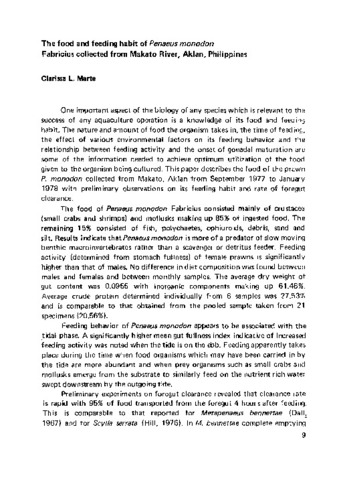
    The food and feeding habit of Penaeus monodon Fabricius collected from Makato River, Aklan, Philippines 

    Marte, Clarissa L. (Aquaculture Department, Southeast Asian Fisheries Development Center, 1978)
    The food of Penaeus monodon collected from Makato R., from Sept 1977 to Jan 1978 is described with preliminary observations on its feeding habit and rate of foregut clearance. Feeding behaviour appears to be associated with the tidal phase. Foregut clearance rate is rapid, with 95% of food transported from the foregut 4 h after feeding. Frequency of occurrence and proportion of total food of various foregut contents are shown, as are dry weight, percentage mineral, organic and crude protein nitrogen from individual and pooled samples of gut contents, and foregut index in P. monodon collected during different phases of one tidal cycle.
  • Thumbnail

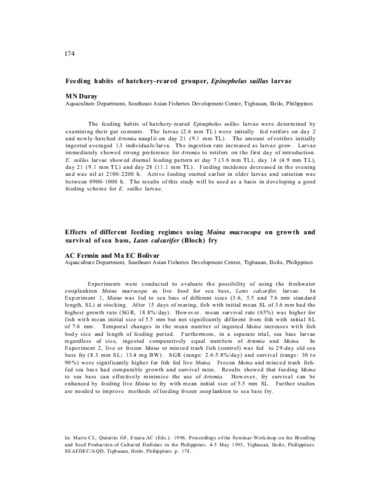
    Feeding habits of hatchery-reared grouper, Epinephelus suillus larvae 

    Duray, Marietta N. (Aquaculture Department, Southeast Asian Fisheries Development Center, 1996)
    The feeding habits of hatchery-reared Epinephelus suillus larvae were determined by examining their gut contents. The larvae (2.6 mm TL) were initially fed rotifers on day 2 and newly-hatched Artemia nauplii on day 21 (9.1 mm TL). The amount of rotifers initially ingested averaged 1.3 individuals/larva. The ingestion rate increased as larvae grew. Larvae immediately showed strong preference for Artemia to rotifers on the first day of introduction. E. suillus larvae showed diurnal feeding pattern at day 7 (3.6 mm TL), day 14 (4.9 mm TL), day 21 (9.1 mm TL) and day 28 (11.1 mm TL). Feeding incidence decreased in the evening and was nil at 2100-2200 h. Active feeding started earlier in older larvae and satiation was between 0900-1000 h. The results of this study will be used as a basis in developing a good feeding scheme for E. suillus larvae.

© SEAFDEC/AQD  2026
Send Feedback | Subscribe


Browse

All of SAIRCommunities & CollectionsBy Issue DateAuthorsTitlesSubjectsThis CollectionBy Issue DateAuthorsTitlesSubjects

My Account

LoginRegister

Statistics

View Usage Statistics

© SEAFDEC/AQD  2026
Send Feedback | Subscribe


Export citations

Export the current results of the search query as a citation list. Select one of the available citation styles, or add a new one using the "Citations format" option present in the "My account" section.

The list of citations that can be exported is limited to items.

Export citations

Export the current item as a citation. Select one of the available citation styles, or add a new one using the "Citations format" option present in the "My account" section.

Export Citations

DOCUMENT REQUEST NOT AVAILABLE

This publication is still available (in PRINT) and for sale at AQD bookstore. The library is currently restricted to send PDF of publications that are still for sale.

You may contact bookstore@seafdec.org.ph or visit AQD bookstore for orders.

FILE UNDER EMBARGO

This file associated with this publication is currently under embargo. This will be available for download after the embargo date.