Ecological considerations in milkfish farming in marine pens and cages in the Philippines
ดู/
วันที่
1998ผู้เขียน

Page views
3,728ASFA keyword

AGROVOC keyword
Taxonomic term

เมตาดาต้า
แสดงระเบียนรายการเต็มShare
นามธรรม
Milkfish farming in the Philippines has a long history and great importance, being widely regarded as the way to domestic food security. But the industry has faced new challenges in the past decade, with the advent of many other farmed aquatic species, mostly cash crops and "export winners," and with the increased pressure to intensify production in brackishwater ponds and in marine pens and cages. There are no up-to-date government statistics on the area and production of marine pens and cages, but industry insiders estimate a yearly production of about 25,000 mt of sea-grown milkfish in 1996 - 1998, mostly from Pangasinan, but also from Quezon, Davao, Cebu, Bohol, Panay, Samar, and Negros. High yields (2 -38 kg/m3) were made possible by very high stocking rates (3 -75 fingerlings/m3) and feeding rates (2-4 kg feed per kg of fish). The high production costs and the pollution from feed wastes and fish metabolites have stopped most operations within 1 - 2 years. This paper examines the trends and problems in milkfish farming in marine pens and cages, and discusses the ecological limits and the projected ecological footprint of this farming system. Milkfish farming in marine pens and cages, as presently practised, is not the magic solution to the fish deficit in the Philippines and is not an appropriate technology to promote on a wide scale. The required investment is enormous. Properly made pens and cages set up in suitable clean-water locations cost much. The ability of milkfish to ensure domestic food security is negated by the use of fishmeal-based feeds. Fish feeds use up fish meal and other fisheries and agriculture products used by people and other sectors. If marine pens and cages must be promoted, integrated coastal area management, an informed precautionary approach, better infrastructure, and improved feeding management are important to ensure sustainability.
การอ้างอิง
Bagarinao, T. (1998). Ecological considerations in milkfish farming in marine pens and cages in the Philippines. UPV Journal of Natural Sciences , 3(1), 67-82. http://hdl.handle.net/10862/1756
Type
ArticleISSN
0118-461Xคอลเลกชัน
- Journal Articles [1262]
Related items
Showing items related by title, author, creator and subject.
-
Series: Aquaculture extension manual; No. 25
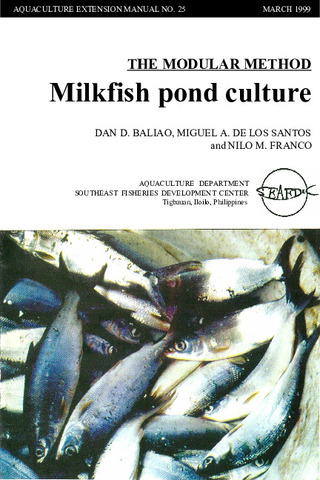
The modular method: Milkfish pond culture
(Aquaculture Department, Southeast Asian Fisheries Development Center, 1999)The modular method of milkfish culture (Chanos chanos) described in the manual is an improvement over the traditional extensive method. The manual is intended for the use of fish farmers and aquaculturists, extensionists, ... -
Evaluation of organic and inorganic fertilizers in brackishwater milkfish ponds
(Elsevier, 1989)The study was conducted in twelve 144-m2 ponds to evaluate the effect of different organic and inorganic fertilizers on the growth, survival, gross production, and profitability of marketable milkfish. The ... -
Milkfish breeding and hatchery technology at SEAFDEC/AQD
(Aquaculture Department, Southeast Asian Fisheries Development Center, 1999)Describes the techniques already adopted by the private sector: broodstock management, broodstock diet, commercial fry production, live transport, and larval diet. A list of AQD research publications on milkfish is included.