A combined upflow and fluidized sand filter for recirculating systems

Share
Abstract
The process required and options for water treatment in recirculating systems have been clearly identified. The four most critical processes are: (1) solids removal, to take out fecal waste, uneaten feed, excess bacterial biomass, and other solids also reducing biochemical oxygen demand (BOD) in the process; (2) biological filtration or biofiltration, primarily nitrification to convert toxic ammonia and intermediate from nitrite to nitrate; (3) gas exchange, which includes aeration to ensure sufficient oxygen supply for fish and biofiltration, and degasification to stripe carbon dioxide; and what may be called (4) ion balance, primarily to maintain pH and alkalinity and prevent the buildup of nitrate, dissolved organic, and other substance. System with extended hydraulic retention times must generally have an alkalinity replenishment regime to compensate for the alkalinity-consuming nitrification process. Additional treatment processes include denitrification (nitrate removal, which helps to augment alkalinity), ozonation (to remove color, organics and BOD; also sterilizes), ultraviolet (UV) sterilization (for disease/pathogen control), and foam fractionation (to remove dissolved organics surfactants). Heaters and/or chillers may be provided for temperature control. It must be emphasized that while the processes and equipment are provided for specific purposes, a complex interrelationship exists in recirculating systems.
Recirculating system components and sizing criteria vary widely, and are mainly provided to comply with specific production needs. A combined upflow and fluidized sand filter design that is applicable and easily adaptable to any system that may be recirculated is presented. Design and operational criteria are provided, as applied to a milkfish broodstock system. In general, for better management and control of water quality, to conserve water and energy and reduce wastewater, and to essentially provide for complete treatment of wastes and mitigate its impact on the environment, a high degree of water recirculation is recommended.
Description
Paper contributed during the 13th Annual Meeting of the Society of Aquaculture Engineers of the Philippines held at the Central Philippine University, Iloilo City on 29 Novermber 1999.
Suggested Citation
de los Reyes, A. A., Jr. (1999). A combined upflow and fluidized sand filter for recirculating systems. Aquaculture Engineering , 14, 8-21. http://hdl.handle.net/10862/1845
Type
ArticleISSN
0117-8881Collections
- Journal Articles [1266]
Related items
Showing items related by title, author, creator and subject.
-
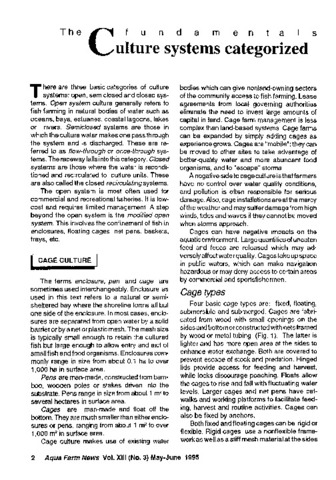
Culture systems categorized: The fundamentals
(Aquaculture Department, Southeast Asian Fisheries Development Center, 1995)The article presents the three basic categories of culture systems: open, semiclosed and closed systems. Open system culture generally refers to fish farming in natural bodies of water such as oceans, bays, estuaries, coastal lagoons, lakes or rivers. Semiclosed systems are those in which the culture water makes one pass through the system and is discharged. These are referred to as flow-through or once-through systems. The raceway falls into this category. Closed systems are those where the water is recondtioned and recirculated to culture units. These are also called the closed recirculating systems. -
Series: Aquaculture extension manual; No. 35
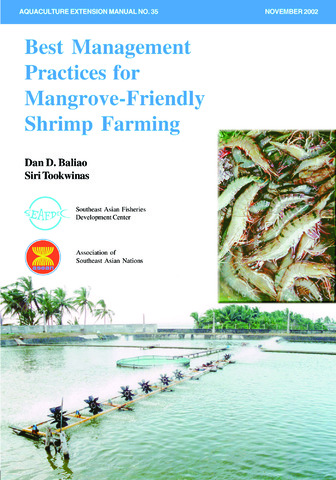
Best management practices for a mangrove-friendly shrimp farming
(Aquaculture Department, Southeast Asian Fisheries Development Center; Association of Southeast Asian Nations, 2002)This 50-page manual puts together the best practices that SEAFDEC/AQD has developed with the Department of Fisheries in Thailand. These practices include the use of biomanipulators and greenwater system, the use of settling ... -
Series: Aquaculture extension manual; No. 35
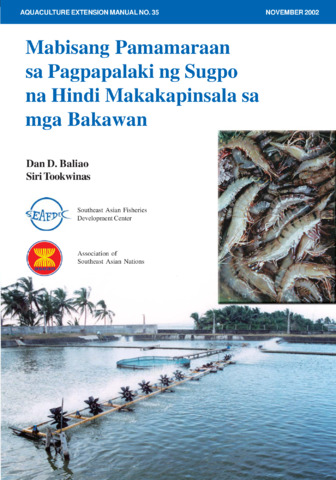
Mabisang pamamaraan sa pagpapalaki ng sugpo na hindi makakapinsala sa mga bakawan
(Aquaculture Department, Southeast Asian Fisheries Development Center; Association of Southeast Asian Nations, 2002)This 50-page manual puts together the best practices that SEAFDEC/AQD has developed with the Department of Fisheries in Thailand. These practices include the use of biomanipulators and greenwater system, the use of settling ...