Community fishery resources management on Malalison Island, Philippines: R & D framework, interventions, and policy implications

Share
Abstract
In 1991, the Aquaculture Department of the Southeast Asian Fisheries Development Center launched a community-based fishery resources management project on Malalison Island, in central Philippines, to help conserve the country's marine resources and to help the fisherfolk rise above their poverty. The eight-year project integrated various disciplines in biology, economics, sociology, public administration, and engineering in its study of fishery resources and fishing communities and in evolving intervention strategies for resource conservation and management, and for community development. The project's most important accomplishment was the inculcation among the fisherfolk of the importance of resource conservation and management. The most important lesson learned was that an enlightened and empowered fisherfolk could be effective managers and responsible users of fishery resources.
Suggested Citation
Agbayani, R. F., Baticados, D. B., & Siar, S. V. (2000). Community fishery resources management on Malalison Island, Philippines: R & D framework, interventions, and policy implications. Coastal Management , 28(1), 19-27. https://doi.org/10.1080/089207500263611
Type
ArticleISSN
0892-0753Collections
- Journal Articles [1267]
Related items
Showing items related by title, author, creator and subject.
-
Socio-cultural context of fishers’ participation in coastal resources management in Anini-y, Antique in west central Philippines
(Elsevier, 2011)The vicious cycle of poverty, overfishing and resource degradation in coastal communities in the Philippines calls for action that will address the problem of declining fish catch and degraded fish habitats. The literature has shown that an efficient and effective coastal management program can be instrumental in approaching this problem. In order to secure food and livelihood of fishers, the Southeast Asian Fisheries Development Center/Aquaculture Department collaborated with the local government of Anini-y, Antique to develop a sustainable utilization of natural marine resources through sea ranching of abalone within the Nogas Island marine protected area. Establishing a marine protected area is a means of conserving natural stocks while sea ranching is considered an effective strategy that can increase fishery resources. The two management schemes are considered as effective coastal resources management strategies. The success of a sea-ranching project is dependent not only on biophysical but also on socioeconomic factors as determinants of community participation and cooperation. A social assessment was conducted to determine the fishers’ socio-cultural characteristics, their perceptions of their coastal resources and knowledge on how to effectively manage these coastal resources. The fishers’ awareness on fishing regulations and the extent of their participation in community's coastal resources management activities were also determined. Data were collected from a household survey using a semi-structured questionnaire, focus group discussions and in-depth interviews with key informants. The fishers generally scored low in almost all aspects of their socioeconomic wellbeing. Most fishers perceived that their coastal resources were in a bad condition which they attributed to illegal and commercial fishing, increasing number of fishers and the poor enforcement of fishery regulations. However, the weighted mean scores of their knowledge on coastal resources management, awareness to fishery regulations and participation in community coastal resource management activities were average. This implied that fishers when trained and developed can become potential partners for effective coastal resources management programs. -
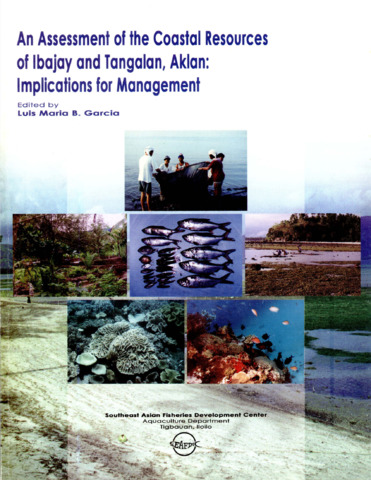
An assessment of the coastal resources of Ibajay and Tangalan, Aklan: Implications for management
(Aquaculture Department, Southeast Asian Fisheries Development Center, 2001)This report describes the present state of marine resources in several coastal barangays of Ibajay and Tangalan, Aklan (Philippines). Field data were obtained from rapid surveys conducted from July to September 1998. Recommendations based on analyses of the data will guide fisherfolk and other stakeholders, particularly the local government units, in their development plans for these neighboring municipalities. Both land and marine products in the area are mainly harvested for the local market. All coastal barangays are dependent on fishing for their livelihood. The medium-scale municipal fishery of Tangalan employs several passive (encircling gill net, bag net, fish corral) and active gears (baby purse seine) compared with the traditional fishing methods employed by Ibajay fishers. Pond aquaculture in mangrove areas is well-developed in Ibajay West (barangays Aquino and Ondoy) and in Tangalan. However, ownership of these ponds is limited to a few individuals and families, unlike in Barangay Bugtong Bato where informal ownership distributed among families has been the traditional rule. Nonetheless, the introduction of so-called environment-friendly methods of utilizing mangroves (e.g., aquasilviculture) and other shared coastal resources may seriously undermine the informal rights-based social structures in the barangays. Without proper rules and enforcement, the application of these methods may be misused, aggravating the already poor overall state of their coastal resources. Major problems affecting their fishing livelihood include siltation of nearshore waters due to illegal deforestation upland, encroachment of municipal fishing grounds by commercial and other fishers elsewhere, and the lack of capital to finance the fishery. Weak inter-organizational links among government and non-government organizations have hampered the implementation of solutions to these common problems in coastal barangays. For instance, a conflict between fishers from these neighboring municipalities over territorial boundaries of common fishing grounds in Pangayawan and Pungtod reefs has not been resolved over the years. Likewise, the introduction of aquasilviculture in mangrove areas may become a potent source of conflict among resource-users who maintain informal rights over the mangrove resource. The overall state of coastal resources in these municipalities is in immediate need of a unified plan to promote both their preservation and conservation. To achieve this end, a joint resource management council representing all resource-users from both municipalities must be organized and convened. To address the presently weak inter-organizational links among existing organizations, this joint council may provide a legitimate forum to identify, resolve, integrate, implement, and enforce guidelines on the common use of resources, both marine and inland. Low estimated yields from the reef fishery, conversion of mangroves for aquaculture beyond the allowable limit, a persistent conflict over fishing rights in several reefs offshore, the limited resources for seaweed and fish mariculture, and threats on existing traditional social structures by progressive resource-users are several issues that require thorough discussions to formulate popularly approved and acceptable management strategies. These strategies include community-based approaches of co-managing resources such as "no-take zones" (sanctuaries), ecotourism development, and livelihood schemes to mitigate, in part, the pressure of over-exploitation of fishery resources. -
Institutional capacity development for sustainable aquaculture and fisheries: Strategic partnership with local institutions
(Terrapub, 2008)Many people living in the rural areas in the Philippines, as in other developing countries in Southeast Asia, depend on aquatic resources for their food and livelihood. For the past two decades, the Aquaculture Department of the Southeast Asian Fisheries Development Center (SEAFDEC-AQD) has been working with fishing communities and people’s organizations, business sector, local government units, national government agencies, non-government organizations (NGOs) and academic and other research institutions to promote the efficient conservation, management and sustainable development of the country’s fisheries and aquatic resources so that these may continue to serve the needs of the people today and tomorrow. Using the lessons learned from those two decades of multi-sectoral and inter-disciplinary collaborations, SEAFDEC-AQD launched in late 2006 a project called Institutional Capacity Development for Sustainable Aquaculture (ICDSA) to hasten the transfer to and adoption by coastal villagers of appropriate technologies that would enhance the productivity of aquatic resources and at the same time safeguard the fragile balance of the aquatic ecology. The experience of SEAFDEC in coastal resource management shows that it is important to engage the collaboration of the local government units and other “on-the-ground” institutions, such as NGOs and people’s organizations, to be able to introduce effectively any social and technological interventions to target community-beneficiaries. However, before a fruitful collaboration among these institutions could be attained, there is a need to build their capacities, and those of the beneficiaries, for the vital roles that they play in the implementation of livelihood projects and environmental management programs. As of January 2008, SEAFDEC-AQD is implementing ICDSA projects in four provinces—Antique, Capiz, Guimaras and Northern Samar in central Philippines. In the pipeline are similar projects for a province in southern Philippines and two provinces in the north.